
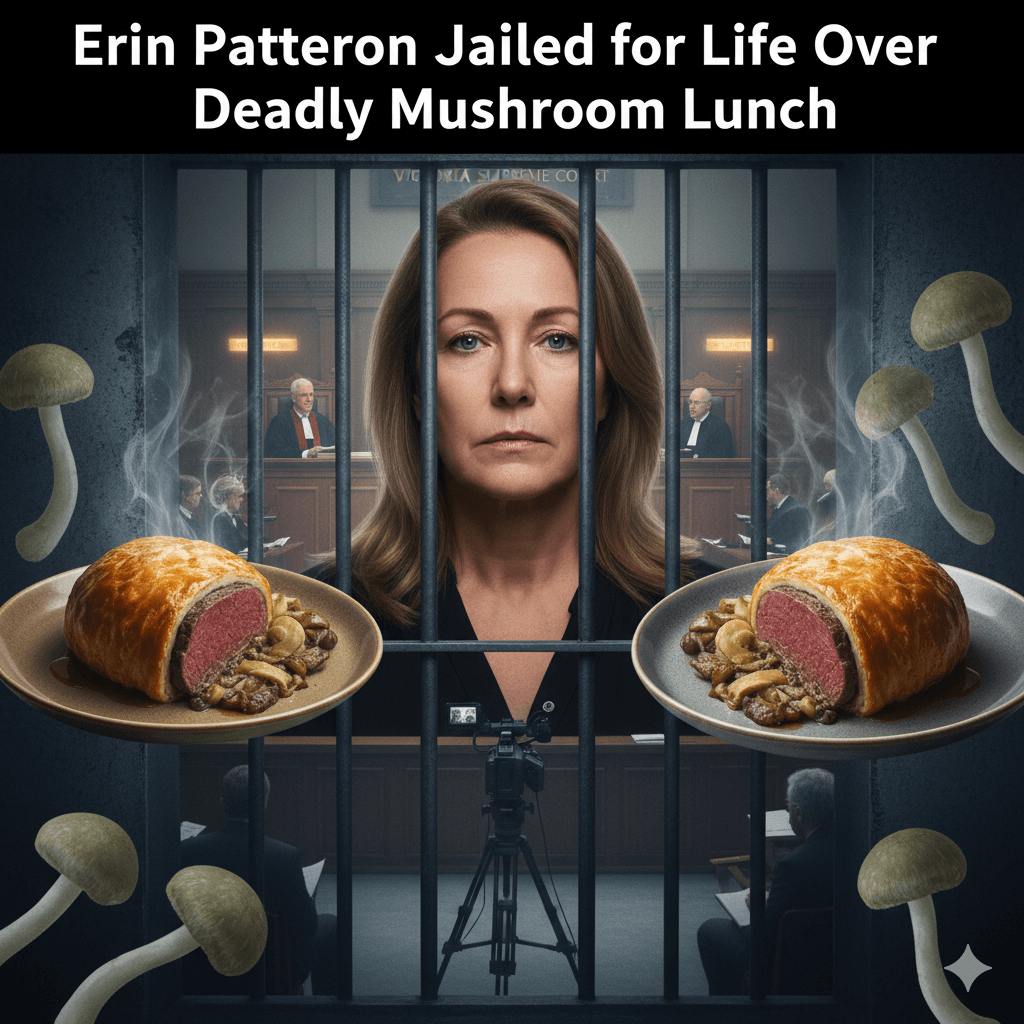
In a case that has gripped the nation, Erin Patterson, a 50-year-old mother of two from Victoria, has been sentenced to life in prison with a non-parole period of 33 years and 15 months of solitary confinement for the chilling murder of three relatives using death cap mushrooms. The sentencing, handed down today in the Victoria Supreme Court, marks one of the harshest penalties ever imposed on a woman in Australia, following a nine-week trial that captivated audiences nationwide.
The Fatal Meal
The nightmare unfolded on 29 July 2023, when Patterson served a beef Wellington laced with deadly Amanita phalloides—commonly known as the death cap mushroom—at her home. The victims, her former in-laws Don and Gail Patterson, and Gail’s sister Heather Wilkinson, fell violently ill within hours. Tragically, Gail and Heather died within a week, while Don succumbed after a failed liver transplant. The sole survivor, Ian Wilkinson, Heather’s husband and a local pastor, endured weeks in hospital and a life-saving liver transplant.
Justice Christopher Beale described the act as “an enormous betrayal of trust,” pointing to Patterson’s calculated behaviour after the poisoning. Evidence revealed she served the meal on grey plates for her guests and used a separate tan plate for herself, suggesting intent to avoid consuming the toxic dish. Patterson had also invited her estranged husband, Simon Patterson, to the lunch, but he declined, citing past suspicions that she had previously attempted to poison him. Simon later told the court that their children now live in “an irreparably broken home,” with their mother responsible for the deaths of their grandparents.
A Mystery Without Motive
Despite the overwhelming evidence, Patterson’s motive remains a mystery. Throughout the trial, she maintained the poisoning was accidental, claiming she inadvertently used foraged mushrooms in the meal. However, prosecutors presented a damning case, including the discovery of a dehydrator—containing remnants of death cap mushrooms and her fingerprints—that she dumped after the incident. The judge noted her “pitiless” refusal to admit the truth, which could have aided doctors in treating the victims, as a key factor in the sentencing.
Justice Beale remarked, “Only you know why you committed them,” acknowledging that the absence of a proven motive left the court and public speculating. This enigma has fuelled the case’s notoriety, spawning podcasts, documentaries, and even a rare live broadcast of the sentencing, drawing dozens of media crews and onlookers to the courtroom.
The Deadly Death Cap
The death cap mushroom, native to Europe but introduced to Australia, is responsible for 90% of mushroom-related fatalities worldwide, according to mycological studies. Its amatoxins are thermostable, meaning cooking does not diminish their lethality. Medical case studies, such as those in the Journal of Medical Toxicology, estimate a mortality rate of 10-30% even with treatment, underscoring the rarity and severity of this case as a deliberate act of mycological murder.
A Harsh Sentence and Ongoing Impact
Patterson’s life sentence, with its lengthy non-parole period, reflects the gravity of her crimes—three counts of murder and one of attempted murder. Given her high-profile status, she is expected to spend much of her incarceration in solitary confinement for her safety. She has 28 days to appeal the verdict and sentence, but legal experts suggest the evidence and judicial reasoning make a successful challenge unlikely.
The case has left a lasting mark on Australia, blending true-crime fascination with a cautionary tale about the dangers of foraging. For the Wilkinson and Patterson families, the loss is irreparable, while the nation continues to grapple with the question: why? Only time—and perhaps Patterson herself—may reveal the answer.