Canberra | September 23 2025
Canberra’s Flagship University in Crisis
The Australian National University (ANU), long regarded as the crown jewel of Australian higher education, is facing an escalating leadership crisis as allegations of mismanagement and eroded staff confidence engulf its top executives.
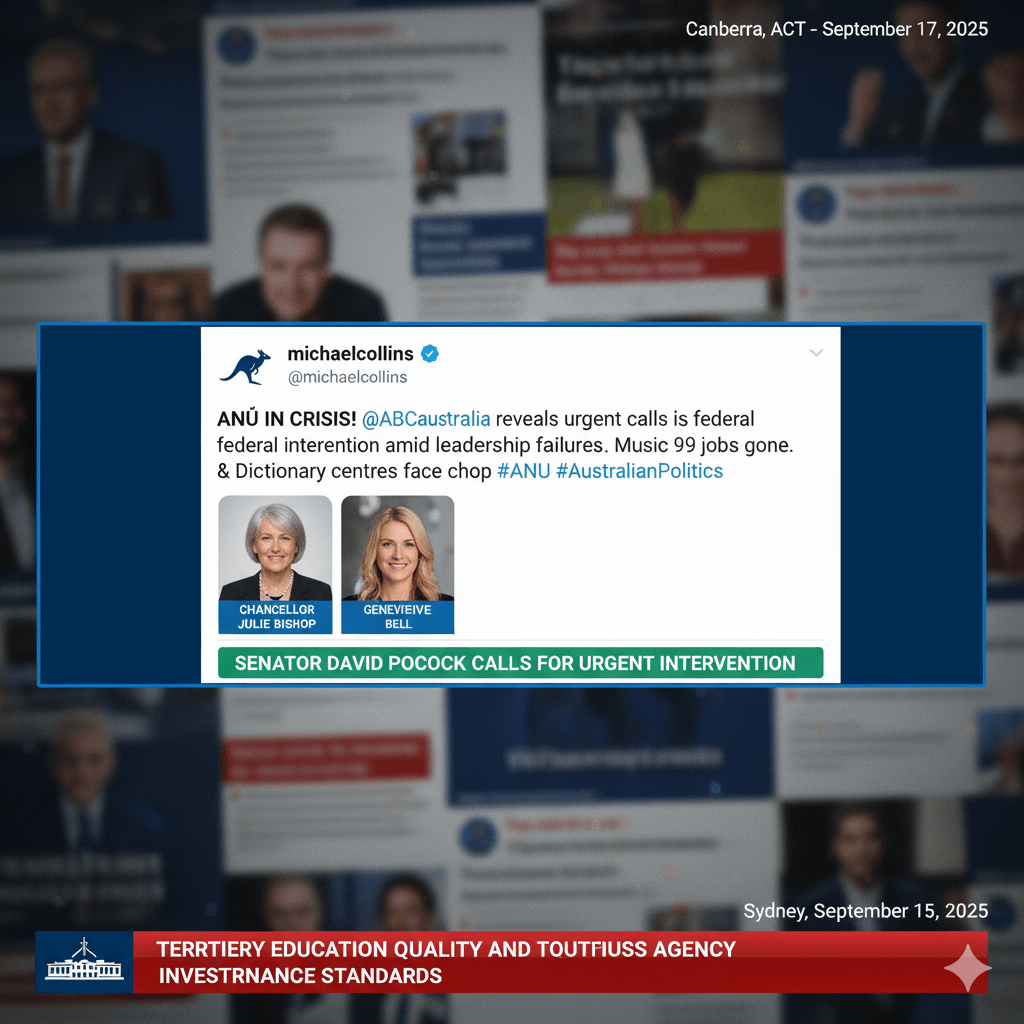
A post on X (formerly Twitter) by user @michaelcollins at 10:35 a.m. AEST on Tuesday linked to an ABC News report detailing “severe internal turmoil” within the institution. The story triggered an immediate political reaction, with Independent Senator David Pocock calling for federal oversight of ANU’s governance.
“Staff have lost all faith in the leadership team,” Pocock told The Guardian Australia on Tuesday. “What’s happening at ANU is symptomatic of a wider crisis in our universities — a crisis of accountability, transparency, and trust.”
Restructure Sparks Outcry
The uproar follows ANU’s sweeping workforce restructure, announced in August 2025, which resulted in 399 redundancies and the proposed closure of several key academic centres, including the Australian National Dictionary Centre and the School of Music.
Critics argue the cuts betray ANU’s founding mission as Australia’s premier research institution. Vice-Chancellor Professor Genevieve Bell, who took office in 2023, defended the plan as “financially necessary to sustain long-term excellence.”
However, leaked internal memos reported by the Canberra Times reveal that senior academics were not fully consulted before decisions were finalised. Staff unions describe “a culture of fear and confusion.”
The next ANU Council meeting on October 3 is expected to determine Bell’s future, though an out-of-session vote could occur sooner if pressure mounts.
“Morale has collapsed,” said one senior lecturer, who requested anonymity. “For many of us, ANU no longer feels like the collegial, world-class institution it once was.”
Chancellor Julie Bishop Under Fire
Chancellor Julie Bishop, Australia’s former foreign minister, has also come under scrutiny for her handling of the crisis. Critics accuse her of being “absent and disengaged,” while supporters argue she has been unfairly targeted for structural issues predating her tenure.
In a brief statement released Monday, Bishop said:
“I remain committed to ensuring the university’s stability and integrity during this period of transition. ANU’s role as a national institution must be preserved.”
Her silence in earlier weeks had fuelled speculation of internal divisions between the Chancellor and Vice-Chancellor, though university officials deny any rift.
Wider Sector Turbulence
The turmoil at ANU mirrors broader instability across Australia’s higher-education landscape.
A federal climate-risk assessment released on September 15 2025 projected a $770 billion hit to national property values by 2050 due to extreme weather events — highlighting universities’ crucial role in mitigation research.
Dr Tanya Foster, senior fellow at the Grattan Institute’s Education Program, warns that governance breakdowns threaten the nation’s innovation capacity:
“When Australia’s leading research university is distracted by internal politics, the ripple effects reach science, technology, and climate research nationwide.”
Regulatory Oversight and Accountability
The Tertiary Education Quality and Standards Agency (TEQSA) has confirmed an ongoing investigation into ANU’s governance practices following multiple staff complaints filed since June.
A TEQSA spokesperson told ABC Investigations:
“We are assessing whether decision-making at ANU meets the Higher Education Standards Framework’s requirements for transparency and academic consultation.”
Meanwhile, Senate hearings last month probed whether public universities are honouring their obligations under the Higher Education Support Act 2003. The inquiry heard submissions from academics describing “toxic cultures” across several Group-of-Eight institutions.
Reputation on the Line
Founded in 1946 to advance national research priorities, ANU consistently ranks among the world’s top 50 universities. But in the 2025 QS World University Rankings, it fell to 52nd, its lowest position in a decade.
Professor Simon Marginson, Director of the Centre for Global Higher Education at Oxford University, attributes the decline partly to governance turmoil:
“Reputation follows stability. When leadership falters, international collaboration, student recruitment, and grant confidence all take hits.”
ANU has pledged to restore stability by launching an internal “Values and Vision Review” this year, but scepticism remains high.
Public and Political Reaction
Social-media reaction has been mixed. The original X post by @michaelcollins — a name coincidentally matching that of Ireland’s revolutionary hero — drew over 1.2 million views in 24 hours. Some users quipped about “academic uprisings,” while others demanded resignations.
Senator Pocock’s call for federal intervention has gained traction, with Greens Senator Mehreen Faruqi adding her voice for an “urgent review of university governance frameworks.”
Education Minister Jason Clare declined to comment on leadership matters but affirmed the government’s “commitment to protecting research integrity and workforce fairness.”
Case Study: The 2011 ANU Cuts
This isn’t the first time ANU has faced internal upheaval. In 2011, a similar restructure under Vice-Chancellor Ian Young led to deep budget cuts and staff protests — a saga now widely studied in university governance courses.
Dr Rebecca Kirkpatrick, an education-policy historian at the University of Sydney, notes that current events echo that earlier crisis:
“Universities under pressure tend to centralise power, often at the expense of collegial governance. What’s happening now at ANU may well shape policy reforms nationwide.”
Looking Ahead
The ANU Council faces a pivotal meeting on October 3, where motions of confidence in both Bishop and Bell could be tabled. Staff associations are preparing protests and lobbying for parliamentary scrutiny.
For a university that helped shape Australia’s post-war intellectual identity, the coming weeks will determine whether it can reclaim its reputation for excellence — or become a cautionary tale in governance failure.