
Sydney | September 22, 2025
Australia’s Historic Diplomatic Shift
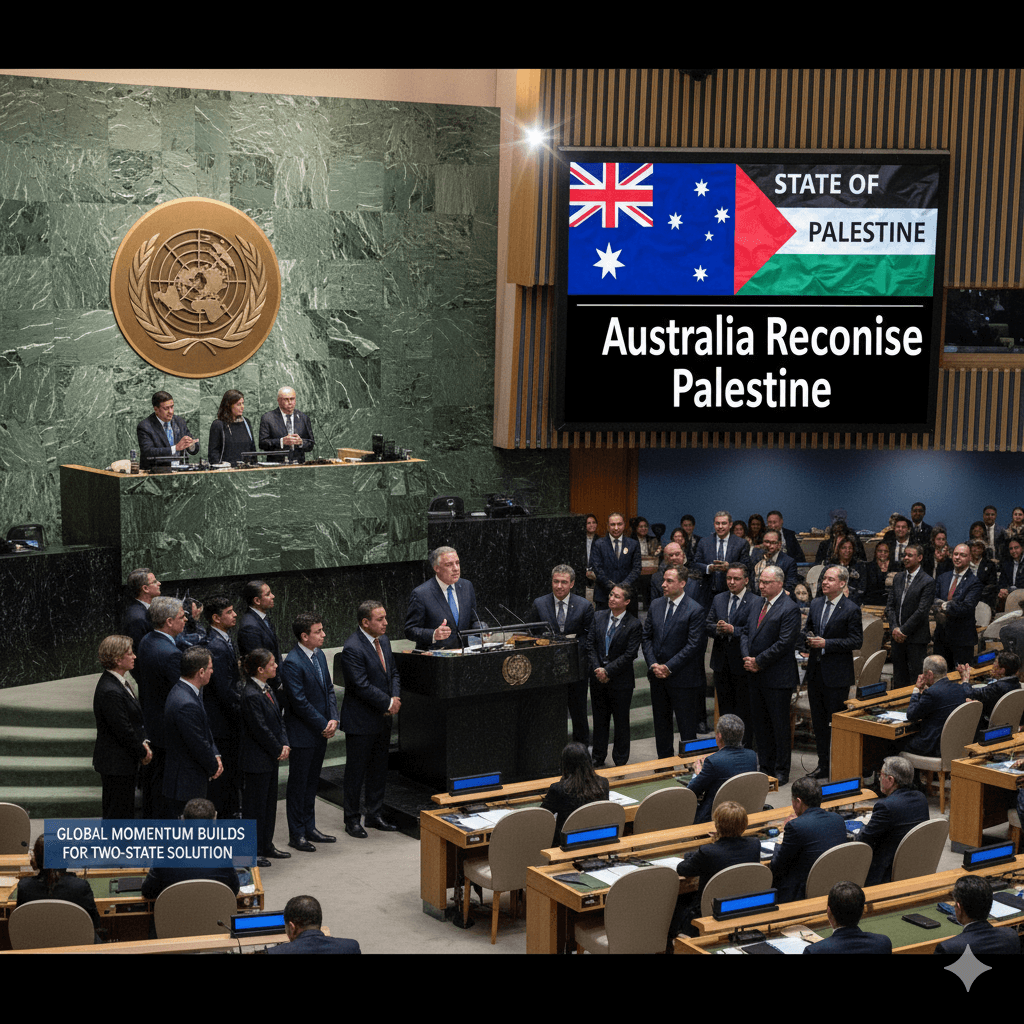
SYDNEY, September 22, 2025 — In a momentous foreign-policy turn, Australia has officially recognised the State of Palestine, joining Canada and the United Kingdom in endorsing Palestinian sovereignty at the 80th session of the United Nations General Assembly in New York.
Prime Minister Anthony Albanese, addressing global delegates, called the move “a moral and strategic necessity” aimed at reviving the stalled peace process. The announcement marks Australia’s first departure from decades of near-unconditional support for Israel since its 1948 founding recognition.
“Australia stands for peace, dignity, and the right of self-determination,” Albanese said from the UN podium. “Recognising Palestine is a step toward a durable two-state solution — one that ensures both Israelis and Palestinians can live securely within internationally recognised borders.”
— UN General Assembly Speech, September 22 2025
Regional and International Reaction
The Palestinian Authority (PA) welcomed the decision, describing it as “a vital step toward justice and stability.” In remarks carried by Al Jazeera English, PA Foreign Minister Varsen Aghabekian urged countries to “convert recognition into meaningful pressure” on Israel to halt settlement expansion and release withheld tax revenues vital to the West Bank’s economy.
Aghabekian also reiterated the Authority’s commitment to democratic reform and to excluding Hamas from any transitional government — echoing conditions requested by Canberra.
Israel’s response was swift and severe. Prime Minister Benjamin Netanyahu denounced Australia’s move as a “reward for terrorism,” vowing to block any future Palestinian state west of the Jordan River. Israel’s National Security Minister Itamar Ben-Gvir called for annexation of parts of the West Bank, further heightening diplomatic tensions.
Meanwhile, Israel’s Opposition Leader Yair Lapid criticised Netanyahu’s “confrontational foreign policy,” warning that alienating Western allies would only deepen Israel’s isolation.
Legal and Political Context
Professor Don Rothwell, international-law expert at the Australian National University, said Canberra’s move aligns with established legal precedent.
“Statehood under international law does not require Security Council approval,” he explained. “Recognition by other sovereign states — especially democratic middle powers like Australia — solidifies Palestine’s claim to legal personality under the Montevideo Convention.”
Rothwell noted that while a U.S. veto would block full UN membership, recognition by over 130 countries now gives Palestine the practical standing of a state.
He added that Australia could follow up by opening a representative office in Ramallah, providing election-monitoring expertise, and supporting institution-building — areas where Australia has prior experience through ASEAN and Pacific observer missions.
Momentum Builds at the United Nations
Australia’s recognition coincides with the France–Saudi Arabia-sponsored “Peace Summit for Palestine” convened at the UN today, aimed at drafting a roadmap for renewed negotiations.
UN Secretary-General António Guterres praised the growing list of recognisers — which now includes the European Union’s three largest economies — calling it “an overdue restoration of political balance.”
“Peace cannot be negotiated with only one party recognised as legitimate,” Guterres told delegates.
The Arab League also welcomed Australia’s move, noting its alignment with the bloc’s May 2025 resolution urging Hamas disarmament and a technocratic Palestinian unity government. Analysts see this as a strategic effort to sideline extremist factions and strengthen moderate leadership in Ramallah.
Domestic Political Fallout
At home, reactions were mixed. The Australian Jewish Association expressed “deep disappointment,” claiming the government’s decision undermines Israel’s security. President David Adler warned that Canberra’s move “risks rewarding incitement and antisemitism under the guise of diplomacy.”
Conversely, the Australian Council for International Development (ACFID) hailed the recognition as “a triumph of human rights over political expediency.”
Foreign-policy analyst Dr. Emma Short of Griffith University noted that public opinion has shifted sharply:
“Our polling in August 2025 shows 63% of Australians now support recognition of Palestine — a dramatic increase from just 34% five years ago.”
Economically, officials say aid reallocation to the Palestinian Authority will remain within Australia’s existing $220 million Middle East Development Fund, ensuring no new budget strain.
Case Study: Diplomatic Precedent in Recognition
Australia’s move mirrors Canada’s 2024 recognition of Palestine following parliamentary consensus and the UK’s May 2025 declaration under Prime Minister Keir Starmer. Both nations tied recognition to Palestinian institutional reforms — a model Canberra adopted.
A case study published by the Brookings Institution (2024) found that early recognition by mid-sized democracies tends to encourage governance accountability and reduce violence by granting legitimate political outlets for national aspirations.
Australia’s Department of Foreign Affairs and Trade (DFAT) plans to release a joint working paper with Canada and the UK later this year on “Recognition as a Tool for Conflict Resolution.”
Future Outlook: Two-State or One-Reality?
While recognition is largely symbolic, experts believe it carries real political weight. Dr. Helen Clarkson, a former UN Special Envoy to the Middle East, said it shifts global discourse:
“When countries like Australia act, it tells both parties that the world is ready for negotiations — not endless occupation or conflict.”
Canberra has reaffirmed support for a demilitarised Palestinian state co-existing peacefully alongside Israel, with Jerusalem as a shared capital — echoing UN Resolution 181 (1947).
Whether this recognition leads to renewed talks or deeper division remains uncertain. For now, Australia’s diplomatic pivot signals a clear intent: a return to principled, multilateral engagement in pursuit of lasting peace.