Sydney, September 25, 2025
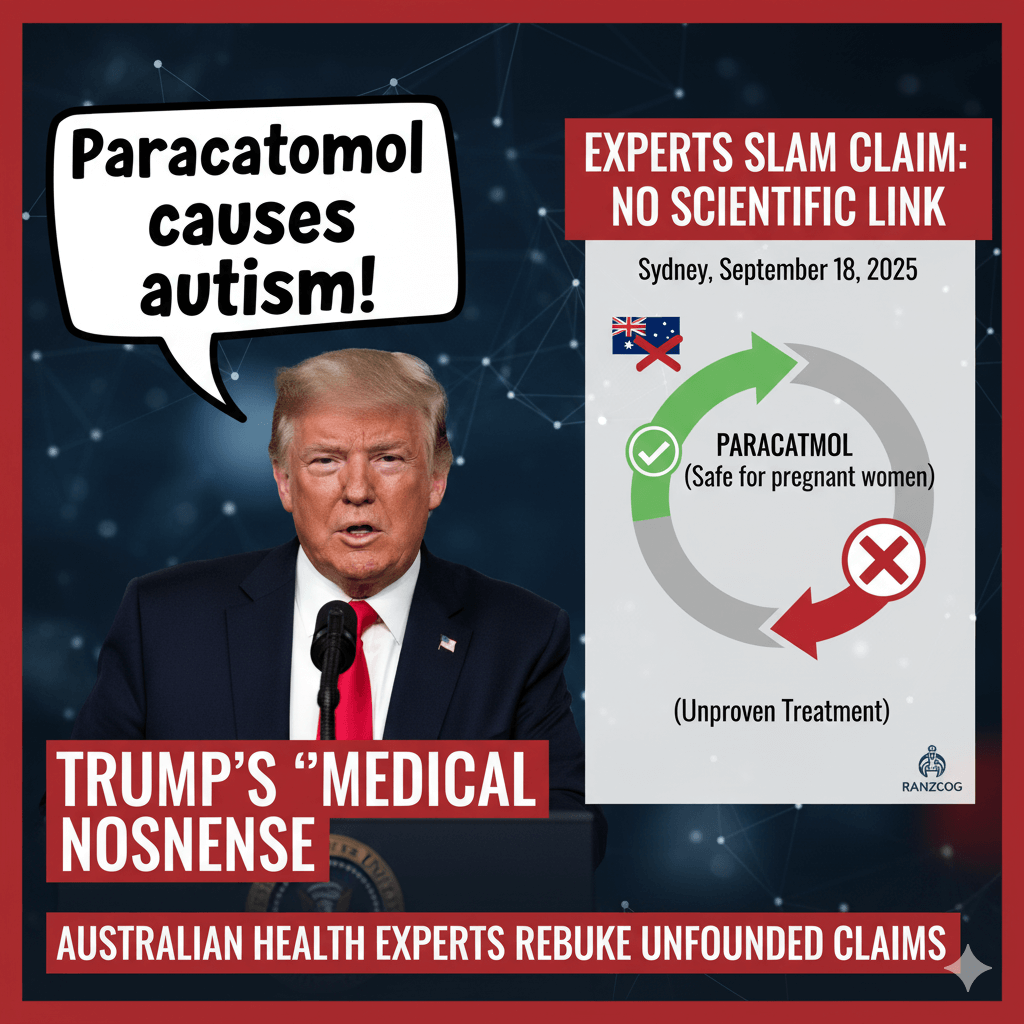
Sydney, September 25, 2025 – Australian health experts have strongly rebuked recent comments by U.S. President Donald Trump suggesting a link between paracetamol use during pregnancy and autism, calling the statements scientifically baseless and potentially harmful to expectant mothers.
Trump’s remarks, made during a White House briefing earlier this week, urged pregnant women to “limit Tylenol use,” implying an unverified connection between paracetamol (acetaminophen) and neurodevelopmental conditions such as autism and ADHD.
Medical authorities in Australia and around the world have responded swiftly, denouncing the claim as “dangerous misinformation.”
Regulatory and Medical Response
The Therapeutic Goods Administration (TGA), Australia’s medicines regulator, reaffirmed that paracetamol remains a Category A drug under Australian pharmaceutical classification — meaning extensive use in pregnant women has shown no increase in birth defects or developmental disorders.
“When used as directed, paracetamol continues to be considered one of the safest pain and fever management options during pregnancy,” said a TGA spokesperson in an official statement.
“There is no evidence to support restricting its use.”
The TGA’s position aligns with that of international regulatory bodies, including the World Health Organization (WHO) and the U.S. Food and Drug Administration (FDA), both of which have found no causal evidence linking paracetamol to autism spectrum disorder (ASD).
Expert Opinions from Australian Health Leaders
Dr. Elisha Broom, spokesperson for the Royal Australian and New Zealand College of Obstetricians and Gynaecologists (RANZCOG), expressed concern that such misinformation could have real-world consequences.
“Unfounded claims like these risk frightening expectant mothers into avoiding safe and essential medication,” Dr. Broom told the Australian Health Review.
“Untreated fever or severe pain during pregnancy can cause complications — and we have very few safe alternatives to paracetamol.”
She emphasized that fever during pregnancy can increase the risk of preterm labour and neural tube defects, particularly in the first trimester. “Proper management with safe medications like paracetamol is critical,” she added.
Scientific Evidence and Case Studies
A 2023 systematic review published in The Lancet Psychiatry analyzed over 1.2 million pregnancies across 12 countries, concluding there was no causal relationship between maternal paracetamol use and autism or ADHD diagnoses in children.
The study found that earlier research suggesting a link was based on observational data prone to confounding factors — such as genetic predisposition, maternal stress, or underlying illness.
“Correlation is not causation,” said Professor Linda Chen, lead researcher at the University of Sydney’s School of Public Health.
“Once you control for maternal health and genetic variables, the association effectively disappears.”
In contrast, untreated conditions such as high fever have been conclusively linked to fetal distress and neural complications, underscoring the importance of balanced medical care rather than fear-driven avoidance.
Broader Context: Public Health and Misinformation
The controversy has reignited debate over the spread of health misinformation from high-profile figures.
Professor Paul Kelly, former Chief Medical Officer of Australia, characterized Trump’s statements as “mal-information” — falsehoods that exploit genuine health concerns to sow distrust in medical science.
“These remarks risk creating unnecessary guilt among parents of autistic children while undermining confidence in established medical guidance,” Prof. Kelly told ABC News.
“It’s unhelpful, unscientific, and cruel.”
Health experts also fear that misinformation about paracetamol could feed into broader anti-vaccine and anti-pharmaceutical narratives online, especially in the wake of recent public health crises.
“When influential individuals question proven medicines without evidence, it erodes trust in the entire healthcare system,” said Dr. Danielle McMullen, President of the Australian Medical Association (AMA).
“Our responsibility as doctors is to keep public health grounded in facts, not politics.”
Global Reaction
International health organizations, including the Centers for Disease Control and Prevention (CDC) and WHO, have reaffirmed their guidance on paracetamol’s safety profile.
The FDA released a statement clarifying that while studies continue, no evidence warrants limiting paracetamol use during pregnancy when medically necessary.
Global media outlets — including BBC Health, Reuters Health, and ABC News Australia — have highlighted the incident as an example of the growing threat of health misinformation.
Conclusion
Australian health experts have united in condemning unfounded claims linking paracetamol use in pregnancy to autism, reaffirming that scientific evidence strongly supports the drug’s safety when used appropriately.
Authorities continue to advise expectant mothers to consult healthcare professionals before making medication decisions and to rely on verified medical information rather than public speculation.
“Public health depends on public trust,” Dr. McMullen concluded. “Science must always speak louder than politics.”