Sydney | October 21, 2025
A Quiet Arrival That Sparked a National Debate
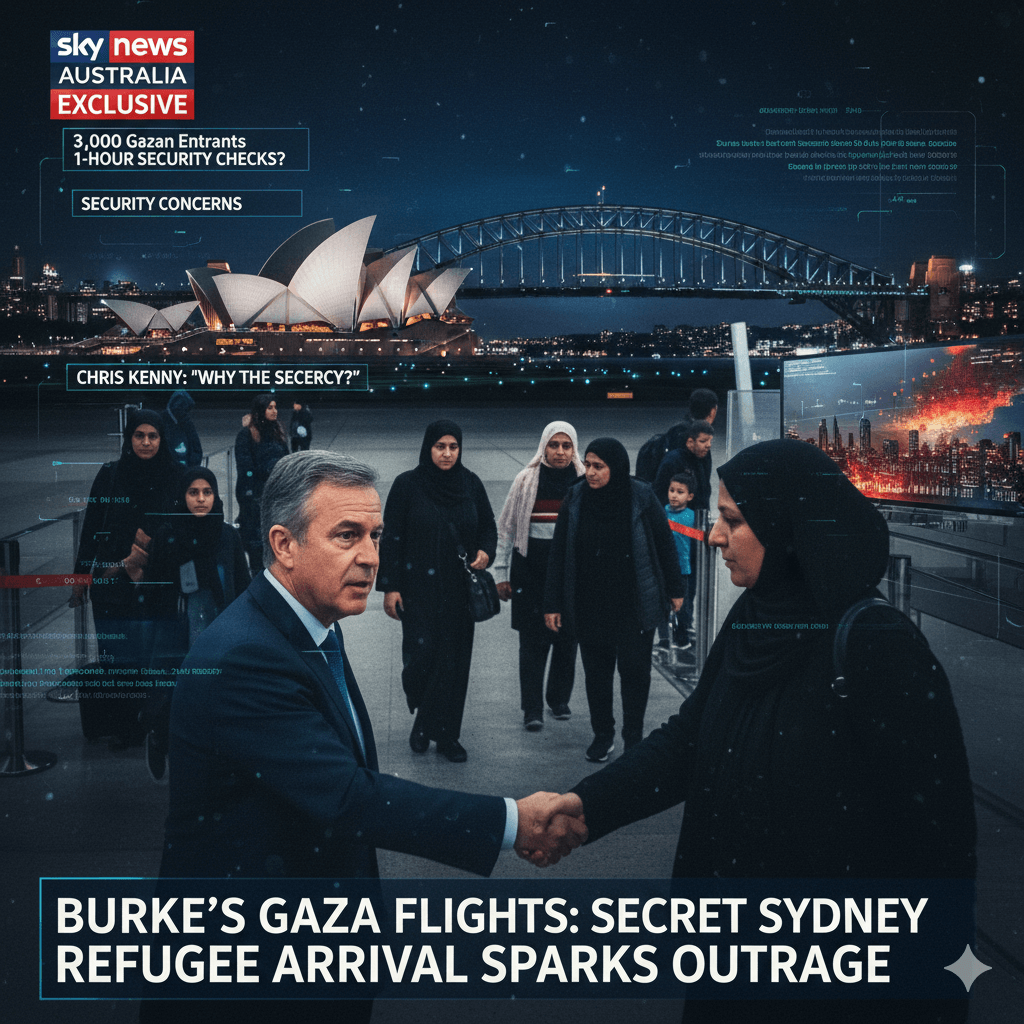
SYDNEY, AUSTRALIA — Home Affairs Minister Tony Burke is facing mounting scrutiny after personally welcoming a group of Gazan refugees to Sydney late Friday night, according to an exclusive report by Sky News Australia.
The small group — estimated at 40 to 50 individuals, primarily family members of Australian citizens — arrived under a new humanitarian visa program designed for those displaced by the ongoing Hamas–Israel conflict.
The reception, held at Sydney International Airport, was conducted without prior public announcement, prompting questions about transparency and the security vetting process.
“If Burke is so proud of his record, why the secrecy?”
— Chris Kenny, Sky News Australia, October 18, 2025
Humanitarian Policy Under the Microscope
The Albanese government’s refugee policy, introduced in mid-September, allows both Palestinians and Israelis unable to return home due to the conflict to apply for temporary humanitarian visas.
Under the current system, Minister Burke personally approves each application following risk assessment by the Department of Home Affairs and Australian Security Intelligence Organisation (ASIO).
According to internal departmental figures obtained by The Australian Financial Review, over 3,000 humanitarian visa applications from Gaza have been received since August, with an approval rate of 23%.
A spokesperson for the department said the arrivals were “consistent with Australia’s longstanding humanitarian obligations,” citing UNHCR guidance on refugee resettlement.
Security Concerns from the Opposition
Critics from the opposition benches have voiced concerns that security checks may be insufficient, particularly given the operational control of Hamas, a designated terrorist organisation, over much of Gaza.
Liberal Senator Sarah Henderson called the one-hour security clearance average “alarmingly brief.”
“When Australians are being told to wait months for a passport renewal, it’s outrageous that people from conflict zones can be processed in under an hour,” she said.
Meanwhile, Shadow Defence Minister Andrew Hastie argued the influx was “putting immense pressure on housing, healthcare, and community cohesion,” adding that “many Australians feel strange in their own home.”
In response, Minister Burke insisted that security vetting remains rigorous, involving multiple intelligence databases and biometric checks.
“These are families seeking safety, not individuals posing a threat. Each case undergoes the full ASIO review process,” Burke told reporters in Canberra.
The Humanitarian Context: Gaza’s Crisis Deepens
The United Nations Office for the Coordination of Humanitarian Affairs (OCHA) reported that over 1.7 million Gazans have been displaced since renewed conflict erupted in mid-2024. Many families are sheltering in makeshift tents or destroyed buildings.
UN News described the conditions as “unimaginably dire,” with limited access to food, clean water, and medical supplies.
Migration agent Jamal Daoud, who helped coordinate the arrivals, told SBS News that the refugees were “mostly women and children with direct Australian family ties.”
“This is not a mass intake — it’s a targeted humanitarian effort,” Daoud said.
Case Study: Balancing Compassion and National Security
Australia’s refugee policy framework has long walked a tightrope between humanitarian obligations and border security.
A 2023 Lowy Institute study found that 68% of Australians support refugee resettlement for families fleeing war zones — yet over half also fear the system is vulnerable to exploitation.
Dr. Michael Reese, a migration law specialist at Monash University, argues that public distrust often arises from “opaque communication.”
“When the government keeps humanitarian actions quiet, even well-intentioned programs can be misconstrued as secretive or unsafe,” Reese explained.
This tension mirrors previous controversies — such as the Syrian refugee intake of 2015, when rapid approvals sparked similar concerns about vetting and transparency.
Calls for Greater Accountability
Shadow Foreign Affairs Minister David Coleman intensified pressure on the government, criticising its decision to maintain funding for the UN Relief and Works Agency (UNRWA) amid allegations of mismanagement.
“The government is writing cheques to UNRWA while cutting defence spending — it’s the wrong and simple decision,” Coleman said.
In response, Burke reiterated Australia’s commitment to multilateral humanitarian aid, noting that UNRWA remains the UN’s primary delivery partner in Gaza.
“Australia can’t turn its back on innocent families because of fear or misinformation,” Burke said. “Our values demand compassion alongside vigilance.”