September 30, 2025 | Canberra, Australia
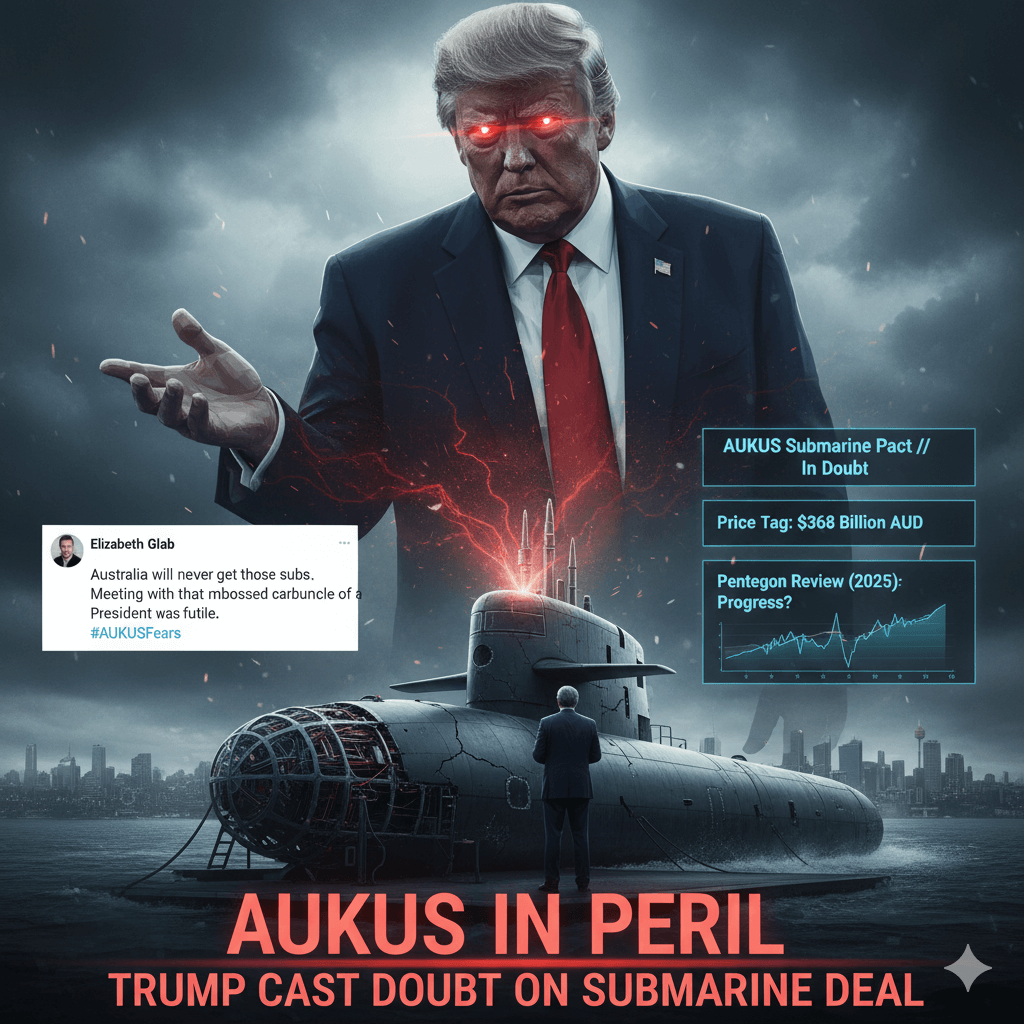
A sharp social-media post by journalist Elizabeth Glab last week re-ignited concerns about Australia’s landmark AUKUS submarine treaty, raising fresh questions over whether Canberra will ever receive the advanced submarines it was promised. The post, published on September 24, described a recent meeting between Prime Minister Anthony Albanese and U.S. President Donald Trump as a “futile gesture” and a “merciful embossed carbuncle of a President” — a pointed jab at Trump’s reliability.
The AUKUS agreement, originally signed by Australia, the United States and the United Kingdom in 2021, was designed to deliver nuclear-powered submarines (SSNs) to Australia, eventually replacing its ageing Collins-class fleet. The projected cost of the deal has ballooned to around A$368 billion, according to analysis by the Australian Strategic Policy Institute (ASPI).
However, delays and emerging doubts about U.S. nuclear-submarine production capacity have emerged as major stumbling blocks. A recent report by the Foreign Policy Research Institute (FPRI) outlines what it describes as a “Virginia problem” — referring to Australia’s interim purchase of U.S. Virginia-class submarines — and questions whether the U.S. fleet can sustain both its own defence needs and the AUKUS commitments.
Pressure Behind the Scenes
In a meeting on September 17, President Trump clashed with ABC reporter John Lyons during a press conference, accusing him of “hurting Australia” while probing the U.S. leader’s business interests. Analysts say the incident has raised fears that Australia’s strategic interests under AUKUS may be contingent on personal diplomacy rather than clear institutional guarantee.
In the wake of that clash, Glab’s post became a lightning rod for defence commentators and social-media users alike. A commentary from the Australia Institute noted that while the meeting had symbolic success, it “revealed little substance” regarding the deal’s delivery.
Strategic Context and Budget Pressures
Australia’s intent under AUKUS is ambitious: the plan foresees a phased acquisition of submarines, beginning with U.S.-built vessels in the early 2030s and culminating in Australia-built SSN-AUKUS class boats in the 2040s. The Lowy Institute calls the program “large, technologically challenging, and industrially ambitious.”
The ASPI strategist Matthew Newman estimated the full program cost—including infrastructure, sustainment and operations—could lie between A$268 billion and A$368 billion. According to The Guardian, commentators question whether that money might offer better national security gains if spent elsewhere.
Case Study: Shipyard & Infrastructure Commitment
In September 2025, Australia announced an A$12 billion investment in a submarine shipyard in Western Australia — part of the infrastructure needed to support the AUKUS fleet. Reuters reported the investment will support construction and sustainment of future submarines under the agreement.
This case highlights a critical challenge: Australia not only needs to acquire submarines, but build and sustain the supporting industrial base. That means staffing, training, nuclear regulation and supply-chain development all remain outstanding. According to the FPRI piece, U.S. domestic submarine build-rates are already under pressure, raising doubts about whether Australia’s delivery schedule is realistic.
Expert Analysis: Sovereignty, Cost and Delivery Risk
Defence specialist Sam Roggeveen at the Lowy Institute argues:
“Australia is buying submarines that fire cruise missiles, but the industrial capacity to deliver them is still nascent. The delays and cost will matter far more than the headlines.”
The Guardian quotes Roggeveen’s “echidna strategy” — an alternative policy emphasising less expensive maritime deterrence instead of high-cost SSNs.
Political and Public Considerations
Domestic critics highlight the lack of transparency around the deal. The AUKUS arrangement requires Australia to host and operate submarines with nuclear propulsion, but remains bound by non-nuclear-weapon status under the International Atomic Energy Agency (IAEA). That raises questions about cost, sovereignty and risk.
Moreover, although President Trump recently said Australia will receive the submarines, ABC reported that while Trump gave assurances, details on timelines and industrial deliverables remain vague.
What Lies Ahead
Ultimately, the success of AUKUS hinges on three factors:
- Whether Australia receives submarines on schedule, with operational capability.
- Whether the industrial and sustainment base (in Australia) is built in time.
- Whether the strategic cost (financial, industrial, diplomatic) proves beneficial relative to alternative defence investments.
As Glab’s social-media critique suggests, the optics are shaky – but the substance remains under construction. If Australia is to deliver on this defence ambition — without compromising sovereignty, budget or strategy — the next few years will be decisive.