
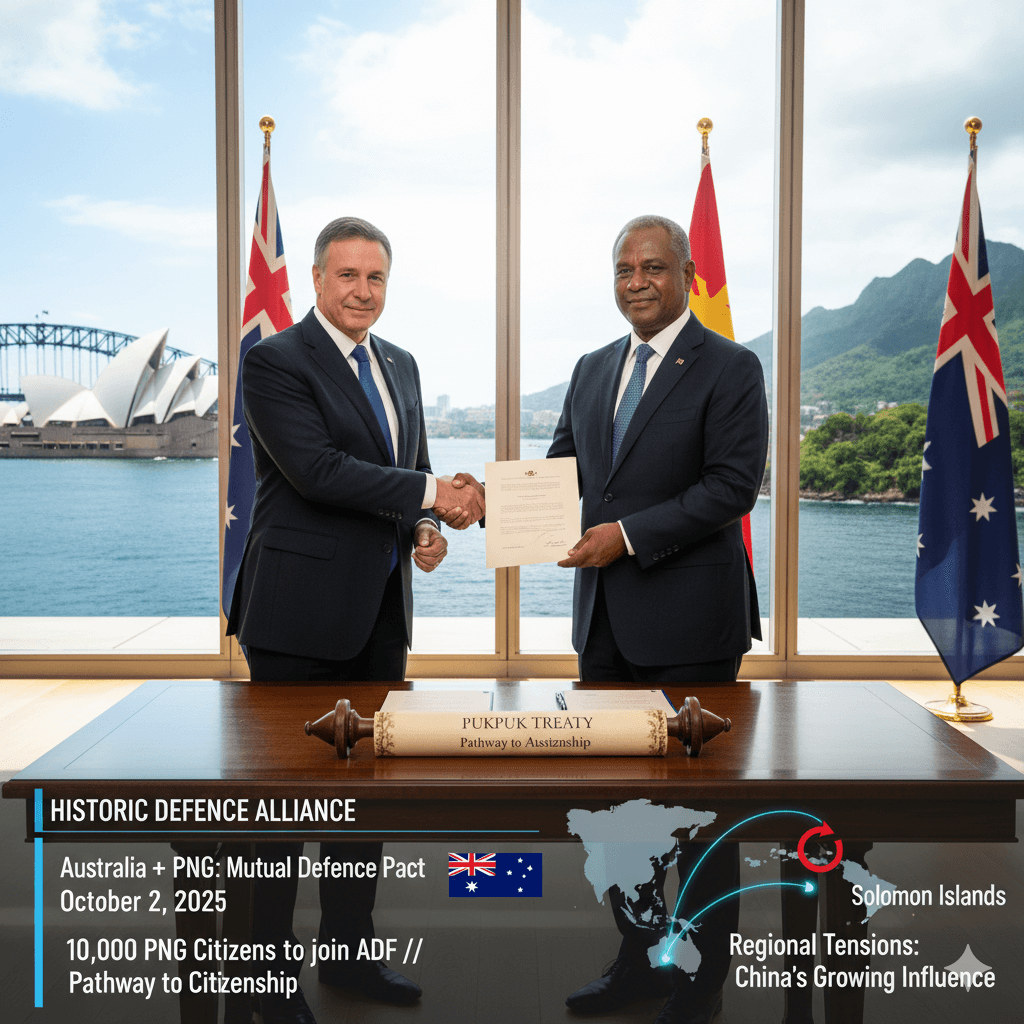
October 8, 2025 | Sydney, Australia
Australia and PNG Finalise the Pukpuk Treaty
Australia and Papua New Guinea (PNG) have formally sealed a historic defence pact, marking Canberra’s first major military alliance since the ANZUS Treaty of 1951.
The Pukpuk Treaty—named after the Tok Pisin word for “crocodile”—was officially approved by PNG’s National Executive Council on October 2, 2025, after months of negotiation. The agreement, described as a “mutual security partnership”, binds both nations to come to each other’s aid in the event of an armed attack, signaling a dramatic shift in Pacific regional defence cooperation.
Prime Minister James Marape called the decision “a defining moment for PNG sovereignty and regional security.” Speaking in Port Moresby, Marape said:
“This is not a treaty of dependence but a partnership of equals. PNG seeks friendship with all — but our security begins with trusted neighbours.”
The deal follows extensive diplomacy by Australian Prime Minister Anthony Albanese, who has made strengthening Pacific alliances a central feature of his government’s foreign policy.
A Strategic Shift in the Pacific
The treaty comes amid growing anxiety over China’s expanding presence in the South Pacific, particularly after Beijing signed a controversial security pact with the Solomon Islands in 2022.
A 2023 report from the Centre for Strategic and International Studies (CSIS) warned that China’s maritime logistics and policing initiatives in Melanesia could “reshape Pacific power dynamics” and reduce Western influence.
Under the Pukpuk Treaty, Australia and PNG pledge mutual assistance in defence and disaster response, establish joint training programs, and allow reciprocal access to military bases.
One of the most striking elements of the deal is a proposal—first revealed by Reuters—to permit up to 10,000 PNG citizens to join the Australian Defence Force (ADF) through a specialised recruitment pathway that could eventually offer Australian citizenship.
Diplomatic Hurdles and Political Negotiation
The road to ratification was not without setbacks. On September 17, 2025, PNG Prime Minister Marape revealed that the initial cabinet vote failed due to a lack of quorum, delaying approval by two weeks. Political infighting and opposition concerns about sovereignty slowed the process.
Australia reportedly sweetened the deal with an expanded Pacific Infrastructure and Sport Partnership, including up to $600 million in funding for community projects and the National Rugby League (NRL) PNG expansion. Canberra framed the initiative as “nation-building diplomacy,” echoing findings from a 2005 DFAT policy paper advocating soft power through sport as a stabilising regional tool.
While the Albanese government has denied a direct link between the NRL funding and the treaty’s passage, analysts see the timing as politically astute.
Expert Analysis: Defence and Development Intertwined
Defence analyst Dr. Peter Jennings, former Executive Director of the Australian Strategic Policy Institute (ASPI), described the Pukpuk Treaty as “the most consequential shift in Australia’s Pacific strategy in 70 years.”
“This is not just about military cooperation—it’s about embedding Australia in the Pacific’s development model,” Jennings told The Australian Financial Review. “Security, infrastructure, and citizenship pathways are all part of a new kind of alliance diplomacy.”
Meanwhile, PNG-based political scientist Dr. Anna Kila from the University of Papua New Guinea highlighted the domestic dimension:
“For many Papua New Guineans, joining the ADF represents economic opportunity as well as security cooperation. The challenge will be ensuring local benefit and not dependency.”
Case Study: Lessons from the Solomon Islands Agreement
The treaty’s development has drawn comparisons to the China–Solomon Islands Security Agreement of 2022, which raised fears of Chinese naval basing in the region.
A 2024 Lowy Institute case study found that the Solomon Islands pact had “limited immediate security value” but significantly shifted perceptions of Chinese strategic reach. The report concluded that Australia’s most effective response would be to “deepen bilateral defence ties with Pacific Island states through inclusive partnerships.”
The Pukpuk Treaty appears to be a direct response to that recommendation, reflecting a pivot toward Pacific security architecture led by regional consent rather than external influence.
Economic and Social Implications
The treaty includes provisions for defence industry cooperation, joint cyber training, and infrastructure protection—all key to both nations’ security futures.
Economically, the pact is expected to open pathways for PNG’s workforce within Australia’s expanding defence and logistics sectors. The Australian Department of Defence estimates the program could add $1.2 billion annually to the regional economy through training, contracts, and shared logistics.
Humanitarian cooperation is also central: joint disaster response frameworks will integrate PNG forces into the ADF’s Humanitarian and Disaster Relief Command, reflecting lessons from cyclone relief operations in Fiji and Vanuatu.
Official Statements and Reactions
In a statement from Canberra, Prime Minister Albanese said:
“This is a major win for peace, prosperity, and partnership in the Pacific. Our security and our futures are inseparable.”
Foreign Minister Penny Wong added that the alliance reflects “a new Pacific family compact built on trust and shared values.”
China’s Foreign Ministry responded cautiously, urging that “no third party target or exclude regional partners.”
What Happens Next
Both nations’ parliaments must now ratify the treaty before it takes legal effect, likely by early 2026. Once ratified, the Pukpuk Treaty will formalise joint command structures, defence education programs, and annual strategic dialogues.
Analysts view the move as a defining test of Australia’s regional leadership at a time when global power competition is increasingly visible in the Pacific.