
October 6 2025 | Sydney, Australia
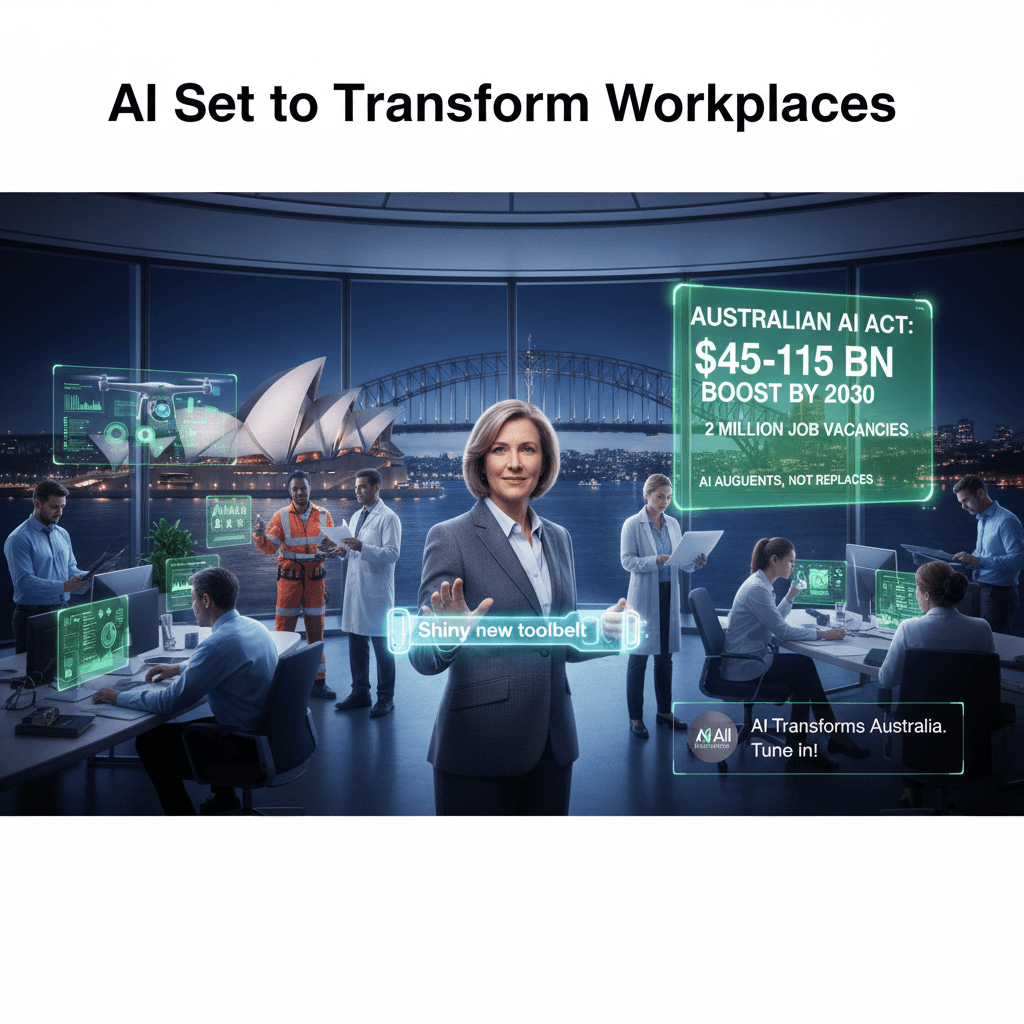
The Australian Government is pressing ahead with a sweeping agenda to reshape Australia’s workforce for the age of artificial intelligence (AI). Led by Amanda Rishworth, Minister for Employment and Workplace Relations, the reform drive emphasises that AI will augment human work rather than replace it — equipping Australians with a “shiny new tool-belt”, as she described in a recent podcast with The Guardian.
New Laws and a Skills Push on the Horizon
The government has announced preliminary moves toward an Australian AI Act, designed to regulate high-risk AI applications and guard against unintended harms. The legislation follows months of public consultation and stakeholder engagement. Alongside the regulatory framework, Rishworth emphasised the urgent need for up-skilling, noting the government is preparing for approximately 2 million job vacancies in coming years as AI becomes embedded in workplaces.
Broader estimates from the Productivity Commission suggest generative AI could add between $45 billion to $115 billion annually to the economy by 2030 — a projection echoed across industry outlooks.
Mixed Reactions from the Workforce
Despite the optimistic tone from the government, not all workers feel reassured. A survey by employment-services firm ADP found that only 11 % of Australian employees feel positive about AI’s impact on their roles. Many remain anxious about job security, workplace change and the pace of transition.
Industry commentary has flagged a gap between policy ambition and worker sentiment. Unions are pressing for comprehensive training and consultation mechanisms to ensure AI adoption is fair and inclusive rather than disruptive.
Global Context and Local Action
Australia’s AI push comes amid a global surge in machine-learning adoption across sectors. A report by the OECD underscores that while AI offers productivity gains, the benefits are far from guaranteed unless paired with workforce readiness and regulatory safeguards.
Domestically, Australia has already taken steps in public-service AI governance. The rollout of the government’s Automation and AI Strategy 2025-27 emphasises “human-centred design”, trust, transparency and ethical deployment of AI in government services.
Case Study: How Employers Are Approaching AI Now
Consider the example of a major Melbourne logistics company which recently deployed AI-powered scheduling and routing systems. Rather than eliminating jobs, the firm used AI to support its workforce: enabling fewer late-night shifts, reducing driver fatigue and freeing staff for customer service roles. Workers received retraining in analytics and decision-making, enabling a shift from repetitive tasks to oversight.
The company reports a 12 % productivity gain and a 10 % increase in staff retention in the first six months of deployment. This case underscores the government’s messaging: that AI should assist workers, not displace them.
Expert Insight: Getting the Balance Right
Dr. Amira Khan, Senior Researcher at the Institute for Peace & Conflict Studies, emphasises that the success of AI policy will hinge on regulatory timing and workforce investment.
“The promise of AI is real — but its risks are equally real. If regulation is too slow or workers aren’t trained, we risk widening inequality rather than boosting productivity.”
Her observation matches industry data showing many firms are adopting AI tools, yet fewer than one-third have formal governance or training programmes in place.
Priorities and Risks Ahead
Key priorities for the Albanese Government include:
- Passing robust AI legislation that governs high-risk use-cases (e.g., health, law enforcement, infrastructure).
- Scaling national skills programmes to up-skill workers in AI literacy, data analytics and digital coordination.
- Strengthening regulatory coordination across states to avoid patchwork laws that slow innovation.
- Embedding worker consultation and rights protections in AI deployment, ensuring roles are not hollowed out by automation.
Risks remain significant: if AI is deployed without safeguards, there is potential for job displacement, algorithmic bias or privacy infringements. The coalition of industry, unions and government must navigate these choices carefully. As the [Guardian] podcast noted, the minister expects AI to be a tool-belt not a replacement — but the real-world rollout will determine whether that holds true.
Looking Ahead
By 2030, if AI adoption across Australian workplaces proceeds as planned, the country could see meaningful rises in productivity and employment quality. However, the path to that future will depend on delivering real training, smart regulation and inclusive rollout. As the government moves into what it calls a “reform decade”, all eyes are on how this vision becomes lived reality for everyday workers.