
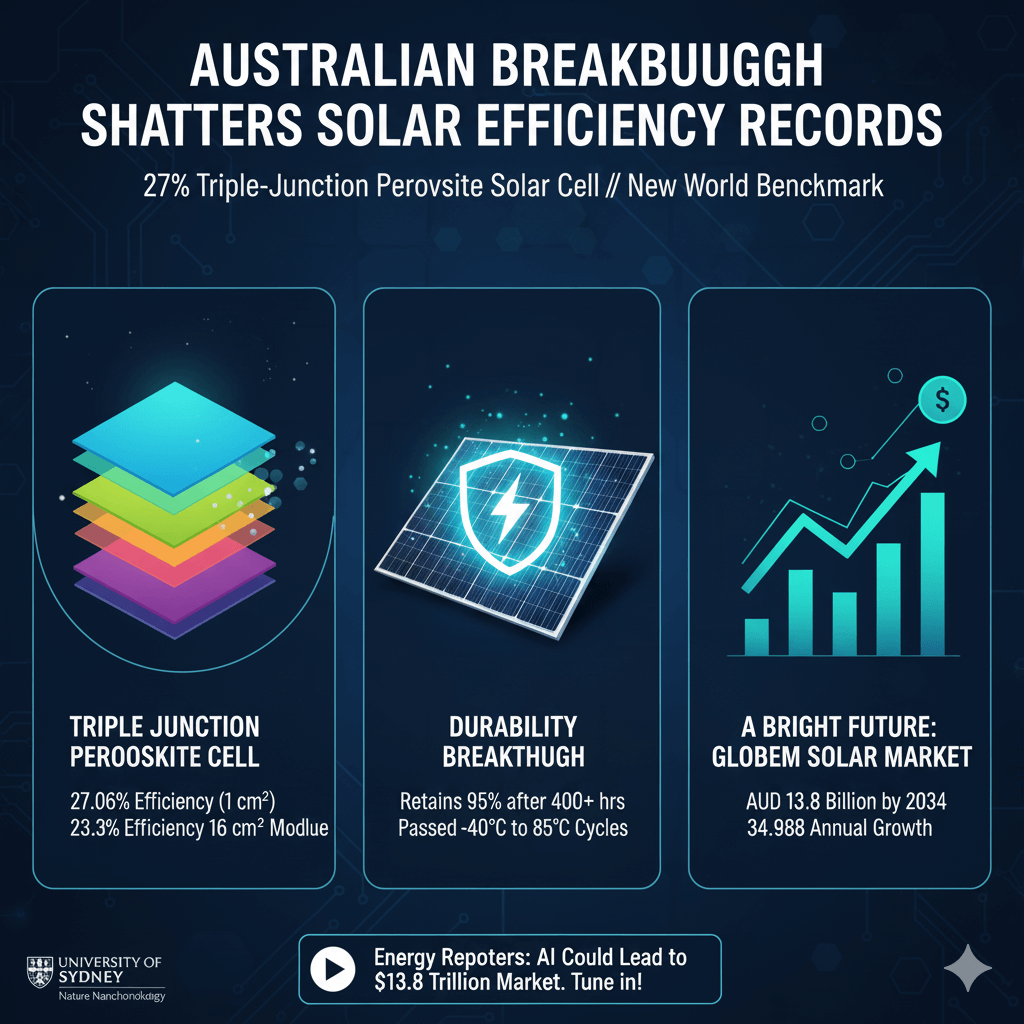
SYDNEY, AUSTRALIA – Scientists at the University of Sydney have smashed global records with a groundbreaking triple-junction perovskite solar cell, achieving an impressive 27.06% power conversion efficiency on a 1 cm² device. The innovation, detailed in a recent Nature Nanotechnology paper, marks a significant leap forward for renewable energy in Australia and beyond. This cutting-edge technology could pave the way for a low-carbon future, as highlighted by Energy Reporters on X today.
The new solar cell also boasts a 23.3% efficiency on a larger 16 cm² module, making it the most efficient of its kind at this scale. Led by Professor Anita Ho-Baillie, the team stacked three semiconductor layers to capture more of the solar spectrum, outpacing traditional single-junction cells. This milestone sets a new benchmark for the industry and showcases the potential of multi-layered perovskite architectures.
Durability Breakthrough for Real-World Use
One of the biggest hurdles for perovskite solar cells has been their tendency to degrade under real-world conditions. However, the Sydney team has tackled this head-on, with their cells retaining 95% of their efficiency after over 400 hours of continuous operation under light. By swapping methylammonium for rubidium and using ultrathin gold nanoparticles to balance charge flow, they’ve achieved the first IEC 61215 thermal cycling certification—surviving 200 cycles from -40°C to 85°C.
This durability boost is a game-changer, addressing a key barrier to commercialisation. The encapsulated cells passed rigorous testing, proving they can withstand Australia’s harsh climate, from scorching summers to chilly winters. It’s a promising step towards scalable, long-lasting solar solutions.
A Bright Future for Solar Energy
The global tandem solar cell market is booming, with projections estimating a value of AUD 13.8 billion by 2034, growing at a staggering 34.98% annually. Australia is well-positioned to lead this charge, thanks to innovations like this and strong government support for renewables. The technology could eventually undercut the cost of silicon panels, making solar power even more accessible for Aussie households and businesses.
While the linked Energy Reporters article mistakenly cited a 16 m² module size (correctly 16 cm²), the excitement around this breakthrough is undeniable. As the world races to meet climate goals, this Aussie ingenuity could light the way to a greener tomorrow. Stay tuned for more updates as this technology moves closer to market!