
October 22, 2025 | Canberra, Australia
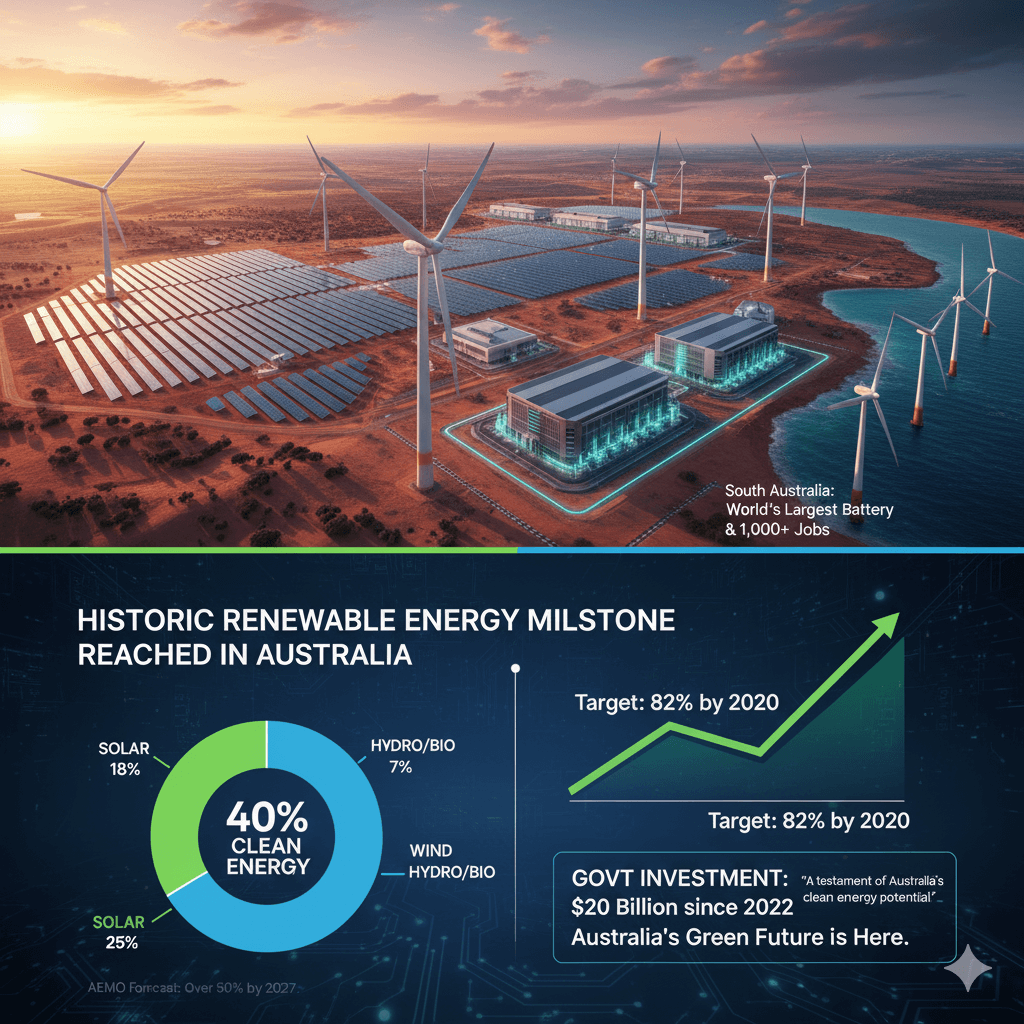
Australia has reached a historic milestone in its transition to clean energy, with renewable sources now accounting for 40% of national electricity generation, according to the Australian Energy Market Operator (AEMO). The achievement marks a pivotal step toward the federal government’s 82% renewables target by 2030, positioning Australia as a global model for sustainable energy transformation.
“This milestone demonstrates that clean energy isn’t just an environmental imperative — it’s an economic opportunity,”
said Energy Minister Chris Bowen during a press conference on Wednesday.
Solar and Wind Lead the Charge
Data from AEMO’s 2025 Renewable Energy Report shows that solar energy contributed 18% and wind power 15% to the national grid this year. The remainder came from hydropower and bioenergy, which together accounted for 7%.
Much of this surge is driven by record-breaking solar installations in Queensland and New South Wales, alongside offshore wind developments in Victoria’s Bass Strait. Projects such as the Kennedy Energy Park and Star of the South Offshore Wind Farm have become cornerstones of Australia’s renewable expansion.
According to BloombergNEF (2025), Australia’s clean energy investment now totals over AUD $20 billion since 2022 — one of the highest per capita rates in the world.
Government Policy and Economic Growth
The government’s Capacity Investment Scheme has played a crucial role in accelerating the energy transition by providing long-term funding certainty for renewable projects. Subsidies, grid upgrades, and public-private partnerships have further fueled the boom.
Energy Minister Chris Bowen praised the collaborative effort between states and industry, calling the milestone “a testament to Australia’s clean energy potential.”
Economic data from the Clean Energy Council (CEC) reveals that the renewable sector supported more than 30,000 Australian jobs in 2025 — a 45% increase since 2021.
“Renewable energy has evolved from an environmental choice to an economic engine,”
said Kane Thornton, CEO of the Clean Energy Council.
Regional Impact: A Case Study in South Australia
Nowhere is this transformation more visible than in Port Augusta, South Australia, where the construction of the world’s largest single-site battery project has created 1,000 new local jobs.
Mayor Sarah Thompson shared that the project has revitalized the local economy while cutting carbon emissions by 40% compared to 2019.
“It’s a win-win for the environment and our towns,”
Thompson told The Advertiser.
This mirrors national data showing that regional renewable hubs — including the Pilbara Solar Precinct and Snowy 2.0 Hydropower Project — are contributing to employment growth and energy independence.
Challenges Ahead
Despite the rapid growth, experts warn that grid stability and energy storage remain major challenges. Australia’s grid infrastructure was designed for centralized fossil fuel plants, not intermittent renewables.
The CSIRO (2025 Energy Systems Report) notes that large-scale battery storage and hydrogen production will be essential to balance supply and demand as renewables expand.
Meanwhile, coal-fired plants still supply around 25% of the energy mix. The Climate Council has urged the federal government to accelerate coal phase-outs to meet international net-zero by 2050 commitments.
“If we want to align with global climate targets, coal must decline twice as fast as it currently is,”
said Dr. Lesley Hughes, Climate Council spokesperson.
Global Context and Public Support
Australia’s achievement comes amid a worldwide push for clean energy dominance. According to the International Energy Agency (IEA), renewables now make up 35% of global power generation, with Australia surpassing the average.
Public sentiment remains overwhelmingly supportive: a 2025 Essential Research poll found that 81% of Australians favor renewable energy investment over fossil fuel subsidies.
The shift has also strengthened Australia’s international partnerships, particularly with Japan and South Korea, in exporting green hydrogen and critical minerals used in batteries and solar technology.
Looking Ahead: Toward 2030
If current trends continue, AEMO forecasts that renewables could surpass 50% of Australia’s electricity mix by 2027. The federal government aims to build on this momentum with national battery storage targets and expanded interconnectors linking state grids.
“The renewable revolution is well underway,”
said Minister Bowen.
“Our task now is to make it resilient, equitable, and future-ready.”
With policy alignment, technological innovation, and sustained public backing, Australia’s journey toward 82% renewable energy by 2030 appears both ambitious and achievable.