
Are IT Employees Looking for Jobs in Abundance in Sydney and Australia? A Complete 2026 Guide
 July 14, 2026
Quick Summary
Looking for an IT job in Sydney or Australia? The market is competitive, but opportunities remain strong for professionals with skills in cloud computing, cybersecurity, artificial intelligence, DevOps, software engineering, and data engineering. Although entry-level roles attract many applicants, experienced candidates continue to find opportunities across banking, healthcare, government, mining, retail, and technology companies. This guide covers the latest IT hiring trends, salary expectations, visa pathways, remote work opportunities, and practical job search strategies to improve your chances of getting hired in Australia.
If you have been applying for IT jobs in Sydney or elsewhere in Australia, you may have noticed mixed messages. Some reports say Australia has an ongoing technology skills shortage. Others describe a highly competitive market where hundreds of candidates apply for the same role.
So, which is true?
The answer is that both can be true at the same time.
Australia continues to need experienced technology professionals in several specialist areas. At the same time, entry-level positions and general IT roles have become more competitive because of changing hiring practices, economic conditions, and the growing use of artificial intelligence.
Whether you are an Australian resident, an international graduate, or an overseas professional considering migration, understanding where opportunities exist can help you make better career decisions.
This guide explains the current IT employment landscape in Sydney and Australia, the roles employers are actively recruiting for, expected salaries, visa opportunities, and practical steps that can improve your chances of finding work.
Is the IT Job Market Saturated in Sydney?
This is one of the most common questions job seekers ask.
The short answer is no, but some parts of the market are much more competitive than others.
Sydney remains Australia’s largest technology employment hub. Major banks, government agencies, software companies, healthcare organisations, telecommunications providers, consulting firms, and fast-growing start-ups continue to recruit IT professionals throughout the year.
However, the market has changed.
Five years ago, many employers were willing to hire graduates with limited experience. Today, organisations often expect applicants to demonstrate practical skills, project experience, and knowledge of modern cloud technologies before offering interviews.
This creates the impression that there are “no jobs”, when in reality there are jobs available for candidates whose skills closely match employer requirements.
Why Some IT Professionals Struggle to Find Work
Several factors contribute to longer job searches.
Increased Competition
Many experienced professionals who were affected by company restructuring have returned to the job market. This increases competition for desirable positions.
AI-Assisted Recruitment
Many Australian employers now use Applicant Tracking Systems (ATS) to screen resumes before a recruiter reviews them.
If your resume does not contain the right keywords, relevant technical skills, and measurable achievements, it may never reach a hiring manager.
Higher Employer Expectations
Instead of hiring general IT professionals, employers increasingly look for specialists with experience in areas such as:
- Cloud computing
- Cybersecurity
- Artificial intelligence
- Data engineering
- DevOps
- Enterprise software
- Platform engineering
Economic Uncertainty
Some organisations delayed recruitment during periods of economic uncertainty, while others shifted hiring towards contract or project-based roles instead of permanent positions.
Are There Enough IT Jobs Available in Australia?
Yes, but demand varies depending on the occupation.
Australia continues to advertise thousands of IT vacancies across metropolitan and regional areas.
Demand remains strongest in industries including:
- Banking and financial services
- Healthcare
- Government
- Defence
- Mining
- Education
- Telecommunications
- Retail technology
- Artificial intelligence
- Cloud services
Employers are looking for candidates who can solve business problems rather than simply manage technology.
Someone who understands automation, cloud infrastructure, cyber risk, or data analytics is often more competitive than someone with only general technical knowledge.
Which IT Roles Are Still Hiring in Sydney?
Not every technology role experiences the same level of demand.
Some occupations continue to receive strong employer interest because they directly support digital transformation and business growth.
Cybersecurity Specialists
Cybersecurity remains one of Australia’s fastest-growing technology sectors.
Businesses continue investing in:
- Security Operations Centres (SOC)
- Threat detection
- Penetration testing
- Governance, Risk and Compliance (GRC)
- Identity and Access Management
- Cloud security
Professionals with recognised certifications and practical experience often receive multiple interview opportunities.
Cloud Engineers
Cloud migration continues across Australian organisations.
Employers actively seek professionals with experience in:
- Amazon Web Services (AWS)
- Microsoft Azure
- Google Cloud Platform (GCP)
- Infrastructure as Code
- Kubernetes
- Docker
- Terraform
Cloud engineers often command above-average salaries because these skills are difficult to replace.
AI and Machine Learning Engineers
Artificial intelligence is changing how organisations operate rather than replacing every IT role.
Companies increasingly recruit professionals who can:
- Build AI applications
- Develop machine learning models
- Create automation workflows
- Work with large language models
- Implement AI responsibly
Candidates who combine programming knowledge with AI expertise are becoming increasingly valuable.
Data Engineers
Modern organisations generate enormous amounts of data.
Data engineers design systems that collect, process, and store this information efficiently.
Typical responsibilities include:
- Building data pipelines
- SQL optimisation
- ETL development
- Cloud data warehouses
- Business intelligence integration
Demand continues to grow because businesses rely on accurate data for decision-making.
DevOps Engineers
DevOps professionals help organisations deliver software faster while maintaining reliability.
Employers value experience with:
- CI/CD pipelines
- Git
- Jenkins
- GitHub Actions
- Kubernetes
- Docker
- Monitoring tools
- Linux administration
- Cloud automation
As more companies adopt cloud-native infrastructure, DevOps expertise remains highly sought after.
Software Developers
Software development remains one of Australia’s largest IT occupations.
However, the market has become more competitive than in previous years.
Developers who understand modern technologies such as:
- React
- .NET
- Java
- Python
- Node.js
- Go
- Microservices
- Cloud architecture
are generally more competitive than candidates with outdated technology stacks.
Employers increasingly prefer developers who can contribute throughout the software development lifecycle rather than focusing solely on coding.
Is Australia Still Facing an IT Skills Shortage?
Yes, but the shortage is selective.
Australia is not experiencing a shortage of every type of IT worker.
Instead, employers report shortages in specialised skills that are difficult to recruit.
Examples include:
- Cybersecurity professionals
- Cloud architects
- Data engineers
- AI engineers
- Enterprise architects
- Platform engineers
- SAP consultants
- Digital transformation specialists
Meanwhile, entry-level help desk positions, junior software development roles, and general IT support jobs attract large numbers of applicants.
This difference explains why some people receive several job offers while others struggle to secure interviews despite submitting hundreds of applications.
The key is aligning your skills with areas where employer demand continues to grow.
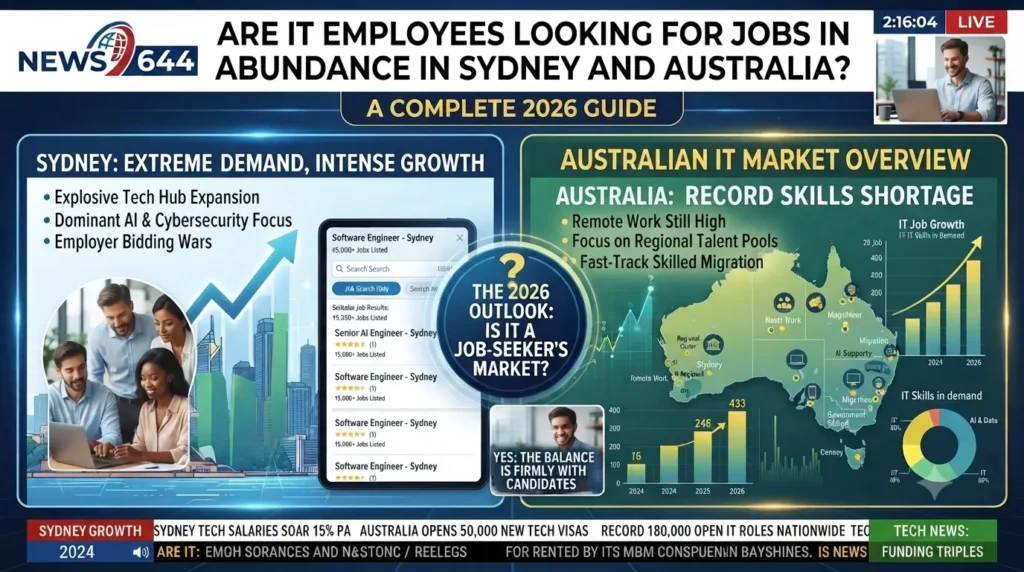
Are IT Employees Looking for Jobs in Abundance in Sydney and Australia?
What Salary Can IT Professionals Expect in Sydney?
Sydney offers some of Australia’s highest IT salaries, but pay depends on your experience, technical skills, industry, and the size of the employer.
Professionals with specialist skills in cloud computing, cybersecurity, artificial intelligence, and enterprise architecture generally earn more than those in general IT support roles.
Typical Salary Ranges
The following ranges are approximate annual salaries (AUD):
| IT Role | Typical Salary |
|---|---|
| IT Support Officer | $65,000–$90,000 |
| Systems Administrator | $85,000–$120,000 |
| Software Developer | $95,000–$150,000 |
| DevOps Engineer | $130,000–$180,000 |
| Cloud Engineer | $130,000–$190,000 |
| Data Engineer | $125,000–$180,000 |
| Cybersecurity Analyst | $110,000–$170,000 |
| Security Architect | $160,000–$230,000 |
| AI / Machine Learning Engineer | $140,000–$220,000 |
| IT Project Manager | $140,000–$210,000 |
Large organisations, multinational companies, and financial institutions often provide additional benefits such as performance bonuses, flexible working arrangements, professional development budgets, and private health insurance.
Which Industries Are Hiring IT Professionals?
Technology jobs are no longer limited to software companies. Nearly every major industry depends on digital systems and skilled IT professionals.
Banking and Financial Services
Banks continue investing in digital banking, fraud prevention, cloud migration, and cybersecurity.
Common roles include:
- Software Engineer
- Cloud Engineer
- DevOps Engineer
- Security Analyst
- Data Scientist
Healthcare
Hospitals, medical research organisations, and healthcare providers rely on secure digital systems and electronic health records.
Growing opportunities include:
- Health IT
- Data Analytics
- Cloud Infrastructure
- Information Security
- Systems Integration
Government
Federal, state, and local government departments regularly recruit technology professionals for digital transformation projects.
Many positions offer long-term career stability and opportunities to work on large-scale public services.
Mining and Energy
Mining companies increasingly use automation, sensors, robotics, and artificial intelligence.
IT professionals support:
- Remote operations
- Industrial networks
- Cloud platforms
- Operational technology security
- Data engineering
Retail and E-commerce
Online shopping continues to grow, increasing demand for professionals who can improve digital customer experiences.
Common positions include:
- Full Stack Developer
- Mobile App Developer
- Cloud Engineer
- Data Analyst
- Cybersecurity Specialist
Visa Opportunities for Overseas IT Professionals
Australia continues to welcome skilled technology professionals, although visa requirements change over time.
Many employers recruit overseas workers when they cannot find suitable local candidates, particularly for specialist positions.
Visa sponsorship is more common for experienced professionals than for graduates or entry-level applicants.
Employers are generally more willing to sponsor candidates who have expertise in areas such as:
- Cloud Computing
- Cybersecurity
- Enterprise Architecture
- Artificial Intelligence
- SAP
- Data Engineering
- DevOps
Candidates with recognised certifications, several years of professional experience, and strong English communication skills usually have better employment prospects.
Before applying, research whether your occupation appears on Australia’s current skilled occupation lists and review the latest visa requirements.
Remote vs Onsite IT Jobs
Remote work became common during the pandemic, but hiring practices have changed.
Today, Australian employers generally follow one of three workplace models.
Fully Remote
Some software companies continue hiring employees who work entirely from home.
These roles often require strong communication skills and proven experience because employers expect minimal supervision.
Hybrid Work
Hybrid work has become the most common arrangement.
Employees typically spend two or three days each week in the office and the remaining days working remotely.
Many professionals prefer this model because it offers flexibility while maintaining collaboration with colleagues.
Onsite Positions
Some organisations still require employees to work from the office full time.
This is common in:
- Government
- Defence
- Banking
- Healthcare
- Critical Infrastructure
- Secure Technology Environments
Candidates who are open to hybrid or onsite work may find more opportunities than those limiting applications to fully remote positions.
Is Artificial Intelligence Replacing IT Jobs?
This is one of the biggest concerns among technology professionals.
The reality is more balanced than many headlines suggest.
Artificial intelligence is changing how people work rather than eliminating the need for skilled IT professionals.
Routine tasks such as writing basic code, creating documentation, and generating reports can now be completed more quickly with AI tools.
However, businesses still need experienced professionals who can:
- Design software architecture
- Build secure systems
- Review AI-generated code
- Solve complex technical problems
- Manage cloud infrastructure
- Protect sensitive information
- Lead development teams
Instead of replacing experienced professionals, AI is becoming another tool that improves productivity.
Candidates who understand how to use AI effectively often gain a competitive advantage.
Should You Learn AI Skills?
For most technology professionals, the answer is yes.
You do not need to become a machine learning researcher to benefit from AI.
Learning practical AI skills can strengthen your resume and improve your employability.
Useful areas include:
- Prompt engineering
- AI-assisted software development
- Automation tools
- Large language model integration
- AI security
- Data analysis using AI
- Microsoft Copilot
- GitHub Copilot
- OpenAI APIs
Employers increasingly value candidates who can combine traditional IT expertise with modern AI tools.
Career Switching into IT
Many professionals from finance, engineering, education, science, and customer service successfully transition into technology careers.
The most successful career changers usually follow a structured learning plan rather than attempting to learn everything at once.
A practical roadmap includes:
Step 1: Choose One Career Path
Examples include:
- Software Development
- Cybersecurity
- Cloud Computing
- Data Analytics
- DevOps
- AI Engineering
Avoid trying to study several specialisations simultaneously.
Step 2: Build Practical Skills
Employers value evidence of your abilities.
Develop personal projects, contribute to open-source software, or create a portfolio that demonstrates your technical knowledge.
Step 3: Earn Industry Certifications
Relevant certifications can help validate your skills.
Examples include:
- AWS Certified Solutions Architect
- Microsoft Azure Fundamentals
- Google Cloud certifications
- CompTIA Security+
- Certified Kubernetes Administrator (CKA)
Certifications alone will not secure a job, but they can strengthen your application when combined with practical experience.
Step 4: Build a Professional Portfolio
Create a portfolio that includes:
- GitHub repositories
- Real-world projects
- Technical documentation
- Personal website
- Case studies
- Problem-solving examples
Recruiters often review portfolios before inviting candidates to interviews, especially for technical positions.
The Hidden Job Market
Not every IT vacancy is advertised publicly.
Many employers fill positions through:
- Recruitment agencies
- Employee referrals
- Professional networking
- LinkedIn connections
- Industry events
- Previous contractors
Building professional relationships can significantly increase your chances of hearing about opportunities before they appear on major job boards.
For this reason, networking should be part of every job search strategy, regardless of your level of experience.
Are IT Employees Looking for Jobs in Abundance in Sydney and Australia?
Why Are Many IT Professionals Not Getting Interviews?
One of the biggest frustrations for job seekers is submitting dozens—or even hundreds—of applications without receiving interview invitations.
In many cases, the problem is not a lack of ability. Instead, it is a mismatch between what employers are looking for and how candidates present their skills.
Common reasons include:
- A resume that is not tailored to the job description.
- Missing keywords required by Applicant Tracking Systems (ATS).
- Limited evidence of practical experience.
- Outdated technical skills.
- Generic cover letters sent to every employer.
- An incomplete or inactive LinkedIn profile.
- Applying for roles that do not match your experience level.
Improving these areas can significantly increase your chances of being shortlisted.
How to Create an ATS-Friendly IT Resume
Many Australian employers use Applicant Tracking Systems to filter applications before a recruiter reviews them.
To improve your resume:
Use Relevant Keywords
Read the job advertisement carefully and include the technical skills and tools mentioned, provided you genuinely have experience with them.
For example:
- AWS
- Azure
- Kubernetes
- Docker
- Python
- Java
- SQL
- Power BI
- Terraform
- React
- DevOps
- Cybersecurity
Highlight Measurable Results
Instead of writing:
“Managed cloud infrastructure.”
Write:
“Managed AWS cloud infrastructure supporting over 500 users while reducing deployment time by 35%.”
Specific achievements make your experience more convincing.
Keep the Format Simple
Use:
- Clear headings
- Standard fonts
- Bullet points
- Reverse chronological work history
- PDF format (unless another format is requested)
Avoid graphics, tables, and excessive design elements that may not be read correctly by ATS software.
How to Optimise Your LinkedIn Profile
Recruiters frequently search LinkedIn before contacting candidates.
A strong profile should include:
A Clear Professional Headline
Instead of:
“IT Professional”
Use something more specific, such as:
“Cloud Engineer | AWS Certified | Terraform | Kubernetes | DevOps”
A Professional Summary
Explain:
- Your experience
- Areas of expertise
- Key achievements
- Career goals
Write in a conversational style that demonstrates your value.
Skills and Certifications
List your technical skills accurately and keep certifications up to date.
Featured Projects
Include links to:
- GitHub repositories
- Personal portfolio
- Technical blogs
- Case studies
- Conference presentations
Recruiters appreciate seeing practical examples of your work.
The Most Valuable IT Certifications in 2026
Certifications are most effective when they support real-world experience.
Highly regarded certifications include:
Cloud Computing
- AWS Certified Solutions Architect
- Microsoft Certified: Azure Administrator
- Google Professional Cloud Architect
Cybersecurity
- CompTIA Security+
- Certified Information Systems Security Professional (CISSP)
- Certified Ethical Hacker (CEH)
Networking
- Cisco Certified Network Associate (CCNA)
- Cisco Certified Network Professional (CCNP)
DevOps
- Certified Kubernetes Administrator (CKA)
- Docker Certified Associate
- HashiCorp Terraform Associate
Project Management
- PRINCE2
- PMP
- Scrum Master Certification
Choose certifications that align with your chosen career path rather than collecting qualifications that are unrelated to your goals.
Why Are Some Applicants Rejected?
Recruiters often mention the same issues repeatedly.
Lack of Relevant Experience
Employers usually prefer candidates who can contribute quickly with minimal training.
Poor Resume Quality
Spelling mistakes, vague descriptions, and missing achievements reduce credibility.
Weak Communication Skills
Technical ability is important, but employers also value professionals who can explain complex ideas clearly.
Limited Problem-Solving Examples
Interviewers often ask candidates to describe challenges they have solved.
Prepare examples using the STAR method (Situation, Task, Action, Result).
No Evidence of Continuous Learning
Technology changes rapidly. Employers expect candidates to stay current by learning new tools and technologies.
Interview Preparation Tips
Technical interviews assess more than coding ability.
Prepare to discuss:
- Projects you have completed.
- Technical decisions you made.
- Challenges you overcame.
- Team collaboration.
- Security considerations.
- Performance improvements.
- Lessons learned.
If you have a GitHub portfolio, be ready to explain your code and design choices.
Confidence comes from preparation rather than memorising answers.
A Practical Job Search Strategy
Instead of applying for every vacancy, follow a focused approach.
Step 1: Identify Your Target Role
Decide whether you want to work in:
- Software Development
- Cybersecurity
- Cloud Engineering
- Data Engineering
- AI
- DevOps
- IT Support
- Project Management
Step 2: Build Skills That Match Employer Demand
Study the technologies most frequently requested in job advertisements.
Step 3: Improve Your Professional Brand
Update your:
- Resume
- LinkedIn profile
- Portfolio
- GitHub account
Ensure they present a consistent picture of your skills and experience.
Step 4: Network Consistently
Connect with:
- Recruiters
- Hiring managers
- Former colleagues
- Industry professionals
Attend technology meetups, webinars, and conferences to expand your network.
Step 5: Continue Learning
Even after securing a role, keep developing your skills. Continuous learning is one of the best ways to remain competitive in the technology industry.
Future Outlook for IT Jobs in Australia
Technology is expected to remain a major driver of Australia’s economy.
Demand is likely to continue for professionals who can support:
- Artificial intelligence
- Cloud computing
- Cybersecurity
- Data analytics
- Digital transformation
- Automation
- Software engineering
- Platform engineering
Some traditional roles may evolve as AI handles repetitive tasks, but opportunities should continue for professionals who combine technical expertise with business understanding, communication skills, and adaptability.
Rather than asking whether IT jobs will disappear, a more useful question is:
“Which skills will employers value over the next five years?”
Professionals who regularly update their knowledge and adapt to new technologies are likely to remain in demand.
Frequently Asked Questions
Is the IT job market saturated in Sydney?
The market is competitive, particularly for entry-level roles. However, employers continue to recruit experienced professionals in cloud computing, cybersecurity, AI, DevOps, and data engineering.
Are there enough IT jobs available in Australia?
Yes. Opportunities exist across finance, healthcare, government, education, mining, retail, telecommunications, and technology companies. Demand varies by role and level of experience.
Which IT roles are currently in the highest demand?
Cloud engineers, cybersecurity specialists, DevOps engineers, AI engineers, data engineers, software developers with modern technology skills, and enterprise architects remain among the strongest areas of demand.
Does artificial intelligence reduce IT employment?
AI is changing how technology professionals work rather than replacing them entirely. Employers increasingly seek candidates who can use AI tools to improve productivity while solving complex business problems.
Can international professionals find IT jobs in Sydney?
Yes, particularly if they have specialist skills, relevant experience, strong English communication, and qualifications that match employer requirements. Visa sponsorship is generally more common for experienced candidates than for graduates.
Is remote work still available?
Yes, although hybrid working arrangements have become more common than fully remote positions. Some sectors, such as government and defence, continue to require onsite attendance.
Which certification should I study first?
Choose a certification that supports your career goal. For example, AWS or Azure for cloud careers, Security+ for cybersecurity, or Kubernetes for DevOps.
How long does it take to find an IT job?
The timeline varies depending on your experience, location, specialisation, and the current job market. Candidates with in-demand skills and well-prepared applications generally secure interviews more quickly than those applying with generic resumes.
Final Thoughts
The Australian IT job market is neither overflowing with opportunities for everyone nor completely saturated. Success depends on matching your skills to current employer demand.
Professionals with expertise in cloud computing, cybersecurity, artificial intelligence, DevOps, and data engineering continue to find strong opportunities across Sydney and Australia. Entry-level candidates may face greater competition, but building practical experience, maintaining an ATS-friendly resume, developing a strong LinkedIn profile, and continually updating technical skills can significantly improve employment prospects.
Instead of focusing on the number of applications you submit, focus on submitting higher-quality applications that clearly demonstrate your value. In a competitive market, a targeted approach is often more effective than applying for every available vacancy.