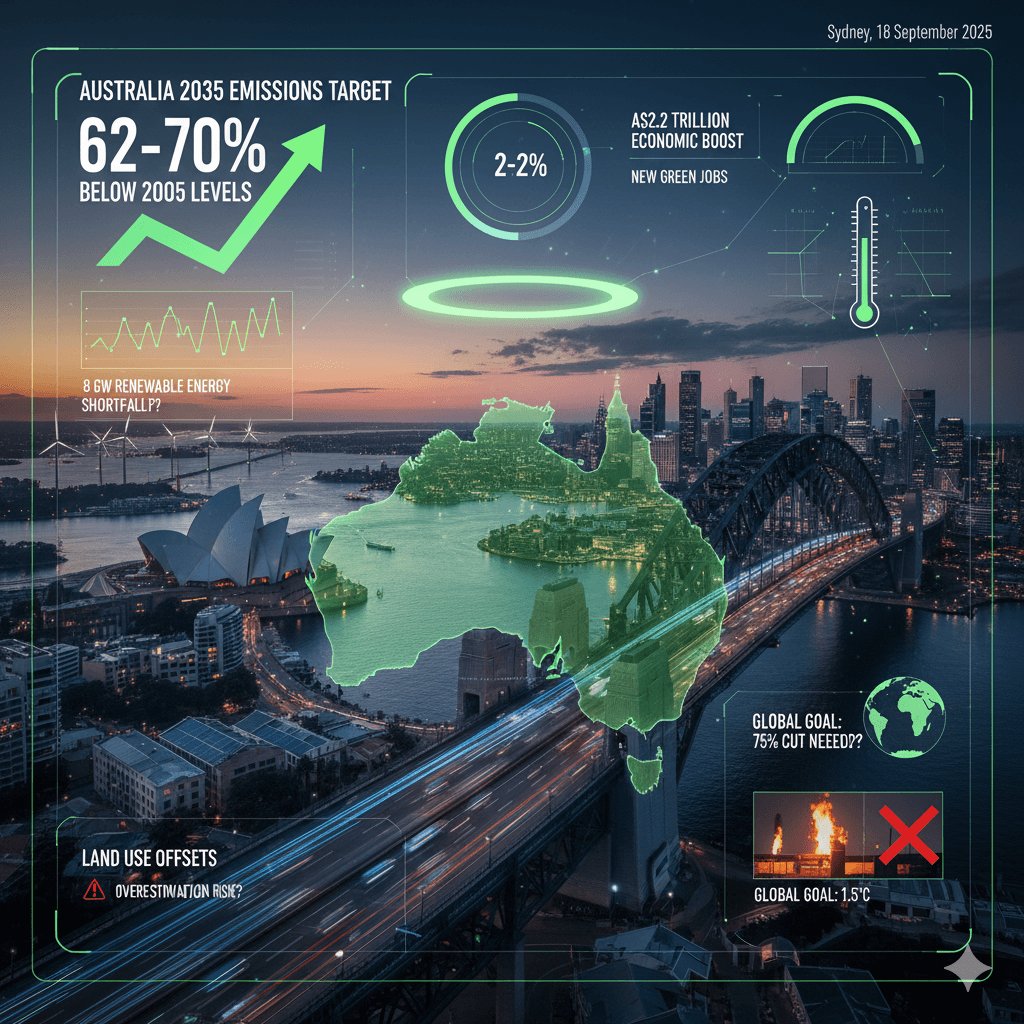
Sydney, 18 September 2025 – The Australian government has unveiled a bold new plan to slash greenhouse gas emissions by 62–70% below 2005 levels by 2035, surpassing its previous 43% target for 2030. Announced by Prime Minister Anthony Albanese, the target aligns with advice from the Climate Change Authority and aims to position Australia as a renewable energy leader while achieving net zero by 2050. The move has sparked both praise and scepticism across the nation.
Economic Boost or Overpromise?
The government claims the transition could grow Australia’s economy by A$2.2 trillion (US$1.4 trillion) by 2050, driven by jobs in renewables, transport, and agriculture. Treasurer Jim Chalmers has hailed it as a “huge economic opportunity,” backed by Treasury modelling. However, critics point to a projected 8 GW shortfall in renewable energy projects, as noted by the Climate Change Authority, raising doubts about the feasibility of this economic uplift.
Concerns Over Land Use Offsets
A key concern is the reliance on land use offsets, which a 2023 Nature Climate Change study suggests overestimating carbon sequestration by up to 30%. Environmental groups argue this could weaken the target’s integrity, while the opposition, led by Sussan Ley, has labelled it “lacking credibility” and warned of potential job losses in major industries. The debate intensifies as historical data revisions highlight shifts in emissions accounting.
Global Context and Local Challenges
The target aligns with Australia’s Paris Agreement obligations, with Albanese set to confirm it at the UN General Assembly later this month. Yet, the IPCC’s 2021 report and recent Climate Action Tracker analysis suggest a 75% cut may be needed to limit warming to 1.5°C, putting pressure on the government to go further. Meanwhile, the approval of fossil fuel projects like Woodside’s North West Shelf has drawn condemnation from the Greens, who call it a “betrayal” of climate goals.
Community and Political Divide
Public reaction is mixed, with support from renewable energy advocates countered by fears of rising costs and industrial shutdowns. Independent senator David Pocock has urged stronger action, while opposition figures like Craig Kelly dismiss it as a “political stunt” that could leave Australians poorer. As the nation grapples with this landmark decision, the path to net zero remains a contentious battleground.