
October 6 2025 | Sydney, Australia
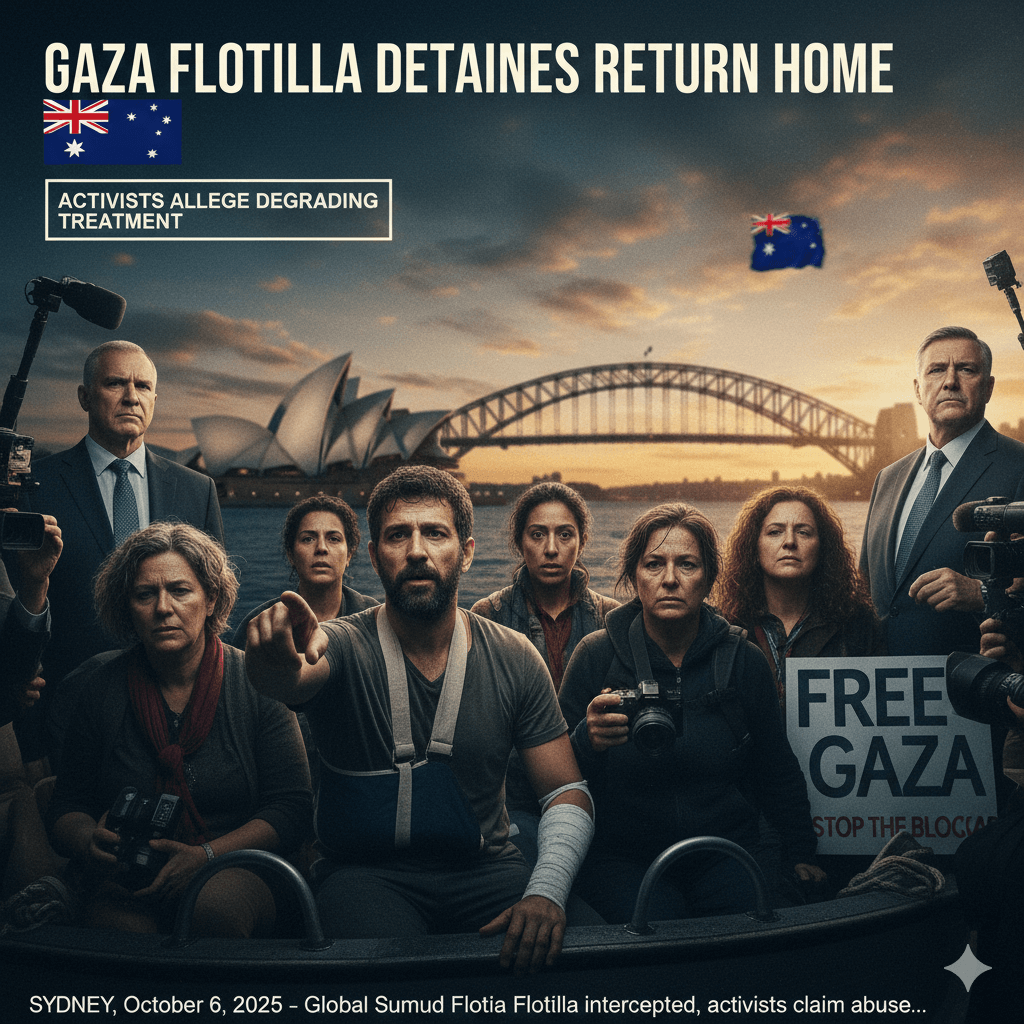
Seven Australians Detained After Flotilla Interception
Seven Australian citizens detained by Israeli forces following the interception of a Gaza-bound flotilla are alleging “degrading and humiliating treatment” while in custody.
The Global Sumud Flotilla — a 42-vessel humanitarian convoy carrying over 450 international participants — was stopped by the Israeli Navy on October 2, roughly 40 nautical miles off the coast of Gaza. The convoy aimed to deliver medical supplies and water filters in defiance of Israel’s blockade on Gaza, in place since 2007.
Among those detained was Surya McEwen, a 40-year-old care worker from New South Wales. McEwen claims Israeli soldiers slapped him, dislocated his arm, and slammed his head into the ground during the boarding operation.
“They treated us like criminals, not humanitarians,” McEwen said in a phone interview with ABC News after his release. “We were there to bring clean water filters — nothing more.”
Another detainee, documentary filmmaker Margaret Lamont, described conditions in the Negev desert detention centre as “inhumane,” alleging limited drinking water and 24-hour light exposure.
Australia’s Department of Foreign Affairs and Trade (DFAT) confirmed that consular staff have met with detainees and are “providing assistance in line with standard protocols.”
Global and Domestic Fallout
The flotilla’s interception has reignited long-running debates about Israel’s blockade policy and the legality of seizing vessels in international waters. Humanitarian organisations such as Amnesty International and Human Rights Watch have criticised Israel’s enforcement of the blockade, arguing it constitutes collective punishment.
According to the United Nations Office for the Coordination of Humanitarian Affairs (OCHA), the blockade continues to restrict essential goods entering Gaza, with infrastructure reconstruction lagging years behind targets. (UN OCHA, 2025)
In Australia, protests broke out in Sydney and Melbourne, organised by the Global Movement to Gaza Australia (GMGA), demanding the activists’ release. GMGA spokesperson Dr Layla Abdullah told The Guardian that McEwen and others have been denied proper medical care.
“Surya’s shoulder injury is serious — he’s on pain medication that Israel refuses to provide,” Abdullah said. “We call on Canberra to act immediately.”
The Australian Greens echoed those calls in Parliament, urging Foreign Minister Penny Wong to lodge a diplomatic protest.
Meanwhile, pro-Israel groups in Australia defended Israel’s security right to intercept vessels attempting to breach its naval cordon. AIJAC (Australia/Israel & Jewish Affairs Council) executive director Colin Rubenstein stated:
“While humanitarian motives are understandable, these flotillas have repeatedly been used by activists to delegitimise Israel’s right to self-defence.”
Inside the Blockade: A 15-Year Policy Under Fire
Israel’s blockade of Gaza — implemented in 2007 following Hamas’ takeover of the territory — has been condemned by the UN Human Rights Council and Red Cross as a major humanitarian constraint. Israel maintains it is necessary to prevent weapons smuggling and protect its citizens from rocket fire.
Over the years, several flotillas — including the deadly Mavi Marmara incident in 2010 — have attempted to challenge the blockade. The Global Sumud Flotilla 2025 is the largest coordinated attempt since that event.
A report by The Guardian noted that several vessels carried independent journalists and climate activist Greta Thunberg, who joined remotely for solidarity broadcasts.
Case Study: Humanitarian Maritime Aid and International Law
A 2024 case study by the University of Sydney Centre for International Law found that humanitarian flotillas occupy a legal grey area under maritime law. While delivering aid to blockaded regions is permitted under Article 70 of Protocol I of the Geneva Conventions, the aid must be coordinated with the controlling power to ensure security.
The report concluded that Israel’s practice of boarding ships in international waters “pushes the boundaries of lawful enforcement.” However, it also noted that unapproved aid convoys “risk escalation and misinterpretation of intent.”
Canberra’s Diplomatic Balancing Act
DFAT continues to walk a diplomatic tightrope. Australia is one of Israel’s longest-standing allies, yet has repeatedly supported UN resolutions calling for “unhindered humanitarian access to Gaza.”
In a statement on October 5, 2025, Foreign Minister Penny Wong said:
“We are deeply concerned by reports of mistreatment. The Australian Government has conveyed our expectations that all detainees be treated humanely and in line with international law.”
The Israeli Embassy in Canberra responded, saying the activists were “safely detained after deliberately attempting to violate a lawful naval blockade.”
Expert Analysis: Trust, Transparency, and the Media Narrative
Dr Omar Levent, international relations expert at the Australian National University, said the controversy highlights Australia’s growing role in global human-rights diplomacy.
“This isn’t just about Gaza — it’s about the optics of humanitarian activism and the credibility of Western democracies in addressing human-rights abuses universally,” Levent told The Conversation.
He added that social media has amplified emotional responses while often ignoring international law nuances.
Looking Ahead
The fate of the detainees remains uncertain. Israeli courts are expected to decide within days whether to deport them or pursue legal charges. DFAT confirmed all Australians are safe and receiving assistance, but advocacy groups have vowed to continue campaigning until their release.
As the dust settles, the Global Sumud Flotilla controversy underscores the enduring tensions between humanitarian intent, security imperatives, and international diplomacy — a triad that continues to define Australia’s role on the world stage.