October 26, 2025 | Sydney, Australia
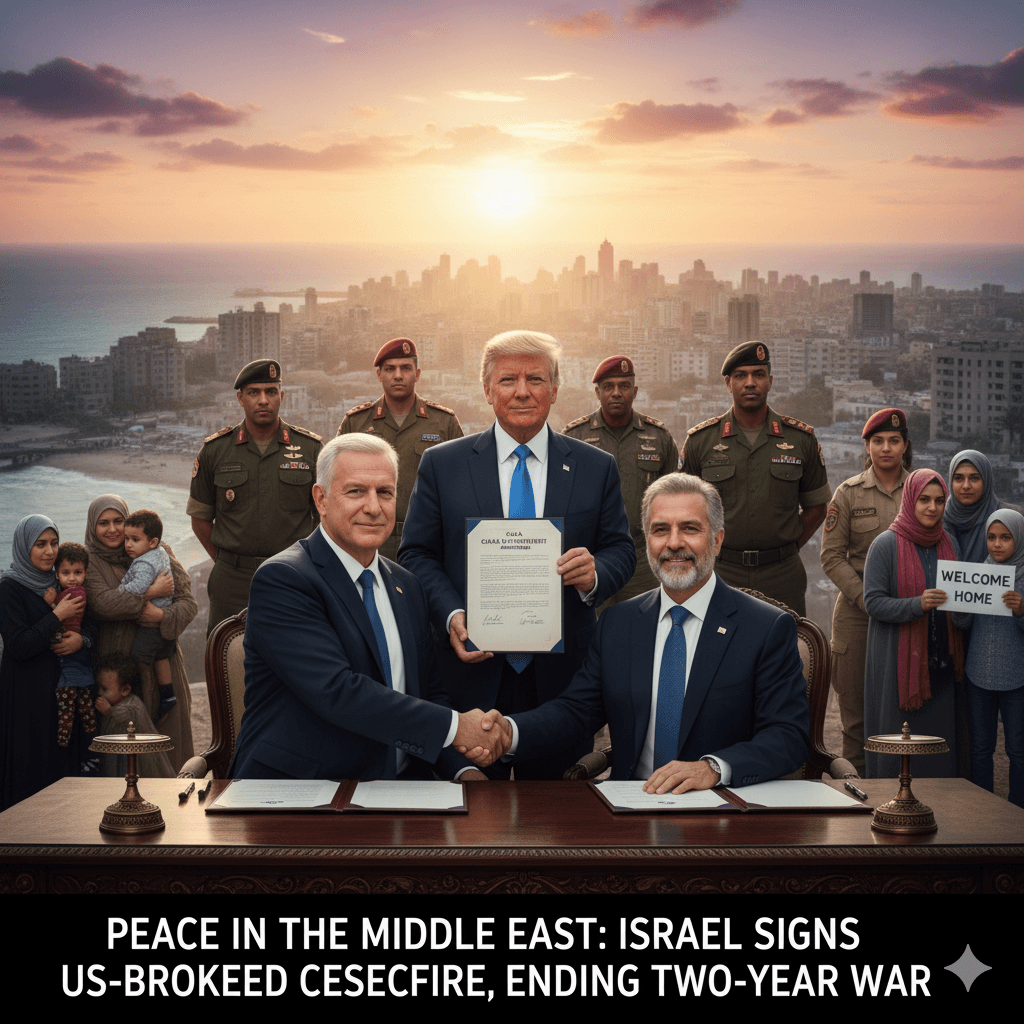
In a landmark development for Middle East diplomacy, Israel has formally signed a US-brokered peace accord under Donald Trump’s 20-point Gaza peace plan, paving the way for an anticipated ceasefire in the Gaza Strip scheduled to begin around midday Saturday (Australian time). After two years of intense conflict that left wide-scale destruction and heavy civilian casualties, the agreement offers a tangible glimmer of hope for relief and lasting peace.
According to multiple reports, under the terms of the deal, the militant group Hamas has 72 hours to release all remaining hostages still held in Gaza. In exchange, Israel will proceed to release hundreds of Palestinian prisoners and detainees. A key component of the deal is the establishment of a multinational oversight force to monitor the ceasefire and support eventual reconstruction and governance reforms.
Power of the Deal: Hostage Exchange & Multinational Oversight
One of the most tangible aspects of the agreement is the hostage-detainee exchange. Sources point to a commitment by Hamas to release living captives and provide the remains of deceased hostages. In turn, Israel will free hundreds of Palestinian prisoners — a gesture aimed at breaking the cycle of retaliation and establishing trust.
Complementing this, the deal calls for deployment of up to 200 US servicemembers from U.S. Central Command (CENTCOM) to Israel. These troops, composed of planners, logisticians and support specialists rather than frontline infantry, will operate from a coordination centre in southern Israel alongside personnel from Egypt, Qatar, Turkey and the United Arab Emirates. The objective: ensure the ceasefire holds, channel humanitarian and reconstruction aid, and lay the foundations for a governance transition in Gaza. According to an Associated Press report, the US is indeed deploying some 200 troops to support the deal. AP News+1
Governance Reform and Reconstruction in Gaza
Beyond the initial ceasefire, the deal outlines a vision for Gaza’s future: Palestinian technocrats will take over daily governance functions under international oversight, while Israel gradually withdraws and remains on standby. The governance model reflects a hybrid structure: stability through local administrative control, with external monitoring to ensure transparency and avoid a vacuum of power. According to The Times of Israel, this model remains under negotiation, with key regional stakeholders weighing in. The Times of Israel+1
Challenges remain significant. Hamas’ disarmament remains unresolved, and Israel retains concerns over security, territory and the role of the Palestinian Authority. The coming weeks will test whether the framework holds.
Case Study: Monitoring Mechanisms in Action
A recent case study of the newly established Civil-Military Coordination Centre (CMCC) in Kiryat Gat—managed by US and partner troops—demonstrates the hands-on implementation of the peace deal. According to a report, the CMCC is staffed with multi-national liaison officers coordinating humanitarian flows, monitoring UAV/drone reconnaissance flights over Gaza and liaising with Israeli forces.
This model echoes other multinational stabilization efforts in conflict zones (e.g., Bosnia, Kosovo) where coordinating civilian and military agents proved crucial in transitioning from war to peace. It underscores a broader lesson: hybrid civil-military frameworks often deliver better post-conflict outcomes than purely military interventions.
Expert Insight: Will It Hold?
Dr. Amira Khan, a senior researcher at the Sydney-based Institute for Peace & Conflict Studies, offers a measured view:
“The structural components of this deal—hostage exchange, oversight mission, governance reform—check many boxes. But the risk lies in realisation: whether parties adhere, how aid flows, and whether security assurances hold. The presence of multinational monitors improves the odds, but implementation is key.”
Given that past agreements have faltered due to delayed follow-through or lack of verification, the emphasis now shifts from signing to sustaining.
International & Regional Reactions
Across the globe, the signing drew both optimism and cautious reception. In the US, the Trump administration hailed the deal as a major foreign-policy victory. In the region, Egypt, Qatar and the UAE welcomed the transition-governance component, seeing it as an opportunity to stabilise Gaza and limit Hamas’ independent power. In Israel, Prime Minister Benjamin Netanyahu framed the agreement as consistent with national security interests, while asserting no compromise on Israel’s core defence prerogatives.
For Australian audiences, the news draws attention to Canberra’s potential role in future regional peacekeeping or humanitarian missions. The cost-benefit calculation of engagement in the Middle East is under renewed scrutiny.
Looking Ahead: Risks and Opportunities
While the ceasefire is set to begin imminently, multiple risk vectors remain:
- Hostage/detainee exchanges: Failure or delays could undermine trust.
- Hamas disarmament: Without clear steps, the underlying threat persists.
- Aid and reconstruction: Bottlenecks could reignite civilian hardship and resentment.
- Governance transition: Establishing technocratic rule may be resisted by entrenched actors.
On the other hand, if successful, this peace deal could serve as a blueprint for future Middle East stabilization—demonstrating how multinational coordination, civilian oversight and phased implementation can work in tandem.