

For a small business, a construction project does not have to close your doors to cause damage.
A road can remain technically open while customers stop coming. Parking can become less convenient. A footpath can feel different. Signage can become harder to see. Delivery drivers can start taking longer routes. Customers who used to walk past your shop every morning may simply stop noticing it.
That is the practical issue behind the growing interest in Parramatta Light Rail Stage 2, small business grants Sydney, Sydney transit construction and business disruption support NSW.
The Parramatta Light Rail Stage 2 project will connect Parramatta and the existing Stage 1 network with communities including Camellia, Rydalmere, Ermington, Melrose Park and Wentworth Point before reaching Sydney Olympic Park and the Carter Street precinct. The project is planned as approximately 10 kilometres of new two-way track with 14 stops. (NSW Government)
The project is being delivered in phases. Enabling works, including major bridge construction, have already commenced, while the NSW Government announced in January 2026 that construction of Stage 2a would move towards main construction, covering the Camellia-to-Wentworth Point section. (NSW Government)
For local operators, the question is not simply, “Will the light rail be good for Sydney?”
The more useful question is:
What should my business do now if construction is affecting access, visibility, customer behaviour or revenue?
1. What Parramatta Light Rail Stage 2 means for local businesses
Parramatta Light Rail Stage 2 is a major transport project rather than a single street upgrade. The official route includes Parramatta, Camellia, Rydalmere, Ermington, Melrose Park, Wentworth Point, Sydney Olympic Park and Carter Street. (NSW Government)
The project includes new stops, bridge infrastructure, active transport connections, public-domain works and related facilities. Stage 2 is also intended to connect with existing rail, future Sydney Metro West infrastructure and ferry services. (NSW Government)
For businesses, that creates two very different periods.
The construction period can create friction.
The completed transport network can create new customer opportunities.
The mistake is to think only about the second phase.
A café in Camellia, a retailer near an affected access route, a service business in Parramatta or an operator serving customers travelling through Sydney Olympic Park may need to manage the construction period first.
2. Why construction can cause loss of foot traffic even when your doors stay open
The biggest mistake a small business can make during major construction is measuring disruption only by whether the premises are technically accessible.
Customers do not think like a construction manager.
They think:
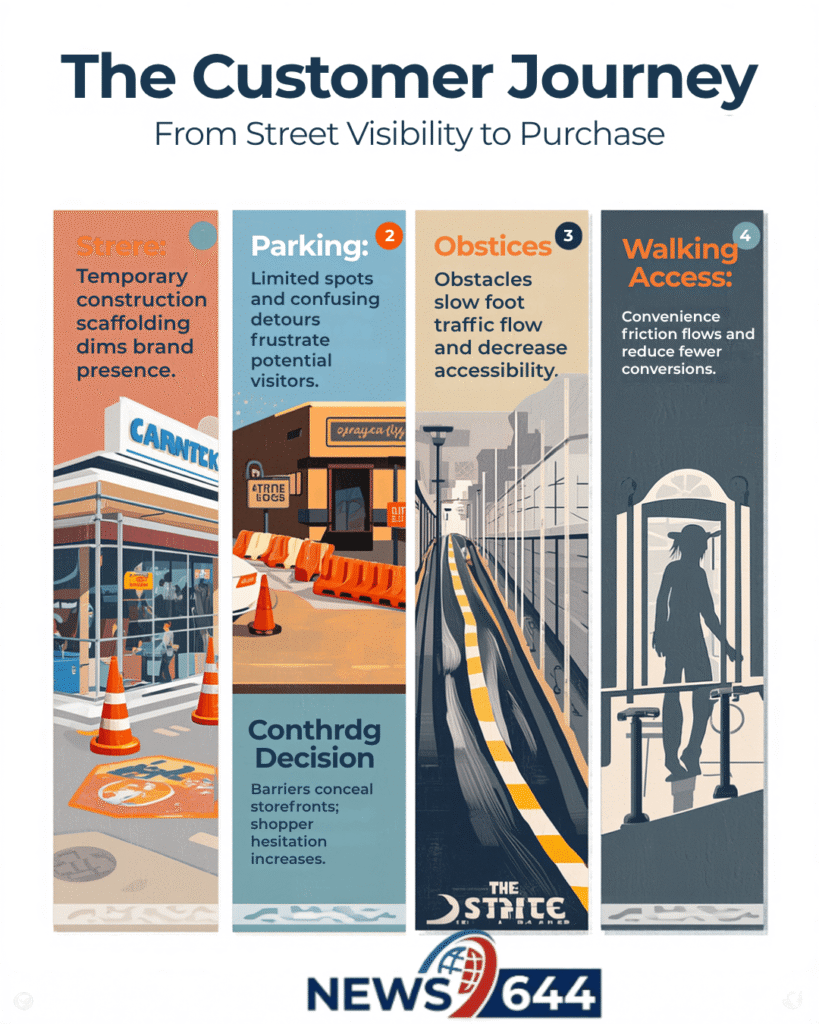
“Is parking easy?”
“Can I still turn into that street?”
“Can I see the shop?”
“Do I have to walk around barriers?”
“Will delivery be difficult?”
“Is there an easier business nearby?”
That means loss of foot traffic can happen before an official closure occurs.
A business may remain open while its trading environment changes dramatically.
Consider a Parramatta café located close to a busy pedestrian route. If temporary barriers move the natural walking path, the café may experience fewer spontaneous visits.
A Camellia retailer may remain open but lose drive-by visibility.
A professional service in Olympic Park may not rely heavily on random foot traffic, but clients could still be affected by changed parking, event congestion or access routes.
A restaurant can also experience a less obvious problem: customers may still want the food but decide that reaching the venue is inconvenient.
The answer is not always a discount.
Often, the answer is reducing friction.
That may mean better signage, click-and-collect, delivery, appointment reminders, clearer Google Business Profile information, temporary parking instructions, stronger local search visibility and direct customer communication.
3. What Parramatta businesses should watch during Stage 2
Not every business will experience the same level or type of impact.
That matters.
A construction project can produce highly localised disruption. One street may experience major works while another nearby business sees little direct impact.
Businesses should therefore monitor their own trading conditions instead of relying on broad assumptions about the whole suburb.
For operators around Parramatta, watch changes in pedestrian movement, road access, parking, loading areas, signage and visibility.
For businesses around Camellia, track changes associated with the Stage 2 route, major works, transport interfaces and customer movement around the precinct.
For businesses serving Sydney Olympic Park, pay attention to customer access, event-day movement, pedestrian connections, major destinations and changes in the surrounding transport network.
The official project information identifies a planned shared light rail and pedestrian zone along Dawn Fraser Avenue in Sydney Olympic Park, together with connections to major employment, entertainment and event destinations. (NSW Government)
That means the eventual customer environment may look quite different from the construction environment.
But businesses have to survive the transition first.
4. Small Business Grants Sydney: what help is actually available?
Searches for small business grants Sydney can create unrealistic expectations.
A grant listed online is not automatically available to every business affected by construction.
Eligibility can depend on location, business type, turnover, project purpose, the nature of the disruption and the specific funding program.
The NSW Government’s current business-grants portal directs operators to NSW and Australian Government grants, rebates, vouchers and other financial assistance programs, including funding finders and tailored business support. (Service NSW)
That makes the funding search itself part of the business strategy.
A crucial distinction for Parramatta operators
At the time of writing, the NSW Government’s specifically named Great Western Highway Closure Small Business Support Grant provides up to $25,000 or $10,000 depending on eligible location, but its eligibility is tied to specified regional NSW locations affected by the Great Western Highway closure. It is not a Parramatta Light Rail Stage 2 grant and should not be presented as one. (NSW Government)
This is exactly why businesses should check current eligibility before assuming that any “small business disruption grant” applies to Parramatta, Camellia or Olympic Park.
For Parramatta businesses, City of Parramatta also provides business programs, mentoring, workshops and support resources, including links to NSW Government funding information. (City of Parramatta)
The Council’s current Small Business Program includes practical business-development sessions, while its Business Concierge service is scheduled to provide face-to-face support from October 2026 through May 2027 in partnership with the Service NSW Business Bureau. (City of Parramatta)
That kind of assistance may be useful even where a business does not qualify for a direct cash grant.
5. Grants, support and compensation are three different things
This distinction can save a business owner a great deal of time.
Grants
A grant is usually a program with defined eligibility and an approved purpose.
The business may need to prove location, turnover, operating status, financial impact or project outcomes.
Business support
Support can include mentoring, advisory services, workshops, business concierge assistance, funding guidance and help understanding government processes.
The NSW Government specifically directs businesses affected by government infrastructure projects toward the Service NSW Business Concierge and the NSW Small Business Commission for support and advice. (NSW Government)
Compensation
Compensation is different.
Where government acquires private property for a public purpose, NSW has a statutory framework under the Land Acquisition (Just Terms Compensation) Act 1991. Government guidance explains that compensation can involve matters including market value, severance and disturbance, depending on the circumstances of the acquisition. (NSW Government)
The NSW Government also publishes a specific guide on compensation following acquisition of a business. (NSW Government)
That does not mean every business that experiences lower sales because of roadworks automatically has a compensation claim.
That is one of the most important points in this entire article.
A business should establish exactly what legal or program pathway applies to its situation before treating reduced turnover as a guaranteed entitlement.
6. How to build evidence for a construction disruption claim
This is where many small businesses fall short.
They know sales are down.
They cannot prove why.
A stronger approach is to create a construction impact file.
Start recording conditions before the disruption becomes severe.
Track:
- Daily or weekly revenue
- Number of transactions
- Average transaction value
- Customer enquiries
- Cancelled bookings
- Delivery delays
- Parking changes
- Pedestrian access changes
- Photos of barriers and signage
- Dates of major work
- Changes to opening conditions
- Customer comments mentioning access problems
- Additional advertising or delivery costs
- Temporary signage expenses
- Staff time spent managing the disruption
The goal is not to manufacture a claim.
The goal is to establish a reliable factual record.
Suppose your revenue fell by 22 per cent.
That figure alone does not establish causation.
But if you can show that revenue was stable for several comparable periods, then access changed, customer complaints about parking increased, transaction volumes dropped and the reduction aligns with documented project activity, you have a much clearer operational record.
That record can also help when speaking with your accountant, insurer, business adviser, council or relevant government agency.
7. How to approach government construction compensation claims
The phrase government construction compensation claims can cover very different circumstances.
Before submitting anything, identify the underlying issue.
Situation A: Your property is being acquired
This is potentially a property-acquisition matter.
NSW Government guidance says acquiring authorities may acquire whole or partial property interests for public purposes and that the Just Terms framework governs relevant acquisition and compensation processes. (NSW Government)
Situation B: Your business is affected but no property is being acquired
This is more complicated.
Do not assume that a reduction in foot traffic creates an automatic statutory compensation payment.
Instead, identify whether the relevant project has specific business mitigation, engagement, access or support arrangements.
NSW parliamentary material published in July 2026 notes that requirements to manage small-business impacts can be included in individual major project approvals, depending on the specific project. (Parliament of NSW)
Situation C: You believe the disruption results from a specific government decision, access restriction or property action
Document the exact event.
Avoid writing a broad complaint such as:
“Construction destroyed my business.”
Write something more useful:
“Temporary access restrictions commenced on 4 September. Customer parking capacity reduced from X to Y. Average weekly transactions declined from A to B over the following four weeks.”
Facts travel further than emotion.
8. What Parramatta businesses can do about declining foot traffic
Waiting for customers to return on their own is risky.
A better approach is to make the business easier to find, easier to reach and easier to buy from.
Keep Google Business Profile information current
Update customers with:
- temporary access instructions
- parking information
- opening hours
- photos showing how to enter
- current phone number
- delivery or collection options
If the normal entrance has changed, show customers the new route visually.
Make local search work harder
Build pages and posts around real customer questions such as:
“Is this café open during Parramatta construction?”
“Where can I park near this business?”
“How do I reach this shop from Parramatta Station?”
“Is this business accessible from Camellia?”
“Where can I collect my order near Sydney Olympic Park?”
These are useful because they respond to real friction.
Give existing customers a reason to return
Instead of relying entirely on new traffic, increase repeat visits.
Examples include:
- loyalty offers
- pre-ordering
- click-and-collect
- appointment reminders
- local email campaigns
- SMS updates
- neighbourhood partnerships
- delivery zones
- corporate catering
- business-to-business offers
9. Sydney transit construction: turn disruption into a digital operations project
Construction is physical.
Your response does not have to be.
A small café or retailer can use simple digital tools to keep customers informed without hiring an expensive technology team.
For example, create one central “Access During Construction” page.
Put the following on it:
We are open.
How to reach us: step-by-step instructions.
Parking: current information.
Public transport: nearest practical route.
Delivery: available areas and ordering method.
Construction update: last verified date.
Contact us: phone and online ordering.
Then link to this page from your Google Business Profile, website, social pages and email campaigns.
That creates one source of truth.
AI can also help with the repetitive work.
For example, a business owner could use AI tools to:
- turn customer questions into FAQs
- draft weekly access updates
- create social captions
- organise reviews
- prepare customer-service responses
- summarise sales data
- identify repeated complaints
- create content variations for local searches
The key is not to hand over business decisions blindly.
Use AI for repetitive administrative work while a person checks important information before it reaches customers.
10. A 30-day action plan for businesses around Parramatta and Olympic Park
Days 1–7: Establish the baseline
Record your current:
- weekly revenue
- transactions
- customer sources
- busiest periods
- parking conditions
- customer complaints
- access arrangements
Photograph the normal customer journey.
Days 8–14: Build your disruption file
Start recording:
- project activity
- access changes
- traffic changes
- parking changes
- barriers
- signage
- noise or delivery problems
- customer comments
- lost bookings
Keep everything dated.
Days 15–21: Reduce customer friction
Update:
- Google Business Profile
- website
- directions
- parking instructions
- booking confirmations
- social media profiles
- email messages
- delivery instructions
Days 22–30: Review funding and support pathways
Check current NSW and Australian Government funding tools.
Do not search only for the word “grant”.
Also search for:
business support
small business advisory
rebates
business resilience
infrastructure support
local business programs
business concierge
The NSW Government’s infrastructure-business support guidance specifically points operators toward Business Concierge and Small Business Commission resources when government infrastructure projects affect trading conditions. (NSW Government)
The City of Parramatta currently provides business programs, workshops, mentoring and business support resources for local businesses. (City of Parramatta)
11. A practical document pack every affected business should maintain
Create one folder on your computer or cloud storage.
Call it:
Construction Business Impact – 2026/2027
Inside it, keep:
Folder 1 — Financial evidence
Monthly reports, BAS records, sales summaries and transaction data.
Folder 2 — Construction evidence
Photos, notices, project updates and dated observations.
Folder 3 — Customer impact
Complaints, cancelled bookings, emails and messages mentioning access or construction.
Folder 4 — Additional costs
Signage, advertising, delivery, temporary staffing or other documented expenses.
Folder 5 — Government correspondence
Emails, reference numbers, application documents and responses.
Folder 6 — Professional advice
Accountant, solicitor, valuer or business adviser correspondence.
This approach also makes your business more resilient generally.
You are building an audit trail rather than scrambling for paperwork after a problem becomes serious.
12. What should businesses in Camellia and Sydney Olympic Park do differently?
Location matters.
Camellia businesses should pay close attention to the sections of the project connecting into the Stage 2 route and the interface with existing transport infrastructure.
The official project documentation identifies Camellia as the Stage 2 connection point and describes a future active-transport bridge linking Camellia and Rydalmere as part of Stage 2a. (NSW Government)
For Olympic Park businesses, the opportunity and challenge look slightly different.
Sydney Olympic Park contains major event, entertainment and employment destinations. The Stage 2 plan includes a shared light rail and pedestrian zone along Dawn Fraser Avenue as well as connections to major event infrastructure. (NSW Government)
Businesses operating in that environment should think beyond ordinary weekday foot traffic.
The customer may be:
- an event attendee
- a commuter
- a local resident
- an office worker
- a visitor
- a family
- a contractor
- a student
- a hospitality customer
Each audience may react differently to construction.
That makes customer segmentation more useful than simply saying “sales are down.”
Frequently Asked Questions
Is Parramatta Light Rail Stage 2 already under construction?
Enabling works and major bridge-related construction have already commenced. The NSW Government has also announced progress towards Stage 2a main construction between Camellia and Wentworth Point. (NSW Government)
Will every Parramatta business receive compensation for reduced foot traffic?
Not automatically.
A reduction in customer numbers does not, by itself, establish a statutory compensation entitlement. The applicable pathway depends on the circumstances, including whether property is acquired and whether the relevant project includes specific business-impact mitigation or support arrangements. (NSW Government)
Are there small business grants Sydney businesses can use?
There are NSW and Australian Government funding and assistance programs, but eligibility varies considerably. Service NSW maintains a current grants and financial-assistance directory. (Service NSW)
Businesses should check the exact location and program criteria before applying.
Is the Great Western Highway Small Business Support Grant available to Parramatta businesses?
The currently published program is targeted at specified locations affected by the Great Western Highway closure and is not a Parramatta Light Rail Stage 2 program. (NSW Government)
Where can Parramatta businesses get business support?
City of Parramatta provides business programs, events, mentoring and support resources. Its Business Concierge service is scheduled to provide in-person assistance at Parramatta Library from October 2026. (City of Parramatta)
What evidence should I keep if construction reduces my revenue?
Keep dated financial records, construction photos, customer complaints, access notices, parking changes, additional expenses and correspondence with relevant agencies.
Should I hire a lawyer immediately?
Not every disruption requires legal advice.
However, where property acquisition, statutory compensation, contractual issues or a significant financial dispute is involved, obtaining independent professional advice can help clarify the correct pathway.
What is the biggest mistake businesses make during construction?
Treating the problem as temporary and waiting for customers to adjust.
The better approach is to measure the impact, document it and actively remove customer friction.
Final Takeaway
For businesses in Parramatta, Camellia and Sydney Olympic Park, the Parramatta Light Rail Stage 2 era is likely to involve both disruption and long-term changes in how people move through the area.
The practical priority is not to predict exactly how every business will be affected.
It is to prepare for measurable changes in access, visibility, parking, customer behaviour and operating costs.
That means:
Measure the baseline.
Document disruption.
Check the correct support pathway.
Do not confuse grants with compensation.
Keep customers informed.
Strengthen local digital visibility.
Reduce dependence on spontaneous foot traffic.
Review current government support before assuming a program applies.
The NSW Government’s own infrastructure-support guidance directs businesses affected by infrastructure projects towards business concierge and Small Business Commission resources, while NSW property-acquisition guidance provides separate rules where land or business interests are acquired. (NSW Government)
For a small business owner, good preparation can turn a vague problem — “construction is hurting my business” — into a documented business case with clear evidence, practical mitigation steps and a much better understanding of which support pathway actually applies.