Sydney | September 19, 2025
A Bold Campaign Dividing the Australian Jewish Community
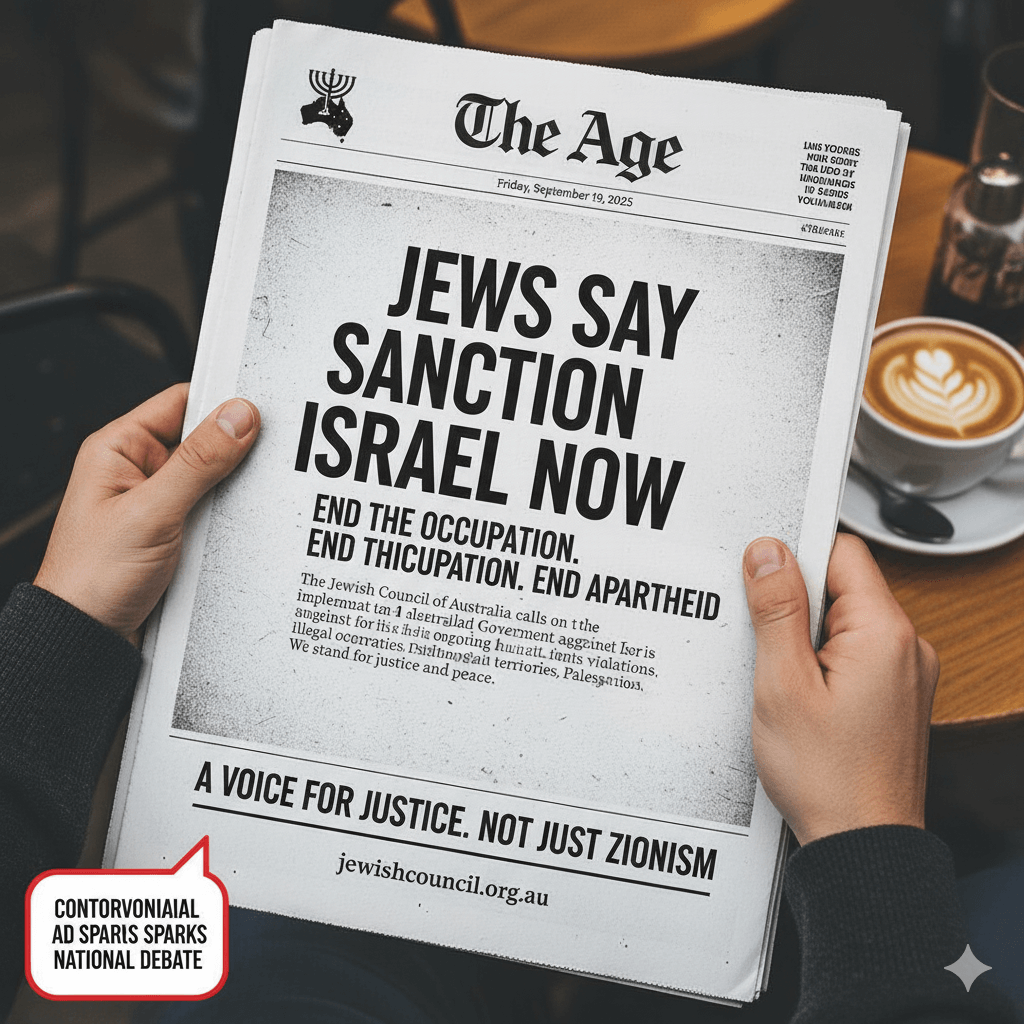
SYDNEY, AUSTRALIA — A bold new advertising campaign launched by the Jewish Council of Australia (JCA) has ignited a heated national debate over Israel, Jewish identity, and human rights advocacy.
The campaign, first reported by Haaretz on September 19, 2025, features striking full-page ads in The Age and The Sydney Morning Herald with the headline:
“Jews Say: Sanction Israel Now.”
The ads, funded through grassroots donations, call for targeted sanctions against Israeli officials and institutions accused of human rights violations in Gaza. The move — unprecedented in Australia’s Jewish community — reflects what the council’s leaders describe as a “moral and political awakening.”
The Jewish Council of Australia, co-led by Sarah Schwartz, a Melbourne-based human rights lawyer, and Dr. Max Kaiser, a historian at the University of Melbourne, identifies itself as “non-Zionist” and advocates for peaceful accountability rather than unconditional support for the Israeli government.
“Our campaign is not anti-Israel — it’s pro-justice,” said Schwartz in a statement. “As Jews, we cannot be silent when human rights are violated, regardless of who commits them.”
Community Backlash and Institutional Pushback
The Executive Council of Australian Jewry (ECAJ) — the country’s peak Jewish representative body — swiftly condemned the ads as “unconscionable” and “deeply divisive.”
In a public response, ECAJ Co-CEO Peter Wertheim argued the campaign “weaponises Jewish identity for partisan activism” and risks inflaming antisemitism in the broader community.
“At a time when antisemitism is rising globally, calling for sanctions against the Jewish state is reckless,” Wertheim told ABC News Australia on Saturday.
The ECAJ maintains that Israel’s right to self-defence remains paramount, and it continues to back a two-state solution grounded in direct negotiations rather than punitive measures.
However, several Jewish academics and young activists have defended the council’s campaign as a legitimate expression of dissent.
Dr. Jordana Silverstein, an expert on Jewish diaspora politics at the University of Melbourne, noted:
“This campaign represents a generational shift. Younger Jews are increasingly uncomfortable with blanket support for the Israeli government.”
Global Context: Sanctions and Accountability Momentum
The Australian debate echoes broader international trends in human rights diplomacy.
In February 2024, the United Kingdom imposed sanctions on four extremist Israeli settlers for violence against Palestinians — a move backed by both Canada and the European Union. Meanwhile, in September 2025, the United States Treasury designated three NGOs linked to the International Criminal Court’s (ICC) investigations into Israel, accusing them of funding bias.
Legal experts see the Jewish Council’s campaign as part of a growing transnational movement advocating conditional engagement — supporting Israel’s existence while calling for accountability mechanisms under international law.
Professor Don Rothwell, an expert in international law at the Australian National University, told The Conversation:
“Sanctions don’t necessarily target a country; they target specific behaviours. When Jewish groups endorse them, it reflects a moral reckoning within the diaspora about how justice and identity intersect.”
Case Study: Community Division and Identity Politics
A 2023 Jewish Policy Research (JPR) survey of British Jews found that only 15% supported sanctions against Israel, with support higher among under-35s and those identifying as secular.
The Jewish Council of Australia appears to draw from similar demographic trends. Its members are largely younger professionals, academics, and social justice advocates — a contrast to more traditional Jewish institutions historically aligned with Zionist advocacy.
Dr. Max Kaiser, the group’s co-director and author of “The Jewish Radical Tradition in Australia”, argues that the campaign’s intent is to reframe Jewish moral responsibility rather than fracture communal unity.
“Jewish history teaches us to stand with the oppressed, not the oppressor,” Kaiser said. “We’re saying that loving Israel doesn’t mean defending injustice.”
However, critics within the Jewish community argue that the campaign’s slogan oversimplifies complex geopolitical realities, potentially alienating moderate voices who support Palestinian rights but oppose blanket sanctions.
Political and Public Reactions
While the Albanese government has not formally commented on the campaign, sources within the Department of Foreign Affairs and Trade (DFAT) told The Sydney Morning Herald that Canberra remains committed to “balanced diplomacy” in the Middle East.
Opposition foreign affairs spokesperson Simon Birmingham warned that the ad could “embolden extremist narratives” and urged community leaders to engage “in dialogue, not division.”
Public opinion, however, appears to be shifting. A Lowy Institute Poll (August 2025) found that 52% of Australians now support imposing sanctions on Israel if UN investigations confirm war crimes — a 14-point increase since 2022.
Expert Commentary: A Generational Turning Point
Sociologist Dr. Miriam Green from Monash University’s Centre for Jewish Studies interprets the controversy as part of a broader generational realignment in global Jewish identity politics.
“Younger Jewish Australians see justice through universalist ethics rather than nationalist loyalties,” she said. “This campaign crystallises that tension — between belonging to a people and speaking out against its government.”
The JCA’s strategy reflects a growing intersection between Jewish identity and social justice activism, linking the Israeli–Palestinian issue with wider movements such as Black Lives Matter and climate justice advocacy.