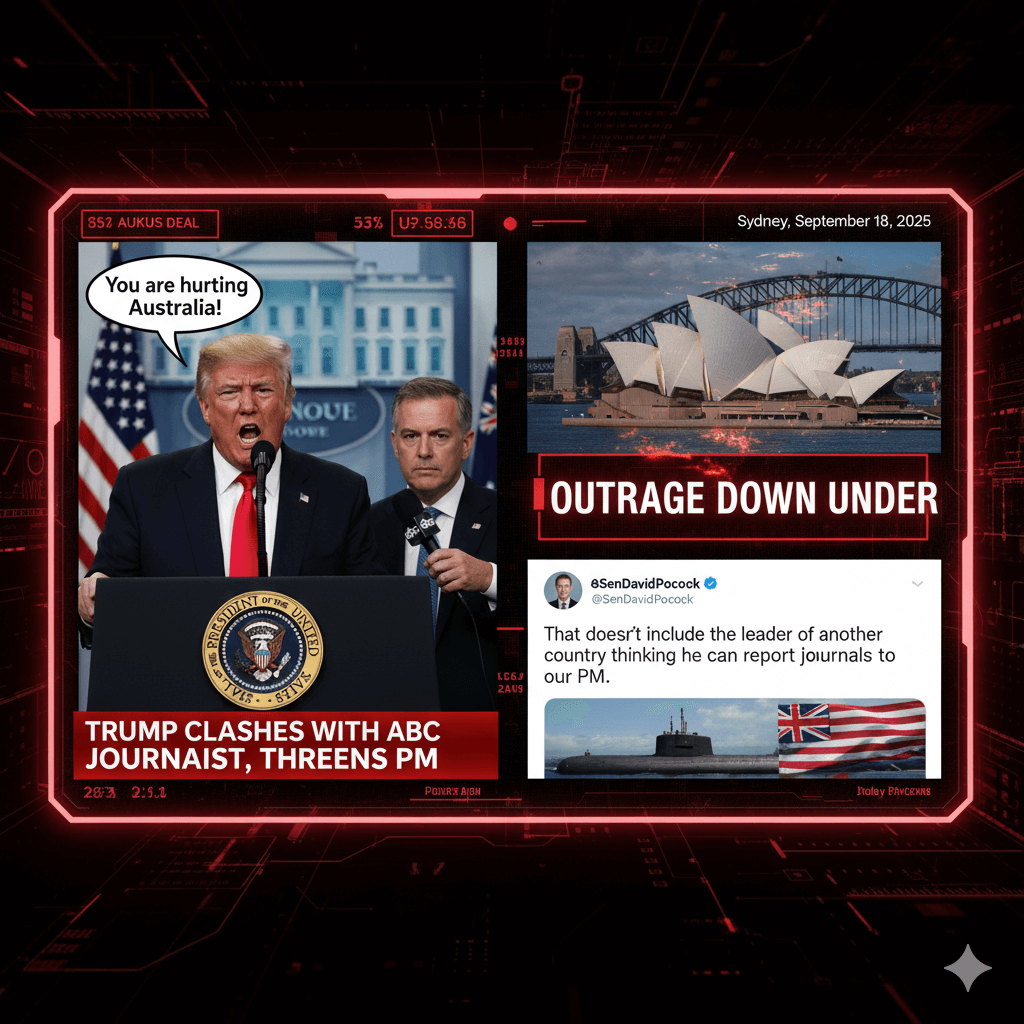
Sydney | September 18, 2025
A Diplomatic Flashpoint: Trump’s Outburst Draws Australian Ire
SYDNEY — A fiery exchange between US President Donald Trump and ABC journalist John Lyons has triggered a diplomatic stir and a national conversation about press freedom.
The confrontation, which occurred during a White House press conference on September 16, 2025, saw Trump accuse Lyons of “hurting Australia” after the reporter asked how much wealthier the president had become since returning to office.
Lyons, who serves as the ABC’s Americas Editor and a veteran of the broadcaster’s Four Corners investigative program, questioned whether Trump’s family business interests had benefitted from his second presidency. Trump deflected, insisting that “my children run the Trump Organization,” before abruptly turning on Lyons.
“In my opinion, you are hurting Australia very much right now,” Trump said, warning he would raise the issue with Prime Minister Anthony Albanese at the upcoming UN General Assembly in New York.
The moment — captured on live television — quickly went viral on social media, with the hashtag #StandWithLyons trending across X (formerly Twitter) and TikTok within hours.
Political Unity on Press Freedom
Unusually, political leaders from across Australia’s partisan divide came to Lyons’ defence.
Treasurer Jim Chalmers told reporters, “He’s just doing his job. Journalists should never be intimidated for asking legitimate questions.”
Independent Senator David Pocock weighed in on X, quipping, “Freedom of the press doesn’t include the leader of another country reporting journalists to our PM.”
Even Nationals Senator Bridget McKenzie, often a critic of the ABC, said:
“There’s nothing wrong with journalists asking tough questions — that’s democracy at work.”
The bipartisan reaction underscores how seriously Canberra takes any foreign interference — real or perceived — with Australia’s public broadcasters and democratic institutions.
ABC Defends Its Reporter
ABC News Director Justin Stevens issued a statement supporting Lyons, calling him “a highly awarded journalist and one of Australia’s most experienced international correspondents.”
Lyons, who has previously served as Middle East Correspondent and Executive Producer of Four Corners, said his questions were “perfectly normal” and consistent with the role of a public broadcaster in holding power to account.
“If a journalist asking a financial question is considered ‘hurting Australia,’ that raises serious questions about press access in the White House,” Lyons told The Sydney Morning Herald.
The ABC, long targeted by conservative figures in both the US and Australia, has often found itself navigating the fine line between diplomatic respect and journalistic independence.
AUKUS Deal Adds Tension to Diplomatic Landscape
The clash comes against the backdrop of rising friction between Canberra and Washington over the AUKUS submarine partnership, the trilateral defence pact involving Australia, the United Kingdom, and the United States.
Signed in 2021, the $368 billion AUD (approximately £176 billion) agreement is designed to provide Australia with nuclear-powered submarines by the 2040s. However, the Trump administration’s review of AUKUS has cast uncertainty over the deal’s future.
According to sources cited by Reuters and the Pentagon’s internal 2025 review, Trump’s advisers have proposed that Australia increase defence spending to 3.5% of GDP as a condition for maintaining US technical support.
Australian defence analyst Dr. Marcus Hellyer from the Australian Strategic Policy Institute (ASPI) told The Guardian Australia:
“The AUKUS deal is too big to fail, but it’s vulnerable to politics. Trump knows he can use it as leverage to extract defence concessions or trade advantages.”
Prime Minister Albanese is scheduled to meet Trump in New York next week, where the submarine pact — and now Lyons’ treatment — are expected to feature prominently in discussions.
Reactions from Washington and Canberra
At the White House, Press Secretary Marjorie Taylor Greene (newly appointed in 2025) defended Trump’s remarks, describing them as “a firm reminder that foreign journalists should respect the office of the presidency.”
Australian diplomats privately expressed concern that the episode could overshadow planned bilateral talks on Pacific security, trade, and climate cooperation.
Former Foreign Minister Julie Bishop, speaking on Sky News Australia, described Trump’s reaction as “a gross overreach,” noting that “press scrutiny is part of the price of leadership in any democracy.”
Meanwhile, academic observers have drawn parallels between the incident and earlier Trump-era clashes with journalists such as CNN’s Jim Acosta and CBS’s Weijia Jiang.
Professor Peter Greste, UNESCO Chair in Journalism and Communication at the University of Queensland, warned that Trump’s behaviour could embolden attacks on press freedom worldwide.
“When the most powerful office in the world lashes out at reporters, it sends a chilling signal that truth-seeking is expendable,” he said.
Case Study: Australia’s Press Freedom Landscape
Australia’s press freedom ranking has fluctuated in recent years. According to Reporters Without Borders (RSF), Australia ranks 39th globally in 2025, down from 26th in 2020, largely due to government secrecy laws and whistleblower prosecutions.
The Lyons–Trump confrontation, though international, has reignited domestic debate over the role of the ABC and the need for stronger protections for journalists.
In 2019, the AFP raids on ABC headquarters over leaked defence documents prompted widespread outrage — an episode that remains fresh in public memory.
As Media Watch host Paul Barry noted this week:
“This isn’t just about one question in Washington — it’s about how much political power can be used to silence journalists everywhere.”
Public Reaction and Social Media Trends
Public reaction has been swift and polarised.
Polls conducted by Essential Media on September 17 show that 67% of Australians support Lyons’ right to ask the question, while 19% believe he should have shown “greater diplomatic restraint.”
On social media, pro-press-freedom advocates — including journalist Hamish Macdonald and former PM Malcolm Turnbull — praised Lyons’ professionalism.
Turnbull posted on X:
“John Lyons did his job with courage and integrity. Free media is the foundation of democracy — in Australia and everywhere else.”