
For a small contractor, getting onto a NSW Government tender can look harder than the actual work.
There are supplier profiles, procurement portals, tender documents, prequalification schemes, insurance requirements and project-specific conditions. The terminology can also be confusing because NSW Government procurement has been moving from the older eTendering-centred model toward buy NSW.
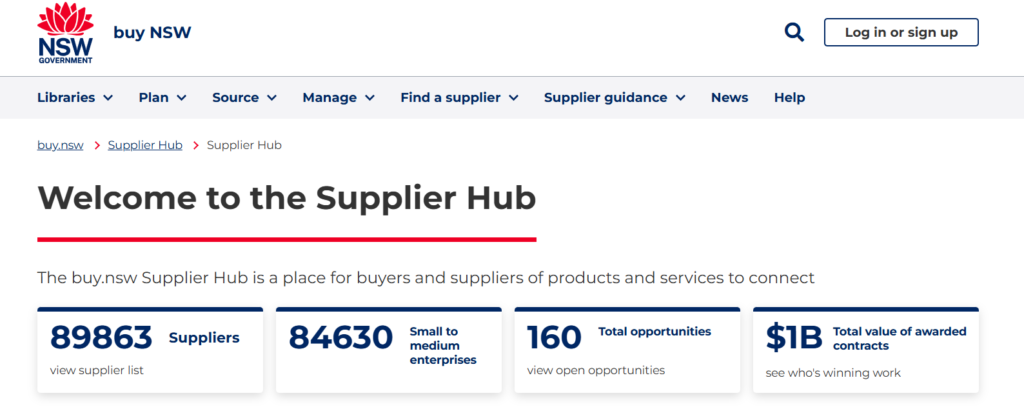
In 2026, the starting point for suppliers is the buy NSW Supplier Hub. NSW Government describes the Supplier Hub as the place where buyers and suppliers connect, and registered suppliers can appear in the government supplier list.
That registration is important, but it is only the beginning.
A contractor still has to find an appropriate opportunity, confirm that the business meets the tender requirements and prepare a response that addresses the actual evaluation criteria.
What NSW Government supplier registration actually does
Supplier Hub registration gives NSW Government buyers a way to find and assess suppliers.
The registration process collects information about the business, including its ABN, business name, contact details, company type, size, legal disclosures and products or services. Suppliers can then develop their profile with additional information such as licences, accreditations, awards, capabilities, references and case studies.
That means your Supplier Hub profile should not be treated as a digital business card.
It should make it clear:
- what your business does;
- where it operates;
- what type of work it handles;
- what licences or qualifications it holds;
- what size projects it can manage;
- what specialist capability it has;
- what relevant experience it can demonstrate.
A buyer should not have to guess what your company is capable of doing.
Supplier Hub vs eTendering: what contractors should use in 2026
This is one of the most important points for anyone searching for NSW Government Tenders Registration.
The platforms have different roles.
The current buy NSW Supplier Hub is used for supplier registration, supplier information and related procurement access. NSW Government says registered suppliers can update their information and view opportunities relevant to their category.
NSW eTendering remains a public tender platform where businesses can search current, past and future tenders, and the site still provides access to tenders and schemes.
At the same time, NSW Government’s 2026 policy update history says references to eTendering were updated to buy NSW.
The safest approach is therefore not to think of the systems as competing portals.
Think of them as parts of the broader procurement system.
Supplier Hub: establish and maintain your supplier identity.
Opportunities: monitor available government work.
eTendering / relevant buy NSW procurement tools: access and respond to opportunities where required.
Schemes: obtain prequalification where a particular procurement channel requires it.
Always follow the instructions attached to the individual opportunity.
Who can register?
Supplier Hub is designed for businesses supplying goods and services to NSW Government.
The system uses the business’s valid ABN as a key identifier. Supplier Hub guidance states that information collected during registration and profile building is associated with that ABN.
For a contractor, this means the registration should match the legal entity that will actually contract with government.
Do not casually register one company and then submit a tender under a different entity.
For businesses with multiple ABNs, Supplier Hub supports multiple company profiles under one registered user account.
What you need before starting registration
1. ABN and business information
Have your correct ABN and legal business information ready.
The Supplier Hub registration process asks for business details, business name and ABN, contact details, company type and size and legal disclosures.
Check the information before submitting it.
An incorrect ABN can create problems because the supplier profile is linked to that business identity.
2. Your business structure
Be clear about whether the contracting entity is:
- a sole trader;
- partnership;
- company;
- trust; or
- another recognised business structure.
The structure matters because individual tenders can request different evidence from different types of entities.
3. Products and services
This is one of the sections that deserves more attention than it normally receives.
Do not simply write:
“Construction services.”
That tells a government buyer very little.
A contractor should describe its actual capabilities in plain language.
For example:
- civil construction;
- drainage;
- road maintenance;
- electrical works;
- building maintenance;
- landscaping;
- concrete works;
- traffic management;
- structural repairs.
Only list services the business can genuinely deliver.
4. Licences and accreditations
If the business holds relevant licences, certifications or accreditations, prepare accurate information before building the profile.
Supplier Hub guidance specifically identifies licences, accreditations and awards as information that can be included in a supplier profile.
Do not list an accreditation simply because it is relevant to the industry.
List the accreditation the business actually holds.
5. Insurance
Insurance should be treated differently from profile information.
A tender can impose project-specific insurance requirements.
The NSW SME procurement framework states that agencies should minimise insurance requirements where possible, and for relevant SME procurement the insurance evidence may be required at contract award rather than with the initial response. The exact treatment depends on the procurement and whether the rules apply.
Never assume that one insurance certificate automatically satisfies every tender.
Read the tender documents.
Step-by-step NSW Government Tenders Registration
Step 1: Create your Supplier Hub account
Start with the official NSW Government Supplier Hub rather than a third-party tender directory.
The current registration guidance states that suppliers start by creating an account and confirming their email address before completing registration.
Step 2: Register the correct business
Enter the business information associated with the ABN that will be used for government work.
Check:
- legal entity;
- ABN;
- business name;
- address;
- contact details;
- company type;
- company size.
Do not rush through this stage.
The information becomes the foundation of the supplier record.
Step 3: Select your products and services
Choose the categories that genuinely describe your business.
The purpose is not to select every possible category.
A narrow but accurate profile is more useful than a long list that suggests capabilities you do not actually have.
Step 4: Complete legal disclosures
Supplier registration includes legal-disclosure information.
Answer these questions accurately.
If a tender later asks for more detailed declarations, the information should remain consistent.
Step 5: Build the supplier profile
After registration, add useful supporting information.
The Supplier Hub guidance identifies examples including:
- licences;
- accreditations;
- awards;
- specialist capabilities;
- references;
- case studies;
- government credentials;
- team information;
- promotional video.
A contractor should focus on evidence rather than marketing language.
Instead of:
“We are the leading contractor in Sydney.”
Use factual information such as:
“Civil contractor providing drainage, concrete and road-maintenance services across metropolitan Sydney.”
Only add claims that can be substantiated.
Step 6: Monitor government opportunities
NSW Government publishes open opportunities through its procurement platforms.
The current Supplier Hub guidance directs suppliers toward open tenders and prequalification schemes, while the NSW eTendering site continues to provide tender searching.
A contractor should monitor opportunities according to its actual capabilities rather than searching only for the word “construction”.
Search by:
- service;
- construction category;
- location;
- project type;
- agency;
- scheme;
- relevant technical capability.
Step 7: Check whether prequalification is required
This is where many small contractors can lose time.
Some opportunities can be competed for through an ordinary tender process.
Others use prequalification schemes or panels.
NSW Government currently lists a Construction Scheme for Works up to $1 million and a separate Construction Scheme for Works between $1 million and $9 million.
There are also construction-related consultancy schemes covering areas such as project management, planning, engineering, security, architecture and assessments.
Before preparing a tender, determine whether the opportunity requires:
- scheme membership;
- prequalification;
- specific licences;
- particular insurance;
- financial capacity;
- technical accreditation;
- previous project experience.
Step 8: Read the entire tender document
Do not begin writing the response after reading only the project description.
Check:
- scope of work;
- closing date and time;
- mandatory requirements;
- evaluation criteria;
- pricing requirements;
- insurance;
- licences;
- WHS requirements;
- environmental requirements;
- subcontracting conditions;
- proposed contract;
- schedules;
- response format;
- required attachments.
The NSW Procurement Policy Framework says procurement should provide suppliers with reasonable time to prepare submissions and that tender and contract requirements should be minimised where feasible.
That does not mean every tender will be short.
A technically complex construction contract can require substantial evidence.
Step 9: Build a compliance checklist
Before writing the response, create a simple table:
| Requirement | Evidence needed | Completed |
|---|---|---|
| ABN | ABN details | Yes/No |
| Licence | Current licence | Yes/No |
| Insurance | Certificate/policy | Yes/No |
| Experience | Project examples | Yes/No |
| Methodology | Project approach | Yes/No |
| WHS | Required documentation | Yes/No |
| Pricing | Completed schedule | Yes/No |
| References | Relevant referees | Yes/No |
| Mandatory declarations | Signed forms | Yes/No |
This prevents a strong technical submission from being undermined by a missing mandatory attachment.
How to build a supplier profile buyers can understand
The profile should answer five questions quickly:
What do you do?
State the core service.
Where do you operate?
Identify the service area accurately.
What work can you handle?
Explain the relevant capability.
What evidence do you have?
Use licences, certifications, references and completed projects where appropriate.
What makes the business suitable?
Give factual information about capacity, specialist equipment, relevant personnel or project experience.
Avoid generic marketing phrases.
Government procurement is based on procurement requirements and evaluation processes, not on who writes the most promotional profile.
The Procurement Policy Framework identifies value for money as the overarching consideration and says it can include quality, cost, fitness for purpose, capability, capacity, risk and total cost of ownership.
What SME contractors should know about procurement thresholds
Small businesses should understand the policy environment, but should not treat thresholds as automatic guarantees of work.
For current NSW Government guidance, construction has specific arrangements.
For construction contracts up to $50,000, NSW Government says it can buy directly from a small business.
For construction up to $1 million, reasonable efforts must be made to obtain quotes from SMEs on the Construction Scheme for Works up to $1 Million.
For non-construction goods and services, the rules differ. NSW Government says it can directly purchase from a regional business up to $150,000 and an SME up to $250,000 under the applicable rules.
Up to $3 million, the SME-first requirement can apply when agencies are permitted to buy directly from a supplier under a contract or scheme.
These provisions create opportunities, but they do not remove the need to demonstrate value, capability or compliance.
Local contractors and the $7.5 million threshold
For large procurements, local participation also becomes relevant.
PBD 2024-02 applies to goods, services and construction valued at $7.5 million or more excluding GST. The NSW Government framework says agencies must check whether NSW-based suppliers can provide the required goods or services and give NSW-based suppliers a full and fair opportunity to participate.
A Sydney contractor should therefore not assume that large contracts are automatically closed to local businesses.
The practical question remains whether the business can meet the contract’s capability and commercial requirements.
How to prepare a tender response
A tender response should follow the buyer’s structure.
If the tender asks for five sections, do not send a 40-page company brochure and expect the evaluator to find the answers.
A practical response structure is:
- compliance statement;
- understanding of the requirement;
- methodology;
- project team;
- relevant experience;
- WHS and risk management;
- environmental considerations;
- program;
- pricing;
- requested declarations and attachments.
Use headings that correspond to the tender documents.
If the evaluation criterion says “Relevant Experience”, use a clear heading such as:
Relevant Experience
Then provide the evidence.
This makes the evaluator’s job easier and reduces the risk of important information being buried.
Common registration mistakes
Mistake 1: Treating registration as tender qualification
Supplier Hub registration does not automatically qualify a contractor for every government contract.
Each tender can impose its own conditions.
Mistake 2: Using the wrong ABN
The Supplier Hub profile is associated with the business’s ABN.
Make sure the contracting entity is correct.
Mistake 3: Listing every possible service
Do not add categories simply because you might want the work one day.
A buyer should be able to understand the business.
Mistake 4: Ignoring prequalification
If the opportunity requires a scheme, ordinary Supplier Hub registration may not be enough.
Mistake 5: Leaving registration until the tender closes
Registration is an administrative step.
Do it before a deadline becomes urgent.
Mistake 6: Submitting a generic company profile
A tender response should address the actual project.
A standard company brochure is not a substitute for answering the evaluation criteria.
Mistake 7: Missing the closing time
Treat the tender closing time as a hard operational deadline.
Do not plan to upload the final response minutes before closing.
What happens after submitting a tender?
Submitting the response does not mean the contract has been won.
The agency evaluates responses according to the procurement documents and applicable procurement rules.
The NSW Procurement Policy Framework states that government procurement should be fair, transparent and based on value for money. It also identifies fair and open competition as a procurement objective.
Depending on the procurement, suppliers may also encounter:
- clarification questions;
- requests for additional information;
- negotiations;
- preferred-supplier processes;
- reference checks;
- due diligence;
- contract negotiations;
- unsuccessful tender notifications;
- post-tender debriefs.
Keep copies of the submitted response and supporting documents.
If the business is unsuccessful, the feedback can be useful when deciding whether to bid again.
Faster payments for eligible small businesses
Cash flow matters to small contractors.
The NSW Government Faster Payment Terms Policy provides eligible registered small businesses with payment terms of five business days for correctly rendered invoices, subject to the policy’s conditions and exclusions.
The current buy NSW guidance says a business with fewer than 20 FTE employees can be automatically registered for Faster Payments when it selects the relevant employee-size information in its supplier profile.
That makes accurate Supplier Hub information useful beyond tender visibility.
A contractor should also follow the contracting agency’s invoice instructions. The policy notes that invoices sent to the wrong recipient may not enter the payment process correctly.
NSW Government tenders vs council tenders
Do not assume that a NSW Government Supplier Hub registration means a contractor is automatically registered for every local council procurement system.
Councils have their own procurement arrangements.
The NSW Government procurement framework itself distinguishes local councils from NSW Government agencies for purposes of the Procurement Board framework.
At the same time, some NSW construction schemes can service NSW Government agencies and local government councils.
The practical rule is simple:
Check the actual buyer named in the opportunity and follow that buyer’s procurement instructions.
For council work, look for the council’s current tender portal, procurement page or nominated procurement platform.
The 2026 contractor checklist
Before chasing NSW Government work, make sure you have:
- Correct ABN
- Correct legal entity
- Supplier Hub account
- Completed Supplier Hub profile
- Accurate service categories
- Current licences
- Relevant accreditations
- Insurance information
- Project references
- Capability statement
- WHS documentation
- Relevant financial information
- Tender monitoring process
- Prequalification applications where required
- Tender response checklist
- Pricing process
- Document-control system
- Submission deadline recorded
- Post-tender follow-up process
Final takeaway
Registering for NSW Government tenders is no longer simply a matter of finding an old eTendering login page.
In 2026, a contractor should start with the buy NSW Supplier Hub, build an accurate supplier profile, monitor current opportunities and understand whether the particular job requires a tender response, scheme membership or prequalification.
For construction businesses, the available SME and construction-scheme arrangements are particularly relevant. NSW Government currently identifies specific pathways for smaller construction procurements and construction work up to $1 million, while larger projects can involve different schemes and procurement requirements.
The registration itself is only the entry point.
The stronger preparation happens before the tender opens: accurate business information, current licences, relevant project evidence, appropriate insurance, a clear capability profile and a repeatable tender-response process.
That is what turns a supplier account into a practical government-procurement pipeline.
FAQ section
Do I need to register on the NSW Government Supplier Hub?
For suppliers covered by PBD 2023-04, NSW Government buyers must confirm Supplier Hub registration at specified procurement stages. The Direction also recognises an exception for genuinely ad-hoc, non-contractual purchases.
Where do I register for NSW Government tenders?
The current supplier-registration starting point is the NSW Government Supplier Hub.
Is NSW eTendering still used in 2026?
Yes. The NSW eTendering public website remains available for searching tenders and schemes. However, NSW procurement information has increasingly been integrated with buy NSW, and the 2026 policy update history records changes to eTendering references.
What information is required for Supplier Hub registration?
The registration process asks for business details, ABN, contact information, company type and size, legal disclosures and products/services.
Does Supplier Hub registration guarantee a government contract?
No. Registration establishes the supplier record and access to procurement systems, but individual opportunities can require separate eligibility, prequalification, licences, insurance and tender requirements.
Can a small construction business tender for NSW Government work?
Yes. NSW Government has procurement arrangements specifically addressing SMEs and construction suppliers, including a Construction Scheme for Works up to $1 million.
Does NSW Government favour small businesses?
NSW has SME procurement policies and an SME-first approach in specified procurement circumstances. Up to $3 million, NSW Government says it must first consider buying from an SME under a contract or scheme where direct purchasing is permitted.
What is the NSW Government construction scheme up to $1 million?
It is a prequalification scheme for general construction work valued up to $1 million.
Can a Sydney contractor benefit from local-supplier policies?
For procurements of $7.5 million or more excluding GST, the relevant NSW policy requires agencies to check for NSW-based suppliers and provide NSW-based suppliers with a full and fair opportunity to participate, subject to the Direction.
Can small suppliers receive faster payments?
Eligible registered small businesses can receive payment within five business days under the Faster Payment Terms Policy, subject to its requirements and exclusions.
Do council tenders use the same registration process?
Not necessarily. Councils have their own procurement arrangements, although some NSW construction schemes also service local government councils. Contractors should follow the procurement instructions of the actual contracting authority.