
Energy costs can become a margin problem very quickly when a business relies on equipment that draws large amounts of electricity at the same time.
That is especially relevant for laundromats, food-preparation businesses, commercial kitchens, refrigerated operations and other Sydney SMEs where production cannot simply stop because the electricity bill has increased.
There is an important change in the way you should approach this problem in 2026.
There is no single NSW small business energy rebate that solves the bill. Instead, there are several different support mechanisms, and each one addresses a different problem. The NSW Energy Savings Scheme can support qualifying efficiency upgrades. The new NSW business battery incentive targets peak demand. The Net Zero Planning Grant can help larger energy users pay for strategic planning. Federal schemes can also support eligible solar and battery projects.
The first question for a Sydney business is therefore not “Which rebate should I apply for?”
It is:
What part of my electricity bill is actually hurting the business?
What NSW small business energy support is available in 2026?
The first mistake is treating every form of support as a cash rebate.
NSW’s Energy Savings Scheme and Peak Demand Reduction Scheme work through certificates. In practical terms, an approved provider or installer can arrange an upfront discount on an eligible installation rather than sending the business a conventional rebate payment after the work is finished.
For a Greater Sydney SME, the main options are:
| Support | 2026 status | Best use |
|---|---|---|
| Energy Savings Scheme | Active | Eligible energy-efficiency upgrades |
| Business battery incentive | Active | Reducing peak demand and storing solar |
| Net Zero Planning Grant | Open | Larger energy users planning efficiency and decarbonisation |
| 2025-26 small-business bill relief | Closed | Not a current 2026-27 application |
| Federal battery support | Active | Eligible solar-connected batteries |
| Mid-scale solar SRES | Eligible installations from 1 Oct 2026; applications expected Nov 2026 | 100 kW-1 MW commercial solar |
The NSW Government has also warned that access to certificate incentives can change as scheme rules are updated, so a quote should be checked against the current rules rather than an old rebate article.
NSW Climate and Energy Action business information
Why peak electricity costs can damage SME profitability
A business can have a relatively normal total electricity consumption figure and still face a serious peak-demand problem.
Ausgrid explains that demand pricing is based on how much electricity a customer is using at a particular point in time. Under a typical demand-pricing structure, the demand charge is generally based on the highest 30-minute period in the applicable peak window.
That creates a different problem from ordinary kWh consumption.
Imagine a laundromat where several large machines switch on together. Or a food-preparation site where refrigeration, ovens, ventilation and hot-water equipment overlap during the same period.
The business may be using energy efficiently in total, but the timing of the load can still create a costly peak.
Ausgrid peak periods for small businesses
Ausgrid’s published demand-pricing guidance gives small businesses a peak pricing window of:
3pm to 9pm on working weekdays
during:
- June to August
- November to March
Ausgrid’s schedule has no peak period in April, May, September and October.
There is an important qualification.
Those are Ausgrid’s published windows. Your retailer may use different demand windows or a different pricing structure. Ausgrid explicitly tells customers to ask their retailer for the exact days, times and method used on the actual retail plan.
That makes the electricity bill the starting point.
Ausgrid network tariff versus your retailer’s price
This distinction matters.
Ausgrid publishes its network prices, but it does not set every component of the final demand charge paid by the customer. Your retailer determines the retail plan and can choose how it passes network charges through to the customer.
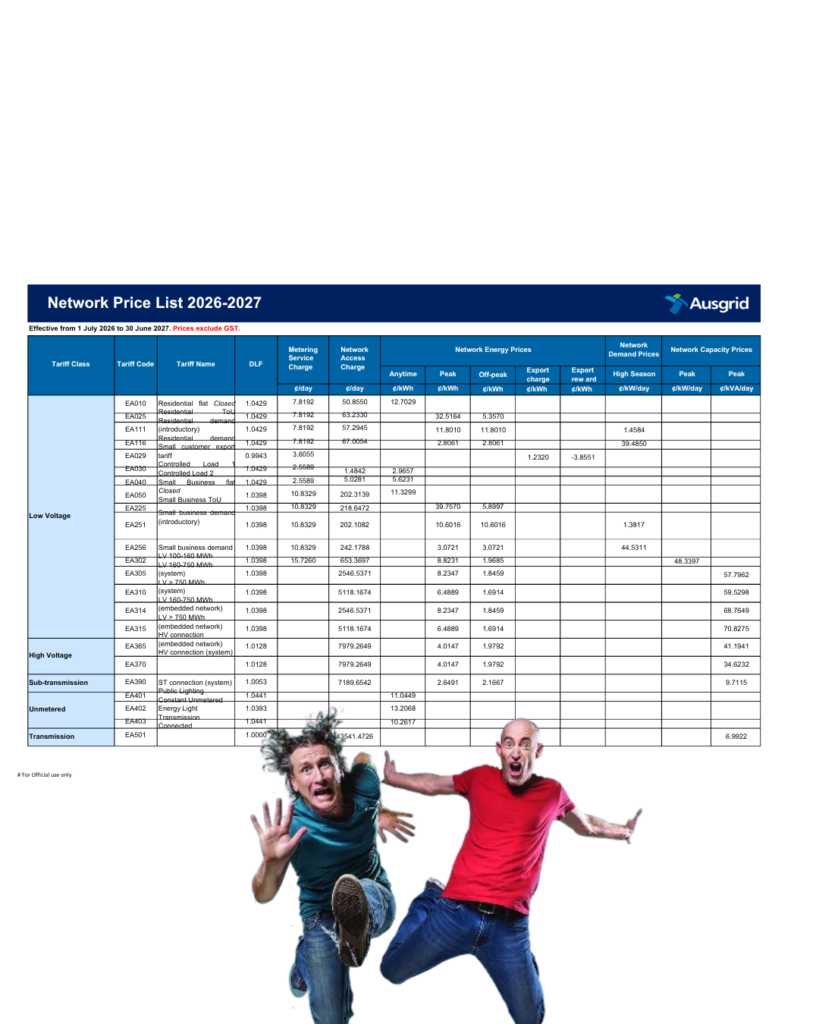
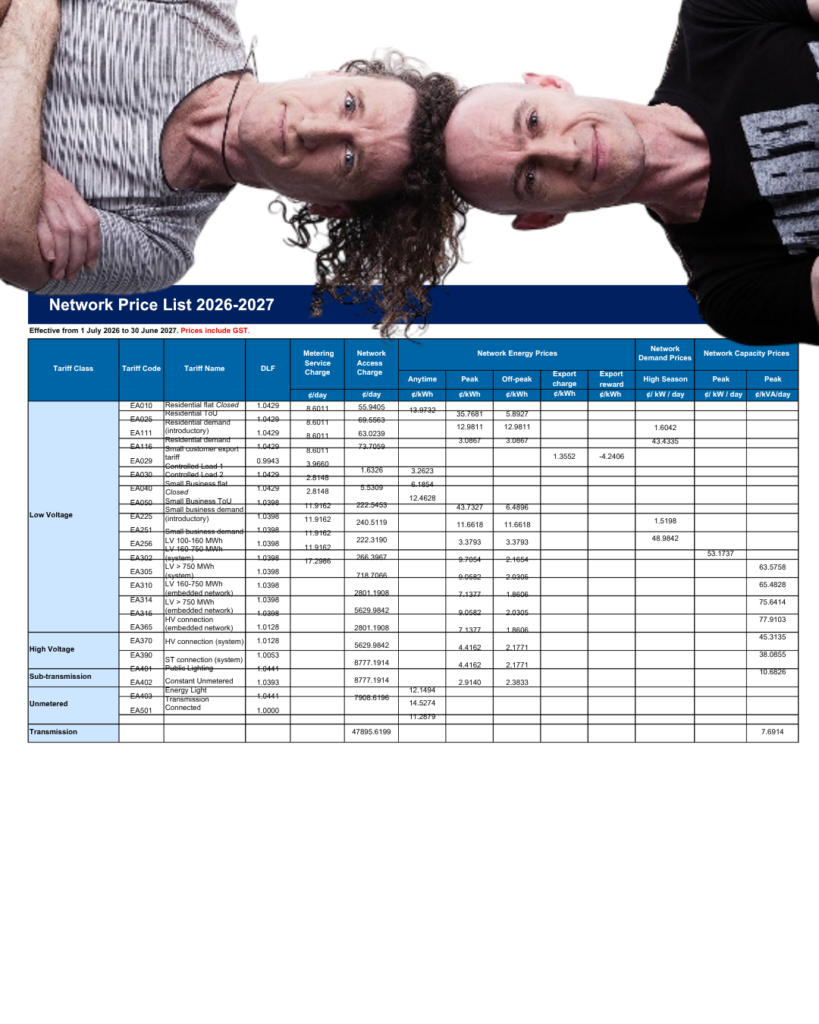
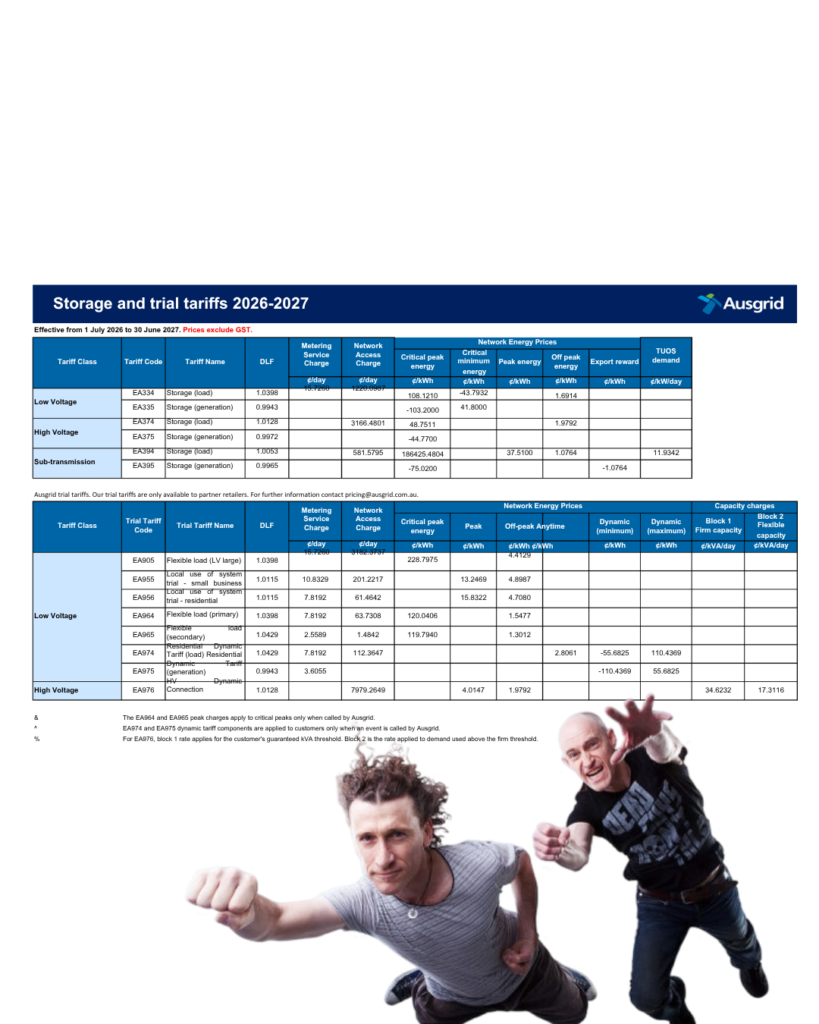
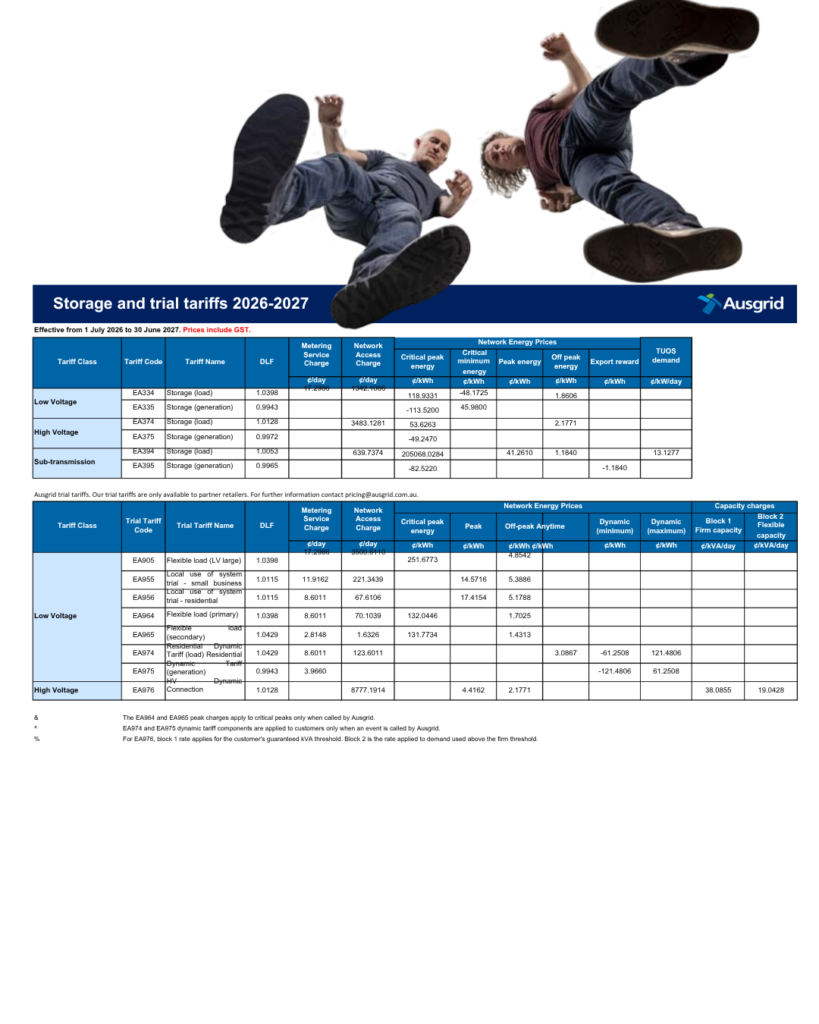
Ausgrid’s 2026-27 Network Price List is effective from 1 July 2026 to 30 June 2027 and includes separate small-business tariff classes, including demand tariffs.
The practical lesson is simple:
Do not copy an Ausgrid network tariff figure into a business budgeting spreadsheet and assume it is your final retail demand price.
Use the network price list to understand the structure, then use the business’s actual electricity contract and bill to determine what is being charged.
How to apply for the NSW Energy Savings Scheme
The NSW Energy Savings Scheme is not normally a matter of completing one consumer rebate form and waiting for a payment.
For business equipment upgrades, the NSW Government directs businesses to an Accredited Certificate Provider (ACP). The ACP assesses the proposed activity and explains the next steps.
This is one of the most important practical rules in the whole process.
Step 1: Pull together your energy records
Before contacting an ACP, gather:
- recent electricity bills
- 12 months of consumption where available
- interval or smart-meter data where available
- the model numbers of major equipment
- existing solar and battery information
- the business’s operating hours
- the periods when the biggest machines operate together.
The aim is to understand both energy use and peak demand.
Step 2: Identify the upgrade rather than starting with the rebate
NSW currently lists business opportunities involving energy-efficient:
- compressed-air systems and improvements such as fixing leaks
- HVAC systems
- hot-water and steam systems
- building equipment
- industrial processes and control systems.
Current NSW eligibility tools also include activities involving refrigerated cabinets, ventilation or refrigeration motors, air conditioning, hot-water equipment and other recognised activities.
The exact eligibility depends on the activity, equipment, installation conditions and current rule.
That means a business should not assume that every efficient appliance automatically qualifies.
Step 3: Engage an ACP before the project starts
NSW’s safeguard certificate estimator states that an Accredited Certificate Provider should be engaged before the project begins to assess feasibility and ensure the accuracy of the submission.
This is a critical protection against starting work first and discovering later that the installation does not meet the scheme requirements.
Find an Accredited Certificate Provider through IPART’s register
IPART’s ACP list is updated monthly.
Step 4: Get a proper quote
The NSW certificate framework is designed so that the value of eligible certificates can flow through the ACP and installer as a customer discount.
Ask the supplier to identify the incentive clearly in the written quote.
That gives the business a much clearer comparison between suppliers.
Step 5: Check the current 2026 rules
The ESS Rule changed in September 2026. IPART confirms that the latest ESS Rule applies from 7 September 2026.
Do not rely on a 2023, 2024 or early-2025 rebate table when the project is being contracted in late 2026.
Which businesses are most likely to benefit from ESS-style upgrades?
Energy-heavy businesses should look beyond the obvious “replace a machine” approach.
Laundromats
A laundromat should first map the equipment that creates the biggest electricity demand and the times when multiple machines overlap.
Hot-water systems, HVAC and some motor-related systems can fall within recognised energy-saving activities, but the specific machine or activity should always be checked against the current rules before the owner assumes an incentive is available.
The operational side matters just as much.
A laundromat may be able to reduce peak exposure by preventing several major loads from starting simultaneously.
That is not a rebate.
It is a load-management decision.
And in a business with demand pricing, that distinction can be financially important. Ausgrid itself recommends reducing demand by changing when appliances operate and by avoiding several high-use appliances running at once.
Food-preparation businesses
Food preparation creates a different pattern.
A site may have refrigeration running continuously, with ovens, extraction, hot water, HVAC and other equipment coming on in response to production demand.
The useful question is not only:
“How many kilowatt-hours did we use?”
It is also:
“What happened during the highest-demand half hour?”
That question should be answered from interval data rather than guessed from the appliance nameplate.
The new NSW business battery incentive
The NSW Government introduced a business battery discount from 1 September 2026 under the Peak Demand Reduction Scheme.
For businesses, the battery can help in three practical ways:
- store solar energy for later use;
- reduce the amount of electricity drawn from the grid during peak periods;
- provide backup power where the installed system supports that function.
For eligible business installations, the battery size must generally be between 20 kWh and 30 MWh.
The NSW Government says the discount is normally shown as an upfront reduction in the installation quote. The larger discount is available where a new or additional solar system is installed with the battery, with NSW describing that combined arrangement as potentially receiving about 30% to 40% off the battery installation cost.
There is currently no planned closing date, although the Peak Demand Reduction Scheme is reviewed and updated as policy changes.
A business can still be eligible even if it has no existing solar. In that situation the battery-only incentive is smaller than the combined solar-and-battery discount.
NSW business battery incentive details
When a battery makes more sense than simply installing more solar
A battery becomes particularly interesting when the business’s energy use does not line up with solar production.
For example, a site might generate solar electricity during the middle of the day but experience its strongest grid demand later in the afternoon.
The battery’s value should therefore be assessed against the business’s actual load curve.
Do not evaluate a battery solely by annual kWh savings.
Ask:
- When does the business reach its highest demand?
- How long does that peak last?
- Is solar already available?
- Can the battery discharge during the relevant period?
- What retail tariff is the business actually on?
- What network and installation approvals are required?
Is the Net Zero Planning Grant relevant to a small business?
For many very small retailers, no.
For a larger energy-intensive SME, potentially yes.
The current Net Zero Planning Grant Round 2 is open and offers up to $25,000, covering up to 50% of project costs. Applications close at 5pm on 30 November 2026, or earlier if funding is exhausted.
The energy-spend threshold is the major filter:
- at least $200,000 a year in energy bills at one NSW site, or
- $500,000 a year across multiple NSW sites.
The eligible work is planning-focused. It can include greenhouse-gas inventories, climate-risk work, cost-saving measures, fuel-switching opportunities, emissions-reduction planning and targets.
For a typical small shop below the threshold, this is not the right headline rebate.
For a multi-site food business, commercial laundry operation or larger processing facility, it may be much more relevant.
A particularly useful point for the laundry sector is that NSW’s own Round 1 success stories include Alsco Uniforms, a commercial laundry operator. NSW says the Campbelltown project used the grant to identify emissions-reduction opportunities and develop an action plan.
That does not mean another laundry business will receive the grant. Eligibility and assessment still apply.
What happened to the small-business energy bill relief payment?
Do not copy old “$150 NSW business rebate” language into a 2026-27 article.
The NSW National Energy Bill Relief for Small Businesses 2025-26 program is closed. The NSW page states that applications closed on 30 June 2026 and that the payment was up to $150 for eligible businesses.
The national Energy Bill Relief Fund itself ended on 31 December 2025.
So a Sydney business looking for help in October 2026 should focus on current efficiency, battery, solar and planning mechanisms rather than assuming another blanket bill credit is available.
Mid-scale solar is a new 2026 opportunity
The federal SRES was expanded from 1 October 2026 so eligible solar PV systems from 100 kW to 1 MW can participate. The Clean Energy Regulator expects STC applications for these mid-scale systems to open in mid-to-late November 2026.
That matters because some commercial and industrial sites were previously caught between small-scale solar support and large-scale generation certificate arrangements.
For a sufficiently large Greater Sydney site, the change can affect the economics of a rooftop solar project.
The important timing point is that eligibility applies to qualifying systems installed from 1 October 2026, but the application process is expected to open later in November.
Businesses planning a 100 kW-plus installation should therefore obtain project-specific advice instead of assuming the certificate value will simply be deducted immediately from the quote.
A practical 30-day plan for an energy-heavy Sydney SME
Days 1-7: Audit the bill
Take the latest bills and identify:
- total kWh consumption
- maximum demand or demand-charge line
- peak-period charges
- supply charges
- solar export credits
- contract expiry
- meter type
- available interval data.
The objective is to establish whether the cost problem is volume, timing, tariff structure or a combination of all three.
Days 8-14: Review the tariff
Ask the retailer:
“What tariff or demand pricing plan am I currently on?”
Then ask:
“How is my demand charge calculated?”
Ausgrid specifically recommends asking the retailer which peak window applies and how the demand charge is calculated.
Do not rely on a generic online tariff comparison without checking the actual contract.
Days 15-21: Assess upgrade options
Choose the equipment with the biggest financial impact.
For ESS, contact an ACP before commencing the project. For a battery project, compare installers that are participating with an ACP under the PDRS.
Obtain more than one quote where practical.
Ask each supplier to identify:
- equipment cost
- installation cost
- government incentive or certificate discount
- network/approval costs
- warranties
- expected operating profile
- assumptions used in the savings calculation.
Days 22-30: Decide what actually changes the bill
By this point the business should have a clearer answer.
If the problem is mainly peak demand, focus on load management, retailer tariff review and potentially battery storage.
If the problem is mainly high equipment consumption, investigate eligible ESS efficiency upgrades.
If the business has very high energy expenditure and a broader transition plan, assess the Net Zero Planning Grant.
If the site can support a larger solar system, assess the new mid-scale SRES arrangements as part of the project economics.
The best result may involve more than one measure.
Common mistakes Sydney businesses should avoid
Calling every incentive a “rebate”
Some NSW programs provide an upfront discount rather than a post-purchase reimbursement. Using the wrong terminology can create false expectations about cash flow.
Using an old rebate table
The ESS and PDRS rules changed in September 2026.
Treating the Ausgrid tariff as the final retail price
The retailer sets the actual customer plan and demand charge.
Starting an upgrade before checking eligibility
The NSW certificate estimator says an ACP should be engaged before the project begins.
Looking only at annual electricity use
Demand pricing means timing matters.
Buying a battery because the rebate exists
A battery should be sized against the business’s load profile, solar output, tariff and operating schedule. A discount does not automatically make a project financially sound.
Treating a grant as automatic
The Net Zero Planning Grant has clear eligibility criteria and funding limits.
The practical takeaway
For a Greater Sydney SME, the most sensible way to approach 2026 energy support is in this order:
Check the bill → identify peak demand → confirm the retailer tariff → identify qualifying equipment → speak to an ACP → assess battery/solar economics → check grant eligibility.
That approach is more useful than chasing a generic “rebate”.
For many businesses, the biggest opportunity may be reducing the number of times several large loads operate simultaneously during a demand-pricing window.
For others, the strongest option may be an eligible efficiency upgrade or a battery that shifts energy use away from the grid at the most expensive time.
The schemes are there, but the right one depends on the structure of the business’s electricity use.
new or additional solar system. Battery-only installations receive a smaller discount.
Can an SME qualify for the Net Zero Planning Grant?
Possibly, but the current Round 2 grant has a significant energy-spend threshold: at least $200,000 annually at one NSW site or $500,000 across multiple NSW sites, along with other eligibility requirements.
Can a business still receive federal battery support?
Eligible small-scale battery systems can receive support through the Australian Government’s SRES framework. The current battery rules use usable capacity for STC calculations, with only the first 50 kWh eligible for STCs.
Can a larger commercial solar system receive SRES support in 2026?
Eligible solar PV systems between 100 kW and 1 MW installed from 1 October 2026 can participate in the expanded SRES. The Clean Energy Regulator expects applications to open in mid-to-late November 2026.
Is there a NSW small business energy rebate in 2026?
There is no single universal NSW 2026-27 electricity-bill rebate for all small businesses. Current support is spread across the ESS, PDRS battery incentives, grants and federal solar/battery schemes. The previous 2025-26 National Energy Bill Relief program is closed.
What is the NSW Energy Savings Scheme?
The ESS is a NSW certificate scheme that provides financial incentives for eligible energy-efficient upgrades for households and businesses. It was established in 2009 and is legislated through 2050.
How do I apply for the NSW Energy Savings Scheme?
For business equipment upgrades, the normal route is to contact an Accredited Certificate Provider. NSW says an ACP should be engaged before the project begins so eligibility and certificate requirements can be assessed.
What is the Ausgrid peak period for small businesses?
Under Ausgrid’s published demand-pricing schedule, the small-business peak window is 3pm to 9pm on working weekdays during June-August and November-March. Your retailer may use different periods.
Is an Ausgrid network demand tariff the same as my retail demand charge?
No. Ausgrid says the retailer sets the customer’s demand charge and may use different peak windows or calculation methods.
Is the NSW business battery incentive available in 2026?
Yes. NSW introduced the business battery incentive from 1 September 2026 under the Peak Demand Reduction Scheme. Eligible battery systems for businesses generally fall between 20 kWh and 30 MWh.
How large is the NSW business battery discount?
NSW says the discount can be about 30% to 40% of battery installation cost when a battery is installed with a new or additional solar system. Battery-only installations receive a smaller discount.
Can an SME qualify for the Net Zero Planning Grant?
Possibly, but the current Round 2 grant has a significant energy-spend threshold: at least $200,000 annually at one NSW site or $500,000 across multiple NSW sites, along with other eligibility requirements.
Can a business still receive federal battery support?
Eligible small-scale battery systems can receive support through the Australian Government’s SRES framework. The current battery rules use usable capacity for STC calculations, with only the first 50 kWh eligible for STCs.
Can a larger commercial solar system receive SRES support in 2026?
Eligible solar PV systems between 100 kW and 1 MW installed from 1 October 2026 can participate in the expanded SRES. The Clean Energy Regulator expects applications to open in mid-to-late November 2026.