
Sydney is an expensive place to take a conventional office lease, particularly when a startup has more ambition than cash flow.
A two-person company does not necessarily need a long commercial lease, a reception area, a private boardroom and a large office. In the first stage, it may need two desks, reliable internet, somewhere to meet a client and access to people who understand what building a young company actually involves.
That is where Sydney’s startup coworking ecosystem becomes useful.
But there is an important distinction in 2026: not every cheap coworking desk is subsidised.
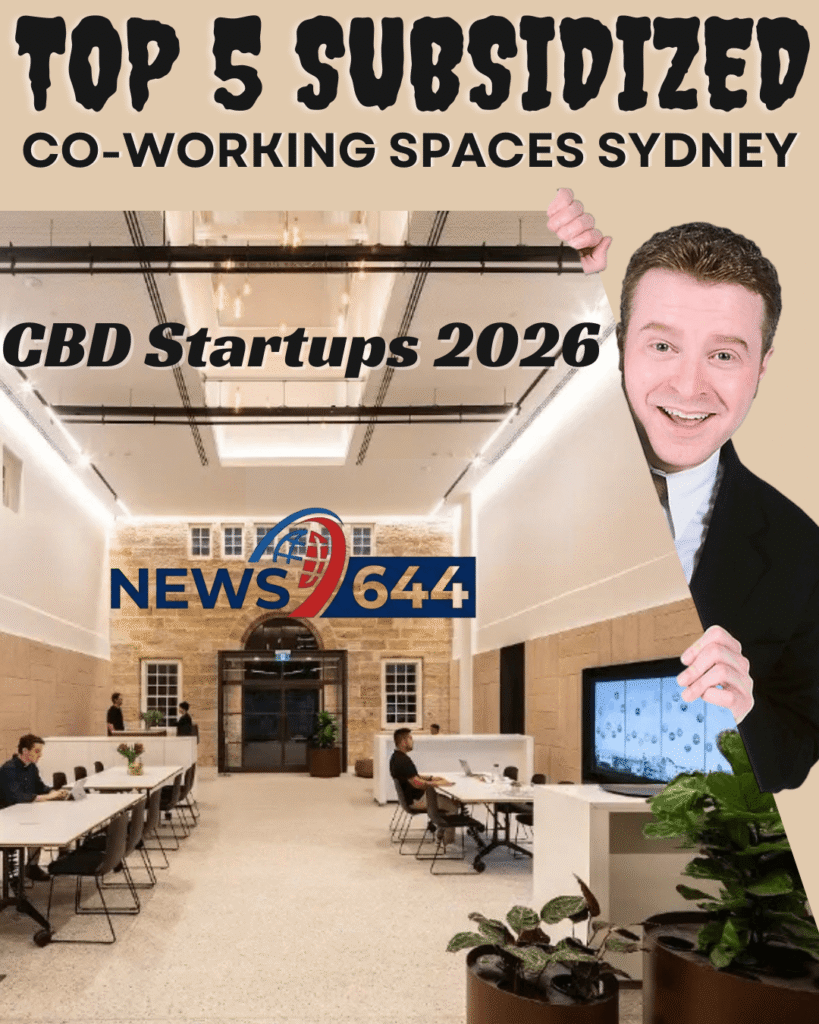
The former Sydney Startup Hub at Wynyard has been replaced by the Tech Central Innovation Hub at 477 Pitt Street in Haymarket. NSW Government says the new hub provides affordable coworking, dedicated desks and office accommodation for startups and scaleups.
The current operator, Stone & Chalk, describes the hub’s startup options as government-subsidised and lists entry points from free and $25 a day for its Build pathway and from $595 a month for Launch.
This guide therefore focuses on five current workspace access options that can reduce the cost of getting into Sydney’s startup ecosystem. They are not five unrelated buildings, and that distinction is deliberate.
What counts as a subsidised coworking space?
A normal commercial coworking company may offer an introductory rate, discounted membership or cheap day pass. That does not make the space government subsidised.
A startup hub is also not necessarily the same thing as a coworking space.
The NSW Innovation and Productivity Council’s research distinguishes coworking spaces from incubators and startup hubs. Coworking generally means flexible shared office accommodation. An incubator combines physical space with additional business-development support, while a startup hub can bring several startup-support organisations and programs together in one coordinated location.
That distinction is useful when comparing Sydney options.
For a founder, the question should not simply be:
“How cheap is the desk?”
A better question is:
“What am I getting for the money, what eligibility rules apply, and what happens when my company needs more space?”
1. Tech Central Innovation Hub — Build
Address: 477 Pitt Street, Haymarket, Sydney
Starting point: From free and $25/day
Best suited to: Founders who need somewhere to work without committing to a monthly office arrangement.
The Build pathway is the clearest answer to the search for cheap hot desking in Sydney.
The current Tech Central Innovation Hub offering includes public coworking together with lounge and desk passes. Stone & Chalk lists options from free and $25 per day.
That makes this fundamentally different from signing a conventional commercial office agreement.
For a founder who works remotely most of the week, the economics can be particularly relevant. You do not necessarily need to pay for a permanent desk if the business only needs a professional workspace for selected days.
The location also puts founders inside Tech Central, a wider innovation precinct covering Haymarket, Ultimo, Surry Hills, Chippendale, Eveleigh and Camperdown. NSW Government describes the district as a major concentration of startups, technology businesses, research institutions, universities and venture capital.
What you should check
The free or low-cost access should not be interpreted as unlimited private-office access.
The Tech Central code of conduct describes Level 1 as a pop-in, pop-out space rather than permanent residency. Regular users needing a weekly or fortnightly desk are directed towards incubator or residency options.
That makes Build useful for testing the environment before committing.
It is also a sensible way to answer a basic question:
Does your startup actually need an office yet?
If the answer is no, paying for a private room simply because it looks professional may be unnecessary overhead.
2. Tech Central Innovation Hub — Launch
Address: 477 Pitt Street, Haymarket
Starting point: From $595/month
Best suited to: Startups that need a consistent workspace rather than occasional hot-desking.
Launch is the next step when a founder has outgrown casual desk access.
The current offering includes flexible or dedicated desks in collaborative and quieter work areas. Stone & Chalk lists Launch options from $595 per month.
This is still very different from taking a conventional commercial office lease.
The key advantage is flexibility. A young company can obtain a more stable base without immediately committing to the fit-out, furniture, long lease and other obligations associated with conventional premises.
The NSW Government describes Tech Central Innovation Hub as an 8,000-square-metre facility across six floors with flexible workspaces, event areas and support for startups and scaleups.
The hub is operated by Stone & Chalk Tech Central Sydney and its current membership structure includes pathways designed around different stages of company growth.
When Launch makes more sense than a hot desk
Consider Launch when:
- you are working from Sydney several days each week;
- you regularly meet co-founders or employees;
- you need a predictable workstation;
- your company has started hiring;
- client meetings are becoming more frequent;
- the team benefits from being physically together.
The important point is that the advertised membership price is only one part of the decision.
Ask about:
- meeting-room access;
- mail handling;
- registered business address;
- printing;
- storage;
- after-hours access;
- visitor rules;
- additional charges;
- notice periods;
- upgrade options.
Those details can change the effective cost of a workspace.
3. International Landing Pad
Location: Tech Central Innovation Hub
Potential access: Up to four months
Best suited to: Eligible international technology businesses entering NSW.
The International Landing Pad is a very different proposition from ordinary coworking.
Investment NSW says the program was created to support overseas technology businesses expanding into Australia, while the current Tech Central program says eligible international businesses can receive up to four months of membership at the Innovation Hub.
This is not a general free-desk offer for every Sydney startup.
Eligibility matters.
The NSW Government states that the business needs to align with the relevant NSW Industry Policy and demonstrate economic, social or environmental benefits to the state.
For a qualifying international startup, however, the arrangement can remove a major early-stage barrier: paying for a permanent Australian office before the company understands the market.
Instead, the founder can use the landing-pad model as a bridge between entering Sydney and deciding whether a longer-term physical presence makes commercial sense.
Who should investigate it?
This is particularly relevant to:
- overseas technology startups;
- international scaleups entering NSW;
- companies testing Australian market demand;
- founders seeking Australian investors or partners;
- businesses that need a Sydney base without immediately taking a conventional lease.
The eligibility requirements should be checked directly before relying on the program.
4. Regional Landing Pad
Location: Tech Central Innovation Hub
Cost: Up to five desk passes per month free for accepted participants
Best suited to: Technology businesses based outside Greater Sydney that are entering the Sydney market.
The Regional Landing Pad solves a different problem.
A regional technology company may not need a permanent Sydney office. It may need somewhere to work when meeting investors, customers, researchers or potential partners in the city.
The current program is a collaboration between Stone & Chalk and Investment NSW.
To qualify, the business must be a technology company at an early, growth or scaling stage, hold an ABN registered outside Greater Sydney and be actively exploring innovation or growth opportunities in NSW. Pure service providers are excluded from the stated eligibility criteria.
Accepted businesses receive up to five desk passes per month free of charge inside the Tech Central Innovation Hub. The program also provides access to shared work areas, meeting booths, kitchens, collaboration areas and high-speed Wi-Fi.
That makes it a useful example of why the phrase “subsidised coworking” needs context.
The benefit is not a cheap commercial desk available to everyone.
It is a targeted support mechanism for a specific group of businesses.
5. UTS Startups
Location: Ultimo, within the Tech Central precinct
Starting point: $250/month + GST casual membership
Best suited to: Early-stage startups looking for an affordable startup-specific environment and willing to go through the incubator’s entry process.
UTS Startups official information is not being presented here as a government-subsidised coworking provider.
It is included because it gives founders another current, relatively low-cost startup workspace option within the wider Tech Central ecosystem.
UTS says its incubator has 250 desks and startup event space. Its current published rates are:
| Membership | Published base rate |
|---|---|
| Day membership | $50/day + GST |
| Casual membership | $250/month + GST |
| Full membership | $500/month + GST |
| UTS alumni/former full-time staff — casual | $150/month + GST |
| Eligible recent UTS students/staff — casual | Complimentary |
| Eligible recent UTS students/staff — full | $400/month + GST |
UTS also lists weekday access from 7am to 7pm, high-speed internet and free bookable meeting rooms for up to 90 minutes per day.
There is a six-approved-team-member limit per startup, with UTS directing larger teams towards nearby options such as Stone & Chalk.
That makes UTS particularly relevant to a small founding team.
The important qualification is that these are published introductory prices and UTS states they may change.
How the five options compare
| Option | Entry cost published | Main advantage | Main limitation |
|---|---|---|---|
| Tech Central Build | Free / $25 day | Lowest barrier to entry | Not a permanent desk solution |
| Tech Central Launch | From $595/month | More consistent startup workspace | Monthly commitment |
| International Landing Pad | Up to 4 months | Market-entry support | International eligibility |
| Regional Landing Pad | Up to 5 free desk passes/month | Free Sydney access for regional tech firms | Regional-tech eligibility |
| UTS Startups | From $250/month + GST | Startup-focused environment | Competitive entry and team-size limit |
These figures are published starting points, not quotes for every founder. Availability, eligibility, membership terms and pricing should be checked before making a decision.
What does “cheap” actually mean for a Sydney startup?
A $25 day pass sounds inexpensive until you calculate how frequently you will use it.
At the same time, a $595 monthly desk may look more expensive than casual coworking but become more predictable for someone working from the city every week.
The calculation should include:
- desk membership;
- GST where applicable;
- meeting rooms;
- printing;
- storage;
- business address services;
- mail handling;
- parking or transport;
- client meeting requirements;
- additional users;
- after-hours access;
- event-space requirements.
This is why comparing headline desk prices alone can produce the wrong answer.
A founder who only needs a desk eight days a month has a different cost profile from a three-person team working in Sydney every weekday.
Meeting room hire in Sydney CBD: check the rules before booking
Meeting rooms can be one of the hidden costs of cheap coworking.
A founder may choose the lowest-cost hot desk and then discover that regular client meetings require another booking system or membership tier.
Tech Central’s current code of conduct states that Level 1 meeting rooms can be booked through the relevant booking system, with meetings limited to 90 minutes per day under the stated arrangement. It also tells users to confirm access and costs with their member organisation.
That matters for startups whose business depends on:
- investor meetings;
- customer demonstrations;
- interviews;
- partner meetings;
- workshops;
- pitch sessions.
Do not assume that “coworking access” automatically means unlimited boardroom access.
Subsidised coworking versus a traditional office lease
For an early-stage startup, the largest financial benefit of flexible workspace may not be the desk itself.
It can be the reduction in commitment.
A conventional office may require the founder to think about:
- lease duration;
- fit-out;
- furniture;
- utilities;
- cleaning;
- internet;
- insurance;
- office equipment;
- security;
- meeting space;
- expansion space.
Coworking bundles some of those requirements into a service model.
The NSW Government’s own Tech Central strategy identifies pricing and amenity as factors affecting the precinct’s growth, while the strategy positions the Innovation Hub as a flexible and affordable workspace for startups and scaleups.
That government involvement is important context. It explains why Tech Central should not be treated simply as another private serviced-office directory listing.
Why Tech Central matters to Sydney startups
The physical workspace is only part of the proposition.
NSW Government describes Tech Central as a six-square-kilometre innovation district supporting a $42 billion economy and around 100,000 workers, with thousands of businesses, research institutions and universities across the precinct.
The 2025 Tech Central Economic Development Strategy says the district contains more than 4,300 businesses and more than 150 research institutes, with a student pipeline of approximately 160,000.
The NSW Government committed $38.5 million in the 2025–26 Budget to Tech Central, including the relocation and enhancement of the Sydney Startup Hub.
That does not mean every startup receives a direct financial subsidy.
It means the workspace ecosystem is being supported as part of a broader public innovation strategy.
That distinction should remain clear throughout any article discussing subsidised coworking.
What to check before joining
Before paying for a desk, ask the workspace these questions.
1. Is the advertised price available to everyone?
Some prices depend on:
- application;
- residency;
- university affiliation;
- location;
- business type;
- startup stage;
- international status;
- regional status.
2. Is GST included?
UTS, for example, publishes several membership prices plus GST.
3. How many days can I use the space?
A day pass, part-time membership and full-time membership can have very different economics.
4. Can I use meeting rooms?
Ask about:
- included hours;
- booking limits;
- visitor access;
- cancellation rules;
- additional charges.
5. Can I use the address for business registration?
Do not assume that having a desk means the provider allows its address to be used as your registered business address.
6. What happens when my team grows?
A two-person startup may need a private room six months later.
Check the upgrade path before joining.
7. Can I leave easily?
A flexible startup workspace should be evaluated partly on its exit terms.
8. What is genuinely included?
Compare the complete service rather than just the desk.
For founders still completing basic business setup, the News644 guide on registering a business name in NSW covers ABN, business-name and related registration issues.
A practical way to choose
Choose Build if:
You mainly work from home and need a professional Sydney workspace occasionally.
Choose Launch if:
You need a regular desk and want to remain within a startup-focused ecosystem.
Investigate the International Landing Pad if:
Your technology company is based overseas and you are entering NSW.
Investigate the Regional Landing Pad if:
Your technology business is based outside Greater Sydney and you need occasional Sydney workspace.
Consider UTS Startups if:
You are an early-stage startup that fits its entry requirements and wants a startup-specific community with published low-cost membership options.
One final cost-saving point
Do not choose a workspace simply because the monthly price is the lowest.
A cheap desk that requires frequent paid meeting rooms, long transport journeys or separate office services can become more expensive in practice.
Conversely, a slightly higher membership may be sensible if it includes the facilities your company uses every week.
The useful calculation is:
Total workspace cost = membership + meeting rooms + transport + extras + unused capacity
That is a much better comparison than simply asking which Sydney desk is cheapest.
Conclusion
Sydney’s current subsidised startup-workspace landscape is more concentrated than a typical “top five coworking spaces” article suggests.
The central government-backed option is the Tech Central Innovation Hub at 477 Pitt Street, which replaced the former Wynyard Sydney Startup Hub model. Its current Build and Launch pathways provide low-cost entry points, while specialist landing pads provide free or supported access to qualifying international and regional technology businesses.
UTS Startups provides another affordable startup-focused option in the Tech Central precinct, although it should not be labelled a government-subsidised commercial coworking provider without further evidence.
For an early-stage founder, the practical lesson is simple: check the eligibility, calculate the complete cost and choose the amount of space the business actually needs today.
A startup does not need to look like a mature company on day one.
It needs a workspace that leaves enough cash and flexibility to build the company.
FAQ section
Is there free coworking space in Sydney CBD for startups?
Yes, current Tech Central Innovation Hub information lists Build options from free and $25 per day. Access conditions should be checked before relying on the free option.
Is Tech Central Innovation Hub government subsidised?
Yes. The current Stone & Chalk information describes the Tech Central Innovation Hub as a government-subsidised innovation hub, while NSW Government documents confirm significant public investment in Tech Central.
How much does coworking cost at Tech Central in 2026?
Stone & Chalk currently lists Build options from free and $25 per day and Launch options from $595 per month. Published starting prices can change, so founders should confirm the current offer before joining.
Can an international startup get free workspace in Sydney?
Eligible international businesses can receive up to four months of membership through the International Landing Pad at Tech Central. Eligibility requirements apply.
Can regional NSW startups get free Sydney coworking?
Eligible regional NSW technology companies can receive up to five free desk passes per month through the Regional Landing Pad. The program requires an ABN outside Greater Sydney and other eligibility conditions.
Is UTS Startups a subsidised coworking space?
It should not be described as a government-subsidised coworking provider on the evidence used in this article. UTS Startups does, however, publish relatively low startup-incubator membership prices and provides coworking and meeting-room access.
How much is UTS Startups coworking?
UTS currently lists a casual membership from $250 per month plus GST and a full membership from $500 per month plus GST. Day membership is listed at $50 per day plus GST. UTS says these are introductory prices and may change.
Do Sydney coworking memberships include meeting rooms?
Not automatically. The inclusions vary by provider and membership. Tech Central’s current code of conduct specifies meeting-room booking arrangements and a 90-minute daily limit under the stated Level 1 arrangement.
Is the old Sydney Startup Hub at Wynyard still the current government startup hub?
No. NSW Government says the Sydney Startup Hub services transitioned to the Tech Central Innovation Hub at 477 Pitt Street from September 2025.
What should a startup check before choosing a coworking space?
Check the total cost, GST, membership term, meeting-room rules, address services, visitor access, transport costs, storage, after-hours access, eligibility and the provider’s upgrade options.