

Sydney’s night-time economy is now governed by a more deliberate precinct model than it was a few years ago.
For venue owners, however, the terminology can be confusing. Purple Flag is not a liquor licence, it is not an individual venue certification, and it does not replace NSW sound or licensing rules. It is a precinct accreditation designed to recognise areas that perform well across safety, movement, diversity, place and long-term night-time management.
At the same time, the NSW Vibrancy Reforms changed how entertainment noise is handled at licensed premises. Since 1 July 2024, Liquor & Gaming NSW has been the lead regulator for entertainment-sound complaints involving licensed venues. The reforms also changed the statutory disturbance complaint threshold and made order of occupancy a central consideration.
That distinction matters when an established pub, nightclub or live music venue is followed by new apartment development.
A new resident can still complain. But the legal framework no longer treats an established venue and a newly arrived resident as though they have exactly the same position.
What Sydney Purple Flag certification actually means
The phrase “Sydney Purple Flag certification” can be misleading because Purple Flag is awarded to a precinct, not to an individual pub or nightclub.
The NSW program is delivered by the Office of the 24-Hour Economy Commissioner in partnership with the UK Association of Town and City Management. A Purple Flag precinct must meet five core principles:
- Wellbeing — the area is welcoming, clean and safe.
- Movement — people can arrive, circulate and leave safely.
- Appeal — there is a diverse choice of food, entertainment and activity.
- Place — the precinct works as an attractive and functional night-time destination.
- Strategic alignment — businesses, government and the community work together on continuing improvement.
The application process reflects that precinct focus. Applicants create a working group, define the precinct map, prepare a precinct snapshot, complete a street-level self-assessment and then submit the evidence for independent assessment. Accreditation is reviewed every two years, with an interim progress report each year.
For a venue owner, that means the useful question is not:
“How do I get my venue Purple Flag certified?”
It is:
“How do I help my precinct become and remain Purple Flag standard?”
That can include joining a local working group, providing business data, helping identify gaps in transport or lighting, supporting visitor information, contributing to safety initiatives and making the venue part of a broader late-night offer.
Purple Flag and SEP are different — and Enmore proves why
The Special Entertainment Precinct framework is a different legal mechanism.
An SEP is an area, streetscape or single venue where a council establishes sound and trading-hour arrangements through a precinct management plan. The SEP framework was strengthened by the 2023 and 2024 Vibrancy Reforms.
Enmore Road is particularly important because it was the first NSW SEP. The planning process was completed to continue the Enmore Road SEP in perpetuity, and Inner West Council later expanded the Enmore area while establishing additional Inner West SEP trials.
The practical distinction is simple:
| Purple Flag | Special Entertainment Precinct |
|---|---|
| Precinct accreditation | Statutory planning/regulatory framework |
| Focuses on quality of the whole night-time destination | Sets local sound and trading arrangements |
| Assesses wellbeing, movement, appeal, place and strategy | Operates through a precinct management plan |
| Requires collaborative participation | Established by council under the SEP framework |
| Can strengthen destination reputation | Can provide greater operating certainty for venues |
A venue can therefore benefit from being inside an SEP without being inside a Purple Flag precinct.
The reverse is also important: a Purple Flag label should not be treated as permission to ignore liquor-licence conditions, sound management requirements or other applicable planning controls.
Sydney CBD and Enmore: what is actually in place in 2026?
Sydney’s Purple Flag network has expanded rapidly.
The NSW Government reported in August 2026 that Sydney had 10 accredited Purple Flag precincts. These include:
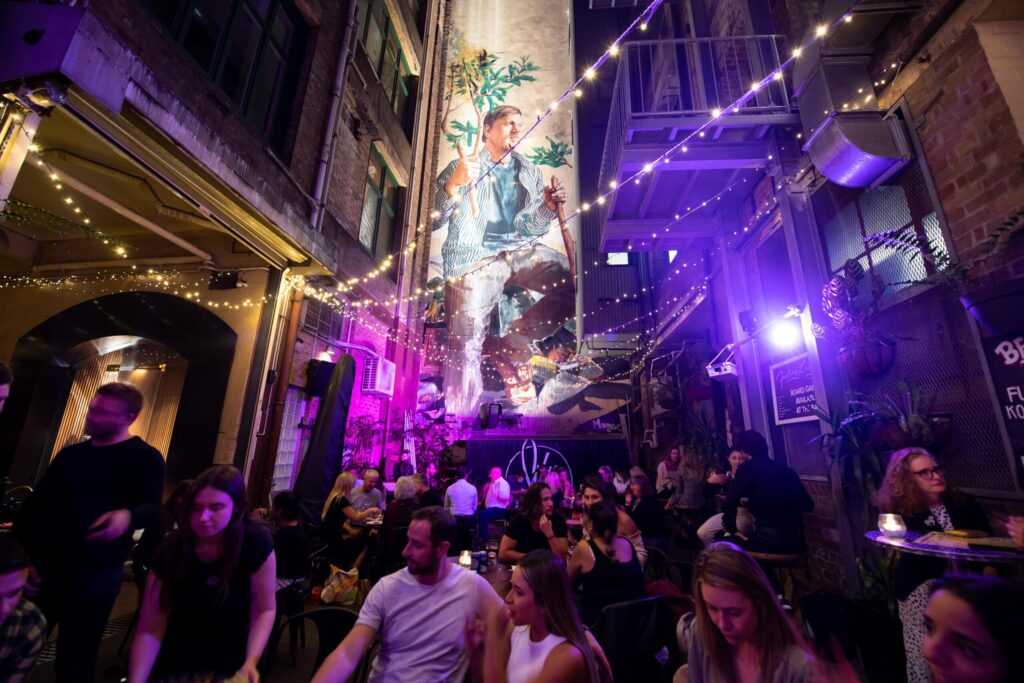
- YCK Laneways in the CBD
- Haymarket
- UpTown Sydney
- Oxford St Rainbow Precinct
- Burwood
- Canley Heights
- Canley Vale
- Lakemba
- Marrickville
- Parramatta.
YCK is especially relevant to CBD operators. It became Australia’s first Purple Flag precinct in February 2023 and covers the York, Clarence and Kent Streets area, with strong transport and pedestrian connections through the CBD.
Enmore is different.
The Enmore Road SEP is a key night-time regulatory framework in the Inner West. Marrickville, separately, has Purple Flag accreditation. That does not mean that every venue on Enmore Road carries a Purple Flag accreditation. The two programs should be described separately in any publication aimed at venue owners.
That distinction is more than terminology. It tells a venue owner which rules to examine.
For Enmore:
- check the current SEP boundary;
- obtain the applicable precinct management plan;
- understand the sound-management framework;
- check the venue’s liquor licence;
- understand which development consent conditions continue to apply.
Liquor and Gaming NSW reforms: what changed after 1 July 2024?
The first major change took effect on 1 July 2024.
Liquor & Gaming NSW became the lead regulator for entertainment sound complaints involving licensed premises under the Liquor Act 2007. The disturbance complaint framework was also changed.
The ordinary resident complaint threshold increased from three people to five
For the standard resident or worker pathway, a statutory disturbance complaint needs five or more people who live or work in the neighbourhood, with the necessary written authorisation requirements and separation of households or businesses.
That is why it is inaccurate to say that “one apartment resident can shut down an established Sydney pub” through the normal statutory resident complaint route.
But the equally inaccurate statement is that “one resident can never cause regulatory action.”
L&GNSW still accepts ordinary noise complaints for recording, intelligence and possible investigation. There are also statutory pathways involving NSW Police or people who satisfy the regulator that the nature or gravity of the matter warrants an alternative route.
Complainants are expected to try direct resolution first
The reforms also require a genuine attempt to address the issue directly with the venue before the standard statutory complaint can proceed.
The official guidelines contemplate phone calls, meetings or written contact, with evidence of the attempts being retained.
For operators, this makes a good internal complaint procedure valuable.
A manager should know:
- who receives resident complaints;
- how the complaint is logged;
- who responds;
- what operational changes are considered;
- when the owner is notified;
- how the response is documented.
A casual conversation at the front door is not the same as a documented complaint-management system.
The 2024 reforms also changed old planning noise conditions
The reforms did more than change complaint numbers.
From 1 July 2024, certain development-consent conditions concerning the way a licensed venue conducted entertainment ceased to have effect. Examples included some decibel-based controls, limits on when live or amplified music could be played, noise-limiter requirements and speaker-placement conditions.
That does not mean every condition on a venue’s development consent disappeared.
Other requirements can continue, including matters such as:
- staffing;
- building design and soundproofing;
- signage;
- HVAC and mechanical noise;
- waste and recycling;
- patron capacity.
A venue owner therefore should not read an old DA schedule and assume that every noise-related sentence still operates, nor should the owner assume every condition has vanished.
The legal category of the condition matters.
The 2025 reforms matter in a 2026 article
A current article must also account for the 24-Hour Economy Legislation Amendment (Vibrancy Reforms) Act 2025.
NSW introduced further changes in late 2025 involving certain old liquor-licence conditions imposed before 24 November 2022. Examples include restrictions on entertainment at particular times, some outdoor entertainment restrictions, decibel-based controls, noise limiters and speaker-placement restrictions. L&GNSW states that these conditions were automatically removed where the reforms applied.
There is an important qualification: a venue still has an ongoing duty to minimise negative impacts on residents and businesses, and L&GNSW can reimpose or update conditions where removal results in unreasonable disturbance.
This is why a venue’s 2026 compliance review should not simply say “the Vibrancy Reforms removed noise restrictions”.
The real question is:
Which restrictions were switched off, which conditions still apply, and what does the current licence and planning framework require?
How does order of occupancy protect Sydney venues?
This is the part many operators are searching for.
The NSW framework defines order of occupancy by looking at when the licensed premises and the complainant first began operating or occupying their premises. The system favours the party established first.
For an established venue facing a later-arriving resident, that can be a significant protection.
When the venue has the favourable order of occupancy
The complaint threshold becomes higher.
A statutory disturbance complaint can only be upheld where:
- the venue caused an unreasonable and serious disturbance to the quiet and good order of the neighbourhood; and
- the complainant could not reasonably have foreseen the disturbance when they moved into or began working in the area.
This is different from the lower threshold applied where order of occupancy favours the complainant.
The regulator describes “unreasonable and serious” as a disturbance that is significant and beyond what is acceptable, assessed in context and based on the evidence available.
Example: an established Enmore venue and a new apartment building
Imagine a pub has operated as licensed premises for many years.
A new residential development is completed nearby. A resident moves into an apartment after the pub has already been operating for a long period.
That resident is not automatically prevented from complaining.
But, where the venue retains the favourable order of occupancy and the other legal conditions are satisfied, the statutory complaint faces the higher threshold.
The resident’s move-in date therefore becomes an important piece of the evidence.
So does the venue’s operational history.
The protection is not a lifetime immunity
This is where venue owners need to be careful.
A venue can lose the advantage of order of occupancy if there has been a substantial change in the operation of the business. The official guidelines give examples including a traditional pub that changes into a much more extensive late-night entertainment model, or an existing outdoor area that is converted into a significantly different, large-scale entertainment use.
At the same time, the framework expressly protects certain live-music activity.
Hosting live music between midday and 10pm indoors, or between midday and 6pm outdoors, is not considered a substantial change to the business for this purpose.
That is important for legitimate live-music programming.
The safe approach is not to argue from slogans. It is to document the venue’s actual pattern of operation.
Keep records showing:
- historical trading hours;
- entertainment formats;
- venue layout;
- outdoor-area use;
- licence history;
- previous approvals;
- material changes made over time.
What if the venue is inside a Special Entertainment Precinct?
An SEP can provide another layer of operational certainty.
Under the SEP framework, the council’s precinct management plan sets the relevant sound-management framework and trading arrangements. Existing sound criteria in development consents or liquor licences that conflict with the precinct management plan can be overridden to the extent of the inconsistency.
For noise disputes, the SEP framework is particularly important.
A statutory disturbance complaint may still be made against a licensed venue within an SEP. However, the higher SEP threshold requires it to be established that:
- the venue failed to comply with the sound-management framework in the precinct management plan; and
- the disturbance was unreasonable.
That shifts the practical question.
Instead of a vague argument about whether the venue is “too loud”, the relevant investigation can become:
What does the SEP plan require, what did the venue do, and what does the evidence show?
That is a much more structured dispute.
Why the Enmore Road SEP matters so much
The NSW Special Entertainment Precinct Guidelines describe Enmore Road as the model that helped inform the wider SEP framework. The final November 2024 guidelines state that the model aims to support live performance while giving greater certainty to venues, residents and other businesses.
The framework also requires the precinct management plan to deal with sound regulation and trading hours, while the broader planning model is designed to make the entertainment function of the area clearer to future residents.
For venue operators, that means the current local SEP documents deserve more attention than generic online advice.
A venue should know:
- the exact SEP boundary;
- the applicable sound criteria;
- the precinct trading framework;
- relevant DCP provisions;
- compliance procedures;
- how complaints are handled.
Inner West Council’s SEP material also identifies soundproofing requirements for new development and operational requirements for new or modified businesses as part of the wider precinct planning model.
That is directly relevant to the “new apartments versus established venues” problem.
What new apartment residents can and cannot do
A new resident still has legal rights and can complain about noise.
The 2024 changes do not abolish residents’ rights.
What has changed is the structure used to decide when a formal statutory disturbance complaint can be lodged and when it can be upheld.
For ordinary resident complaints:
- five eligible people are generally required for the statutory route;
- direct engagement with the venue must first be attempted;
- order of occupancy can alter the threshold;
- evidence matters;
- the regulator assesses complaints case by case.
For a venue in an SEP, the precinct management plan becomes particularly important because the sound framework is built into the precinct structure.
The important practical point is therefore:
Do not build your compliance strategy around defeating residents. Build it around proving how your venue operates, what rules apply and what steps you took when an issue arose.
What to do when a new resident complains about venue noise
1. Find out what kind of complaint it is
A direct resident complaint is not necessarily a statutory disturbance complaint.
A general noise complaint can still be recorded or investigated, while a formal statutory disturbance complaint has specific procedural requirements.
Ask for:
- date;
- time;
- type of noise;
- location;
- duration;
- frequency;
- whether the issue is music, patrons or another activity.
2. Check order of occupancy immediately
Do not wait until a formal dispute is underway.
Find the records showing when:
- your venue started operating from the premises;
- the complainant started living or working nearby;
- the business model changed;
- major entertainment changes occurred.
3. Review the current licence
Check the current liquor licence, not only old licence paperwork.
The 2024 and 2025 reforms changed the status of some conditions, but existing obligations can remain and new or reimposed conditions are possible in appropriate circumstances.
4. Review the development consent carefully
Separate:
- entertainment conditions affected by the reforms;
- conditions that continue to apply;
- building and soundproofing obligations;
- patron-capacity requirements;
- mechanical noise;
- waste and collection controls.
5. If you are in an SEP, obtain the current precinct plan
The plan should be treated as an operating document.
Know the sound criteria that apply to your venue and how your venue is expected to demonstrate compliance.
6. Respond professionally and in writing
A sensible response can prevent a small complaint from becoming a larger dispute.
Keep a record of:
- the complaint;
- your response;
- measures considered;
- actions taken;
- relevant dates;
- any follow-up.
7. Use acoustic evidence when it is appropriate
The official complaint guidelines note that L&GNSW may invite written submissions, inspect premises and consider acoustic testing where appropriate. They also note that mobile-phone sound measurements are not reliable enough to be used as regulatory evidence because device accuracy varies and proper technical procedures matter.
Do not treat a phone decibel app as the same thing as professional acoustic evidence.
Build a venue evidence file before you need it
A venue should have a simple compliance folder that can be produced quickly.
| Document | Why keep it |
|---|---|
| Current liquor licence | Establishes current licensing conditions |
| Current development consent | Shows applicable planning conditions |
| SEP precinct management plan, if applicable | Establishes local sound and trading framework |
| Licence history | Helps establish operational continuity |
| Historical trading hours | Useful for order-of-occupancy and operational-change questions |
| Entertainment schedules | Shows the nature and timing of programming |
| Venue floor plans | Helps explain internal and external sound sources |
| Records of material renovations | Identifies operational or physical changes |
| Resident complaint log | Creates a chronology |
| Written responses | Demonstrates engagement and mitigation |
| Acoustic reports | Provides technical evidence where required |
| Photographs of relevant areas | Documents gates, outdoor spaces, speakers and building treatments |
The objective is not to create a huge legal archive.
It is to make the facts easy to establish.
Purple Flag can still help a venue that is not individually accredited
This is where venue operators often underestimate the program.
Purple Flag accreditation depends on the whole precinct working properly after dark.
A nightclub cannot solve late-night transport by itself.
A pub cannot redesign the public footpath alone.
A live-music venue cannot provide citywide wayfinding, cleaning, policing coordination and public safety infrastructure.
That is why the Purple Flag model is built around collaboration across council, businesses, transport, safety and community stakeholders.
For a venue operator, the five Purple Flag principles provide a useful operational checklist.
Wellbeing
Look at security, patron care, incident response, cleanliness and the practical experience of leaving the venue.
Movement
Look at how customers leave the venue, where ride-share vehicles stop, transport access and pedestrian routes.
Appeal
Look at what your venue contributes beyond alcohol sales. Live music, cultural programming, food, events and different customer experiences all contribute to the precinct offer.
Place
Look at frontage, lighting, wayfinding and the condition of the surrounding environment.
Strategic alignment
This is often the most valuable business principle.
A venue that participates in local precinct planning is more likely to know what the council, neighbouring businesses and other agencies are trying to achieve.
That matters when the area changes.
Can an individual Sydney venue apply for Purple Flag?
Not in the way an individual business applies for a normal certification.
The NSW program says applicants need to apply as part of a group, usually through a working group supported by the local council and an established business group.
Venue owners can therefore:
- lead a local precinct initiative;
- join an existing working group;
- contribute data and business knowledge;
- help define the precinct;
- take part in night-time self-assessments;
- support improvements identified through the process.
For operators in areas without Purple Flag status, the first practical conversation is usually with the council’s economic development or night-time economy team.
What should a Sydney venue owner do in 2026?
Use this sequence.
First: identify whether the venue sits inside an SEP.
Second: obtain the current precinct management plan and DCP material where applicable.
Third: review the current liquor licence and identify conditions that still apply.
Fourth: establish the venue’s order-of-occupancy evidence.
Fifth: document any operational changes made after nearby residents moved in.
Sixth: create a formal complaint-response process for managers and staff.
Seventh: keep acoustic, planning and licensing evidence together.
Eighth: participate in the local business or precinct group rather than treating every neighbour issue as a one-to-one fight.
The goal is not to eliminate legitimate resident concerns.
The goal is to make sure a venue is assessed against the rules that actually apply to its location and operation.
The practical lesson for Sydney pubs, clubs and live venues
The NSW night-time economy framework has moved toward a place-based model.
Purple Flag is about the quality and management of a whole night-time district.
SEPs are about defined local rules for trading and entertainment sound.
Liquor & Gaming NSW manages statutory disturbance complaints for licensed venues.
Order of occupancy affects the complaint threshold where the venue is the earlier-established party.
And the planning system increasingly tries to make the existence of entertainment precincts visible to incoming residents.
For an established Sydney venue, especially in a mixed-use area, that is a major change from the old assumption that the newest resident automatically sets the standard for the street.
But the reforms are not a blank cheque.
A venue still needs to operate lawfully, comply with applicable conditions, minimise unreasonable impacts and respond properly when there is a genuine problem. The strongest position is therefore a documented one: know your precinct, know your licence, know your history, know your sound framework and keep evidence.
1. Is Sydney Purple Flag certification available to individual pubs and nightclubs?
No. Purple Flag is a precinct accreditation, not an individual venue licence or certification. Businesses can participate in the working group that prepares a precinct for assessment.
2. What is Purple Flag designed to recognise?
It recognises precincts that perform strongly across wellbeing, movement, appeal, place and strategic alignment in their night-time economy.
3. Is Enmore Road a Purple Flag precinct?
Enmore Road is a Special Entertainment Precinct. Marrickville has Purple Flag accreditation, but Purple Flag and the Enmore Road SEP are separate frameworks.
4. Can one new apartment resident make a statutory disturbance complaint against a Sydney venue?
Under the ordinary resident/worker pathway, a statutory disturbance complaint generally requires five eligible people from different households or businesses, along with the other legal requirements. However, general noise complaints and certain alternative statutory pathways still exist.
5. How does order of occupancy protect Sydney venues?
Where order of occupancy favours the venue, the disturbance must be unreasonable and serious, and it must not have been reasonably foreseeable to the complainant when they moved into or began working in the area.
6. Can a venue lose its order-of-occupancy protection?
Yes. A substantial change in the operation of the business can affect the venue’s position. The guidelines specifically protect certain live-music activity, including indoor live music from midday to 10pm and outdoor live music from midday to 6pm.
7. Do SEPs completely prevent noise complaints?
No. Statutory disturbance complaints can still be made against licensed venues in an SEP. The SEP framework applies a higher threshold, including compliance with the precinct’s sound-management framework and unreasonable disturbance.
8. Did the 2024 reforms remove all noise conditions from venue development consents?
No. Certain entertainment-related noise conditions ceased to have effect, but other conditions — such as patron capacity, staffing, building requirements, HVAC noise and waste controls — can continue.
9. Did NSW make further venue noise changes after 2024?
Yes. The 2025 Vibrancy Reforms removed certain older liquor-licence conditions restricting entertainment or imposing acoustic limits, subject to the continuing obligations of licensees and the regulator’s ability to act where unreasonable disturbance occurs.
10. What should an established venue keep as evidence?
At minimum, maintain the current liquor licence, development consent, SEP documents if applicable, historical operating records, evidence of operational changes, complaint records and relevant acoustic reports. The official complaint guidelines recognise written submissions and acoustic testing as part of the investigation process where appropriate.