

Opening a café in the Sydney CBD, Haymarket, Newtown or Redfern involves more than fitting out a kitchen and registering a food business. If your kitchen discharges trade wastewater, you also need to establish which Sydney Water requirements apply to the premises, what pre-treatment equipment is needed and how that equipment must be maintained.
The distinction matters. City of Sydney food safety inspections assess food hygiene and related requirements. Sydney Water manages the conditions under which trade wastewater enters its sewer network. A café may need to satisfy both sets of obligations.
This guide explains how to check your requirements, arrange grease trap servicing, plan equipment in a restricted tenancy and keep the right records before opening or changing your kitchen operations.
Start here: Sydney Water’s retail food trade wastewater guidance.
1. What is a Sydney Water trade waste agreement?
Trade wastewater is wastewater produced by business activities that needs to be managed before entering the sewer system. In a café or restaurant, it can contain fats, oils, grease, food particles, sauces and cleaning residues.
Sydney Water sets requirements for businesses discharging trade wastewater. Retail food businesses using grease traps must comply with the relevant connection agreement and servicing conditions.
Before leasing a café, ask whether the existing wastewater arrangements match the activities you intend to carry out. A tenancy previously used for coffee and packaged food may have different needs from a kitchen preparing fried food, meat dishes and large volumes of meals.
Check the existing approval, equipment details and servicing records rather than relying solely on the previous tenant’s description.
If your activities or wastewater discharge change, contact Sydney Water to establish whether you need a new approval or a variation to an existing arrangement.
2. Sydney Water requirements versus council food safety inspections
These are related operational responsibilities, but they are not interchangeable.
| Requirement | Responsible organisation | What to check |
|---|---|---|
| Trade wastewater approval and discharge conditions | Sydney Water | Applicable agreement, permitted discharge and pre-treatment requirements |
| Grease trap servicing records | Sydney Water and the authorised WasteSafe transporter | Required servicing interval, transporter and completed service records |
| Food safety and hygiene inspections | City of Sydney or the relevant local council | Food handling, cleanliness, facilities and applicable food safety standards |
| Plumbing and installation work | Appropriately qualified plumbing professionals, with relevant approvals | Equipment suitability, compliant installation and required certificates |
| Planning or building approvals | Relevant consent authority | Whether the fit-out or equipment installation needs separate approval |
The NSW Food Authority explains that local councils regularly inspect retail food businesses. These inspections assess food safety, hygiene and relevant premises requirements.
Sydney Water separately requires food businesses discharging trade wastewater to comply with their applicable conditions. A successful food hygiene inspection should not be treated as proof that the wastewater approval and maintenance requirements are satisfied.
For the local food business approval process, see the City of Sydney’s official guidance.
3. Grease traps, grease arrestors and pre-treatment
Pre-treatment is the equipment and process used to manage wastewater before it enters the sewer. For commercial kitchens, grease traps or grease arrestors help separate fats, oils, grease and solids from wastewater.
A grease arrestor relies on wastewater flow and separation to retain much of this material before discharge. It cannot perform properly if it is incorrectly sized, poorly installed, overloaded or inadequately maintained.
Sydney Water’s requirements depend on the business activity and the wastewater being discharged. Some premises may require additional equipment, so do not order a trap based only on the kitchen’s floor area or a supplier’s standard package.
Before buying equipment:
- Check Sydney Water’s applicable requirements and listed pre-treatment equipment.
- Have a qualified plumbing professional assess the proposed installation.
- Confirm that the equipment can handle the expected wastewater flow.
- Plan for cleaning, inspection and safe access.
- Check whether the proposed installation requires council or other approvals.
Sydney Water advises businesses to check equipment requirements before purchasing or installing new treatment equipment. Installing an unsuitable system first can lead to avoidable costs and compliance problems.
See Sydney Water’s guide to grease traps and other pre-treatment.
4. How often must a Sydney café clean its grease trap?
There is no single pump-out interval that applies to every café.
Sydney Water specifies the required frequency based on factors including grease trap size and the volume and quality of greasy wastewater generated by the business. The applicable agreement is therefore the starting point for setting your cleaning schedule.
A café should not assume that quarterly, monthly or weekly servicing is correct simply because another restaurant follows that interval.
To establish your schedule:
- Find the relevant Sydney Water agreement or approval for the premises.
- Confirm the specified pump-out frequency.
- Select an authorised WasteSafe transporter.
- Arrange servicing in accordance with the required schedule.
- Check that each service is recorded correctly.
- Keep the agreement and servicing records accessible to the person managing the premises.
WasteSafe is Sydney Water’s electronic system for tracking the generation, collection, transport and disposal of grease trap waste. The authorised transporter records servicing through the system.
If your kitchen output increases, you change your menu significantly or your existing equipment struggles to cope, contact Sydney Water about the applicable requirements. Do not change the agreed servicing interval without checking what is permitted.
Official resource: Select a Sydney Water WasteSafe transporter.
5. Planning a grease arrestor in a tight CBD tenancy
Limited space can make wastewater compliance difficult in older buildings, basement premises and narrow retail tenancies. The mistake is leaving equipment access until after the kitchen layout has been approved or installed.
Sydney Water’s plumbing guidance identifies several practical requirements for grease trap access and servicing. These include unobstructed clearance above the trap, safe access for the servicing contractor and sufficient access for the equipment to be opened and maintained.
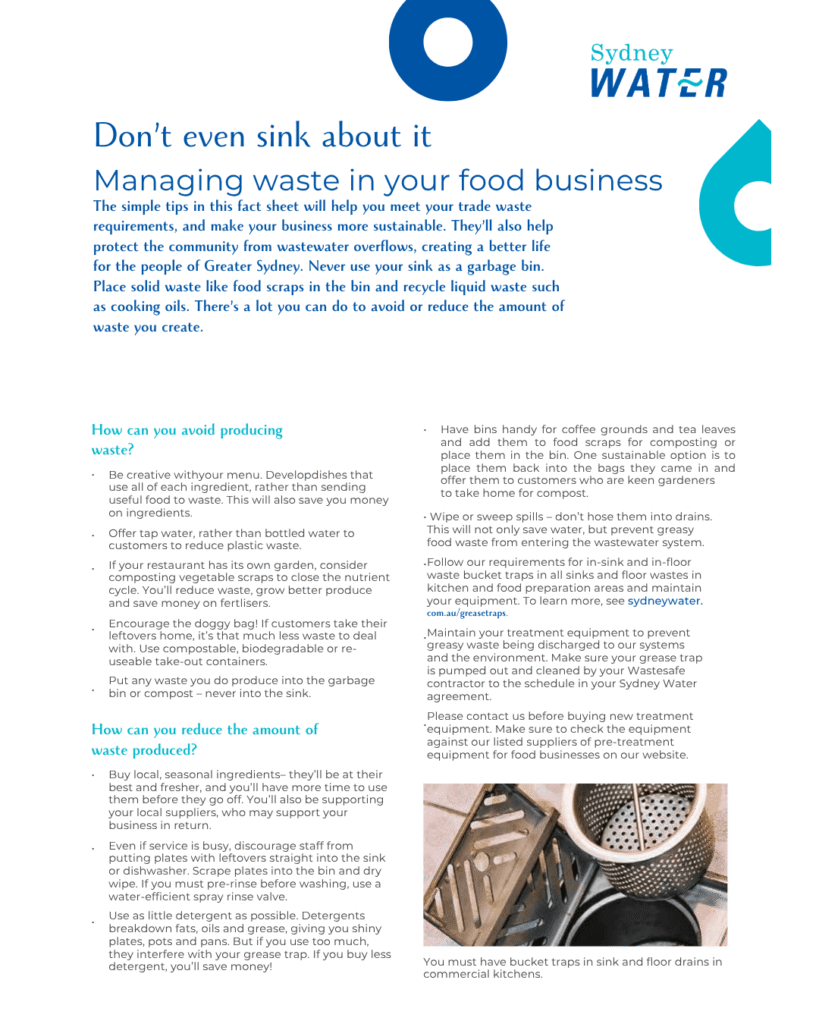
Where a tanker cannot reach the trap directly, a fixed pump-out line may be an option in suitable circumstances. Its design needs to be discussed with the servicing contractor and checked against relevant requirements and approvals.
Before signing off a kitchen design, ask the plumber and waste contractor to review:
- the proposed trap location;
- available headroom and lid clearance;
- access for inspection and cleaning;
- the route from the servicing vehicle to the trap;
- whether a fixed pump-out line is suitable;
- drainage layout and the risk of grease solidifying in long pipe runs;
- any building, strata or council constraints affecting installation.
A workable installation must be serviceable throughout the tenancy, not merely fit inside the available floor plan.
Read Sydney Water’s plumbing guidance for retail food businesses before finalising the design.
6. Trade waste fees and the cost of compliance
The cost of managing trade wastewater may include Sydney Water charges, application or variation fees where applicable, and the private contractor’s charges for collecting, transporting and treating grease trap waste.
These are separate cost items. A quote for a pump-out does not necessarily include Sydney Water charges, and an authority fee does not necessarily cover the contractor’s service.
Sydney Water’s published fee information describes different charges for different aspects of trade wastewater management. The amount payable depends on the applicable fee category and circumstances.
Before budgeting, confirm:
- which Sydney Water charges apply to your business;
- whether an application or variation fee is payable;
- the contractor’s price per service;
- whether additional access or pumping arrangements affect the contractor’s price;
- how servicing costs are divided between landlord and tenant under the lease.
Use the current Sydney Water trade wastewater fees page rather than relying on an old quotation or an undated online price list.
For the lease, obtain written clarification about responsibility for existing equipment, repairs, servicing access and any upgrades required for the proposed business. The agreement with Sydney Water and the commercial lease address different obligations.
7. What happens if a café has no grease trap?
Do not assume that every café needs an identical grease trap, or that a small café is automatically exempt.
Sydney Water determines the applicable requirements according to the business’s processes, discharge and relevant approval pathway. If you are opening a small coffee shop, takeaway outlet or café with limited food preparation, ask Sydney Water to confirm what pre-treatment is required for that exact operation.
If the business discharges trade wastewater without required approval or equipment, it may breach its applicable conditions. Sydney Water identifies potential consequences of poor wastewater management, including blockages, overflows, property damage and environmental harm. Enforcement or additional costs depend on the actual breach and applicable rules.
This guide does not establish a single fine for every business operating without a grease trap. Do not rely on an unverified penalty figure when assessing your risk.
If you have taken over an existing tenancy and cannot find the agreement, contact Sydney Water before assuming that the previous operator’s arrangement remains suitable.
8. Substances and practices to keep out of the wastewater system
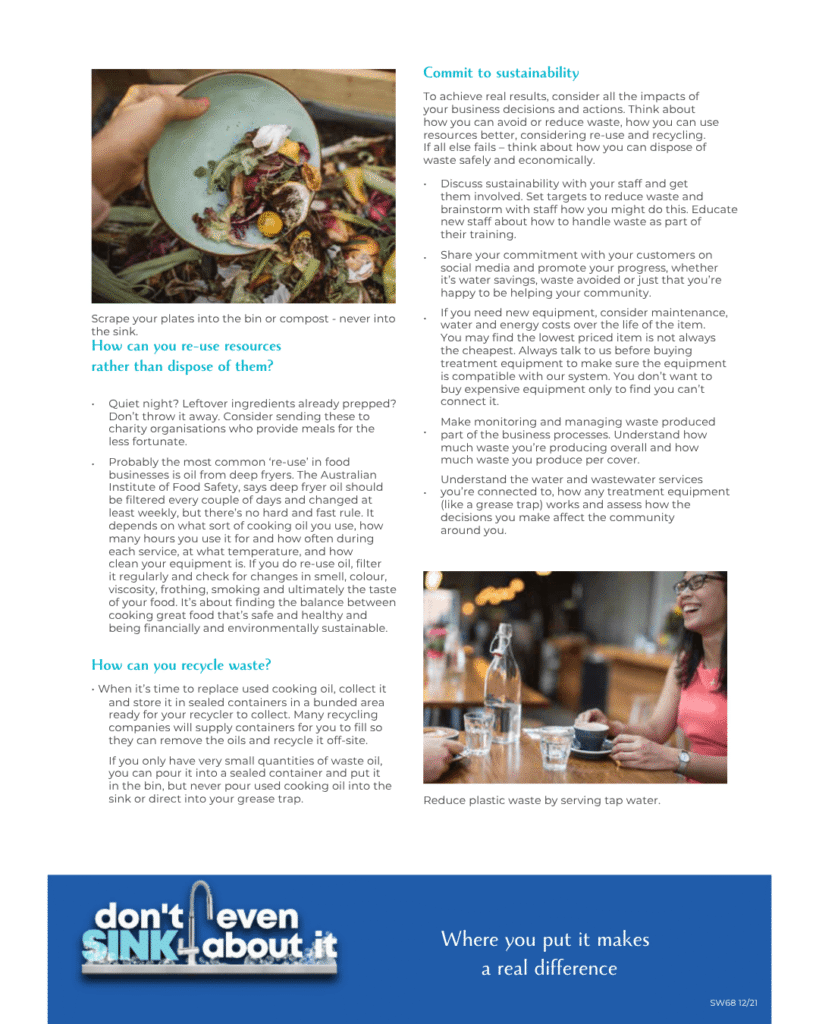
Warning: Never pour waste cooking oil directly into a sink or grease trap. Sydney Water advises that waste oil can quickly overload a grease trap. Collect it separately and arrange appropriate disposal.
Staff should also avoid practices that interfere with pre-treatment or introduce prohibited substances into the wastewater system.
Sydney Water says businesses must not add solvents, enzymes, bacteria products, odour-control agents or pesticides to grease traps or pre-treatment systems. Its guidance also identifies in-sink food waste disposal units and garbage grinders as equipment that is not permitted on business premises under its commercial trade wastewater requirements.
Other useful controls include:
- scraping food scraps into a bin before washing dishes;
- collecting used cooking oil separately;
- wiping greasy spills rather than hosing them into floor drains;
- using cleaning products sparingly and according to instructions;
- maintaining sink and floor-waste bucket traps where required;
- training staff to report drainage problems and overflows promptly.
These controls reduce the amount of grease and solids entering the wastewater system and help protect the equipment.
9. A practical compliance checklist before opening
Use this checklist when opening a café, changing a menu or planning a kitchen refit.
- Confirm the trade wastewater approval or agreement that applies to the premises.
- Check whether the planned food preparation activities change the wastewater requirements.
- Confirm the required pre-treatment equipment with Sydney Water.
- Have a qualified plumbing professional review the installation.
- Ensure the trap can be inspected, opened and serviced safely.
- Appoint an authorised WasteSafe transporter.
- Record the required pump-out interval in the maintenance calendar.
- Keep the agreement and servicing records accessible.
- Check current authority fees and contractor charges.
- Confirm the relevant food business notification and inspection requirements with the local council.
- Clarify landlord and tenant responsibilities in writing.
If any item remains unresolved, address it before committing to equipment or assuming that the premises is ready to trade.
Conclusion
Sydney café trade waste compliance starts with confirming the requirements for the actual premises and kitchen operations. The right equipment, an appropriate servicing schedule and accurate WasteSafe records are central to managing grease trap obligations.
City food safety inspections and Sydney Water wastewater requirements should be managed as separate but complementary responsibilities. For a CBD tenancy with limited space, involve the plumber and servicing contractor before the fit-out is finalised.
Use Sydney Water’s current guidance and your business-specific agreement to confirm what applies. Do not rely on generic cleaning intervals, assumed small-business exemptions or unverified penalty claims.
1. Does a Sydney café need a Sydney Water trade waste agreement?
A café discharging trade wastewater must meet the applicable Sydney Water approval and connection requirements. Confirm the pathway for the specific business activities and premises.
2. Does a City of Sydney food safety inspection cover grease trap compliance?
Not automatically. Council inspections assess food safety and hygiene, while Sydney Water sets separate trade wastewater requirements. Businesses should maintain evidence for both.
3. How often must a café grease trap be pumped out?
Sydney Water specifies the required frequency according to factors including grease trap size and the volume and quality of greasy wastewater generated. Follow the requirement for your premises rather than assuming a universal interval.
4. Can a small café operate without a grease trap?
Do not assume an exemption based on business size. Ask Sydney Water to confirm the applicable pre-treatment requirements for the specific activity and wastewater discharge.
5. What is a grease arrestor?
A grease arrestor is a pre-treatment system designed to retain much of the grease and solid material in commercial wastewater before it reaches the sewer.
6. Who can clean a Sydney Water grease trap?
Businesses with grease traps must use an authorised WasteSafe transporter to empty and clean the equipment at the frequency specified by Sydney Water.
7. What are the costs of trade waste compliance?
Costs can include applicable Sydney Water charges, application or variation fees, and private contractor charges for servicing, transport and waste treatment. Check the current fee schedule and obtain a quote for your premises.
8. Can a grease arrestor be installed in a small CBD kitchen?
The installation must meet the applicable requirements, including appropriate equipment selection and safe servicing access. Sydney Water says a required grease trap must not be installed in a kitchen, food preparation area or food storage area. Obtain professional advice before finalising the layout.
9. Can I pour used cooking oil into the sink or grease trap?
No. Sydney Water advises against pouring waste oil into the sink because it can quickly overload the grease trap. Collect used oil separately and arrange appropriate disposal.
10. Which substances must not be added to a grease trap?
Sydney Water prohibits adding solvents, enzymes, bacteria products, odour-control agents and pesticides to grease traps or pre-treatment systems under its commercial trade wastewater requirements.
11. Are there fixed fines for operating without a grease trap?
There is no single penalty figure established by the sources reviewed for every such situation. The applicable requirements and consequences depend on the business, the relevant approval conditions and the nature of any breach. Check the official rules rather than relying on an unverified online figure.
12. Where can I check current Sydney Water trade wastewater fees?
Use the official Sydney Water trade wastewater fees page. Confirm the charge categories that apply to your business and distinguish authority charges from private servicing costs.